Radiator replacement in Tullamarine costs $400 to $1,000 for most vehicles, rising to $700 to $1,500 for European and performance models. A minor leak repair runs $150 to $400, and a full cooling system service with radiator, hoses, and thermostat sits at $500 to $1,200. Radiators last 8 to 15 years or 150,000 to 250,000 kilometres. The radiator sheds engine heat by passing hot coolant through fine tubes that the airflow cools. When it fails the engine overheats in minutes, warping heads, blowing gaskets, or seizing outright. Carrick Motors on Carrick Drive diagnoses and repairs radiators for drivers across Tullamarine, Airport West, and Gladstone Park. This guide covers how the radiator works, the warning signs, common faults, and what repair costs.
How Your Radiator Works
The radiator moves engine heat into the air through a sealed coolant loop. Hot coolant leaves the engine through the top hose, flows through rows of thin tubes lined with fins, and the air passing across those fins carries the heat away. The cooled coolant drops out the bottom hose and returns to the engine for another pass. The water pump keeps that loop moving whenever the engine runs.
Airflow is what makes it work, and it comes from two sources. At speed, air flows through the radiator naturally, so highway cooling looks after itself. At idle or in slow traffic there is no natural airflow, so an electric fan pulls air through instead. A dead fan means overheating in traffic, which is exactly the condition Tullamarine’s stop-start roads create.
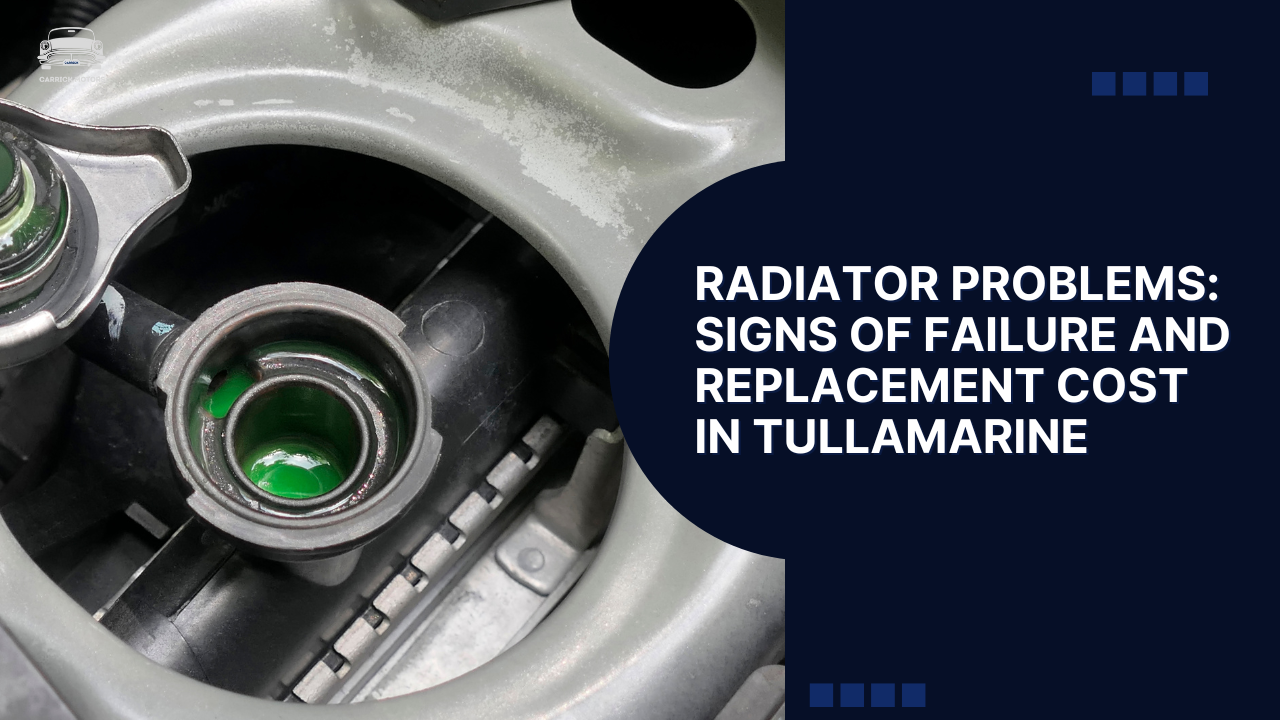
The system also runs under pressure, usually 13 to 18 psi, held by the radiator cap. That pressure lifts the coolant’s boiling point well above 100°C so it doesn’t boil over in normal use, and an overflow tank takes the coolant that expands as it heats and returns it as things cool. A worn cap that can’t hold pressure lets the system boil early, which is why a $30 cap matters more than its price suggests.
Signs Your Radiator Is Failing
Failure warns you before it wrecks the engine, so catching the signs early is what keeps a radiator problem from becoming an engine bill. Watch for these:
- Overheating. The temperature gauge climbs past normal, the warning light comes on, or steam rises from the engine bay. A clogged or leaking radiator, or blocked airflow, is behind it. Stop driving if the gauge goes into the red.
- Coolant leak. Green, orange, or pink fluid pools under the front of the car. The radiator’s plastic end tanks, the core tubes, and the hose connections are the usual leak points.
- Low coolant level. The reservoir keeps dropping below the minimum and you top it up often. Coolant doesn’t burn off in normal use, so a falling level means a leak somewhere in the system.
- Discoloured coolant. Rusty brown coolant means internal corrosion, an oily or milky look points to a head gasket letting oil or combustion into the coolant. Healthy coolant stays bright and clear.
- Overheating in traffic but not on the highway. This points straight at the cooling fan or a partial blockage, since the highway supplies the airflow the fan is failing to provide.
- Weak cabin heat. The heater runs off the same coolant, so low coolant from a radiator leak leaves it blowing lukewarm.
- Visible damage. Bent fins, a cracked plastic tank, corrosion, or stone damage to the core all cut cooling and often leak.
Overheating is the urgent one. An engine run hot for even a short time can cost thousands, so never push on with the gauge in the red, pull over and let it cool. Cooling system work sits within our all cars mechanical repairs service, where the fault is confirmed before quoting.
Common Radiator Problems
Most radiator faults fall into a handful of types. Knowing them helps you judge repair against replacement.
External leaks come from stone damage to the core, cracked plastic end tanks, corroded fittings, or impact. You see coolant on the radiator or dripping from one spot, and a pressure test pins down where. A minor leak may be repairable at $150 to $350, a tank swap where possible is $200 to $400, and a full replacement runs $400 to $1,000.
Internal blockage builds from corrosion debris, scale, or old stop-leak residue clogging the tubes. The car overheats even with full coolant, and parts of the radiator run cooler than others. A flush may clear a light blockage at $100 to $200, but a solidly blocked radiator needs replacing.
External blockage is leaves, bugs, and dirt packed between the condenser and radiator, choking the airflow. It shows as overheating at idle while the highway stays fine, and a careful clean at $50 to $150 fixes it. Tank failure happens as the plastic end tanks grow brittle with age and crack, weeping coolant at the seams and usually meaning replacement. Core tube failure from internal corrosion produces multiple small leaks that repair can’t reliably fix. And a failed radiator cap, at just $20 to $50, lets the system lose pressure and boil early, a cheap fix often missed.
Radiator Replacement Cost in Tullamarine
Cost tracks the vehicle and the job. Small cars like a Yaris, Mazda 2, or i20 run $400 to $650. Medium cars such as a Corolla, Mazda 3, or i30 sit at $450 to $750. Large cars like a Camry or Commodore land at $500 to $900, and SUVs such as a RAV4, CX-5, or Tucson at $550 to $950. Utes and 4WDs run $500 to $1,200, sometimes with a transmission cooler in the mix. European vehicles from BMW, Audi, or Mercedes reach $700 to $1,500 on premium parts.
Smaller jobs sit below replacement: a radiator cap $20 to $50, a flush $100 to $200, a minor leak repair $150 to $350, a hose $80 to $200. On top of a replacement, budget coolant at $50 to $100 and a thermostat at $100 to $250 if it’s done at the same time, which is usually worth it. A full cooling system service, radiator, hoses, thermostat, and flush, runs $500 to $1,200 and resets the whole system at once. These bands line up with the wider market once labour is counted.
Repair or Replace?
The repair-versus-replace call comes down to how much is wrong and how the numbers stack up. Repair makes sense for a single isolated leak on an otherwise sound radiator, on an older car where you just need it working, or as a temporary fix to reach the workshop.
Replacement wins when there are multiple leaks, age-related corrosion throughout, core damage, or a blockage a flush won’t clear. Modern plastic-tank radiators in particular are often not worth repairing, since the tanks keep cracking once they start. The rule of thumb: when a repair would cost 50 to 70 percent of a replacement, replace. On parts, OEM gives the exact fit and best life, quality aftermarket brands offer strong value, and budget units are a false economy that rarely last.
The Radiator and the Cooling System
The radiator is one part of a system, and the parts wear at similar rates. The water pump circulates the coolant, and a failed pump overheats the engine no matter how good the radiator is. The thermostat controls flow by temperature, and a stuck one overheats or overcools. The hoses connect it all and perish with age, and the fans supply airflow at low speed.
Because these share a lifespan, replacing the radiator alone can leave you back in the workshop weeks later for the next tired part. Doing the related items together, fresh hoses, a new thermostat, clean coolant, while the system is already open saves the labour of a second visit. Keeping the cooling system healthy also ties into a regular car service, where it’s inspected as a matter of course.
Preventing Radiator Problems
Most radiator failures trace back to coolant neglect, so prevention is mostly coolant care. Change the coolant at the interval in your handbook, use the exact type your vehicle needs, and mix it correctly, since pure coolant or pure water both cause problems. Fresh coolant protects against the corrosion that eats radiators from the inside, and a scheduled engine oil and filter service is a natural time to have it checked.
Simple checks do the rest. Look at the coolant level monthly and investigate any drop rather than just topping up. Glance over the radiator for damage, leaks, or debris in the fins, and feel the hoses for soft or bulging spots. On the road, watch the temperature gauge in traffic, never keep driving when it climbs, and avoid long idling on hot days. Ahead of summer, a pre-season check of the fan, coolant, and system condition catches a marginal system before the first heatwave finds it for you.
Tullamarine Heat and Your Radiator
Local conditions lean hard on the cooling system. Hot summer days cut how much heat the radiator can shed, because the gap between coolant and air temperature shrinks. Stop-start traffic removes the natural airflow and leaves cooling entirely to the fan, and running the air conditioning adds heat to the engine bay while its condenser sits in front of the radiator and blocks some airflow.
The upshot is that a cooling system which just scrapes by in winter can tip into overheating on the hottest days. A pre-summer service, checking fan operation, coolant condition, and overall capacity, is cheap insurance against a roadside overheat in January.
How Radiator Diagnosis Works
Diagnosis confirms the radiator is the fault before it’s replaced, because overheating has several possible causes. The check runs in three parts. A pressure test seals the system and holds pressure, and a drop shows a leak while the gauge points to roughly where. A visual inspection then traces coolant stains, checks the fins and tanks for damage, and looks over the hoses and cap. And a thermal check, feeling or scanning the radiator surface, reveals cool spots where tubes are blocked.
Those three separate a radiator fault from a water pump, thermostat, fan, or head gasket problem, all of which can mimic it. Getting that right means you don’t pay to replace a good radiator when the real fault sits elsewhere in the cooling system.
How to Book Your Radiator Service
Booking with Carrick Motors takes one call. Ring +61 3 9330 1082 or message the workshop on WhatsApp, and we pressure-test the cooling system to find the real fault before quoting. We service all makes and models, fit quality radiators with a warranty, check the related hoses, thermostat, and fan at the same time, and offer free pick-up and drop-off within 10 km of Tullamarine. If the car is overheating, don’t drive it in, call and we’ll arrange to bring it to us.
Frequently Asked Questions
How do I know if my radiator is bad?
A bad radiator shows overheating, coolant leaking under the front of the car, a coolant level that keeps dropping, discoloured or rusty coolant, and visible damage to the fins or tanks. A temperature gauge climbing in traffic is a common sign. A pressure test confirms the radiator as the source before any repair.
Can I drive with a radiator leak?
A small seep may let you drive carefully to a workshop while watching the temperature. An active leak losing coolant fast should not be driven, since overheating follows quickly and wrecks the engine. Any leak worsens over time. If the gauge rises above normal, stop at once, because a $500 radiator problem can become a $3,000-plus engine repair.
How long do radiators last?
Radiators last 8 to 15 years or 150,000 to 250,000 kilometres, depending on coolant maintenance and vehicle type. Plastic-tank aluminium radiators tend to fail sooner than older all-metal designs. Regular coolant changes and never letting the engine overheat are what push a radiator toward the top of that range.
Is it worth repairing a radiator or replacing it?
For a small isolated leak on a sound radiator, a $150 to $350 repair can be worth it. But cracked plastic tanks, multiple leaks, or corrosion throughout are better replaced. When a repair would cost more than 50 to 70 percent of a replacement, replacing gives better value and reliability. Modern radiators are often cheaper to replace than repair.
Why does my car overheat in traffic but not on the highway?
Highway speed forces air through the radiator and cools it well. In traffic there’s no natural airflow, so cooling depends entirely on the electric fan. If the fan is failing, the car overheats at idle while the highway stays fine. A partial radiator blockage or a weak water pump can cause the same pattern, so have it inspected.
Can a bad radiator cause engine damage?
Yes. A failing radiator causes overheating, and overheating warps cylinder heads, blows head gaskets, damages bearings, and can seize the engine. A $500 radiator fault can turn into a $3,000 to $8,000 engine repair if the engine cooks. That’s why radiator problems are addressed promptly and an overheating car is never driven on.
How much does radiator replacement cost in Tullamarine?
Radiator replacement costs $400 to $1,000 for most vehicles in Tullamarine, or $700 to $1,500 for European models. That covers the radiator and labour. Adding a thermostat, hoses, and coolant for a full cooling system service runs $500 to $1,200. Getting the related parts done together avoids paying the labour twice.
What colour should my coolant be?
Healthy coolant is bright and clear, usually green, orange, or pink depending on type. Rusty brown coolant signals internal corrosion and needs a flush. A milky or oily look is more serious, pointing to a head gasket letting oil or combustion gases into the coolant, which needs inspection straight away rather than just a top-up.
Radiator failure causes overheating that can destroy an engine in minutes, while replacement costs $400 to $1,000 and prevents the whole scenario. Don’t ignore a coolant leak or a rising temperature gauge. Call Carrick Motors on +61 3 9330 1082 to book your radiator replacement in Tullamarine today.