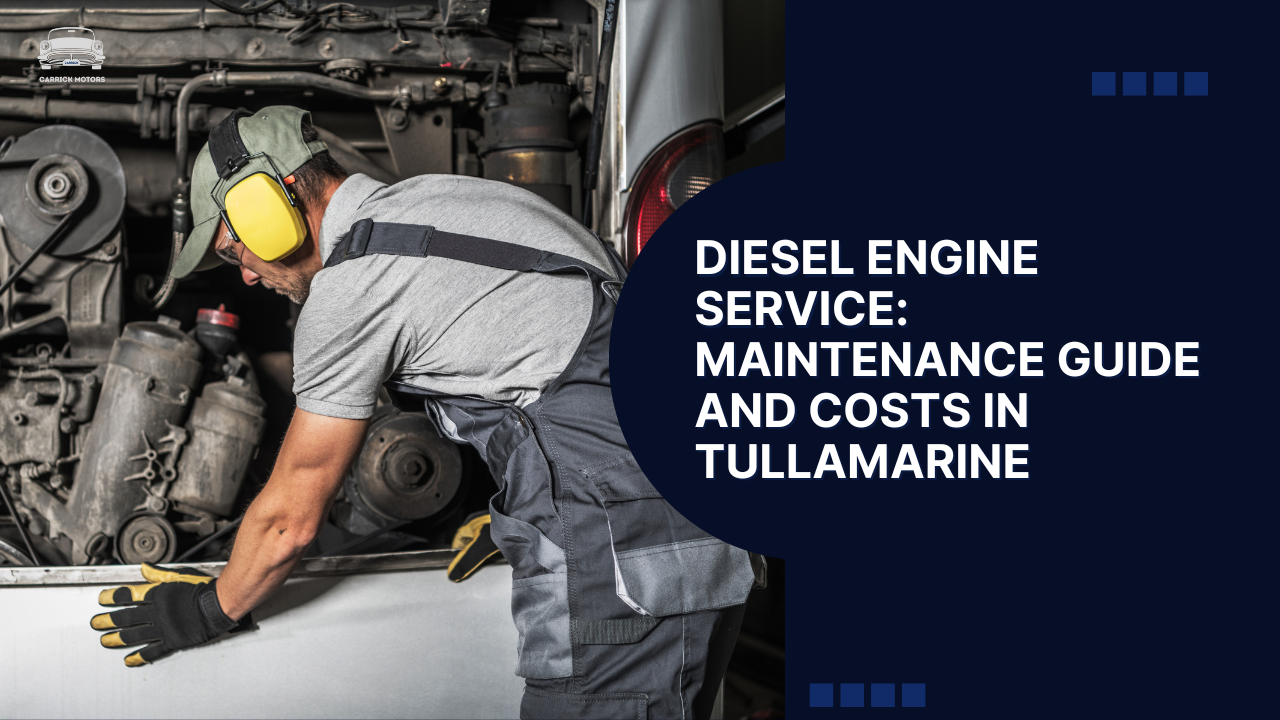
Diesel engine service in Tullamarine costs $250 to $600 for standard maintenance, with major services reaching $400 to $900. Diesel-specific jobs sit on top: a fuel filter is $150 to $350, DPF cleaning $300 to $600, and injector service $400 to $1,200. Diesels differ from petrol engines in how they burn fuel and in the emissions gear they carry, so they need their own service routine. Get it right and a diesel runs efficiently, tows hard, and often passes 400,000 km. Carrick Motors on Carrick Drive services diesel SUVs, 4WDs, utes, and commercials for drivers across Tullamarine, Airport West, and Gladstone Park. This guide explains what a diesel needs, why, and what it costs.
How Diesel Engines Differ from Petrol
The core difference is ignition. A diesel has no spark plugs. It squeezes air to a much higher compression, 15:1 up to 22:1 against a petrol engine’s 9:1 to 12:1, until the air is hot enough to ignite the fuel the instant it is injected. Modern diesels feed that fuel through common-rail injectors at over 2,000 bar, far above any petrol system.
That design brings real strengths. A diesel pulls 20 to 30 percent more energy from each litre, makes strong torque low in the rev range for towing and hauling, and its heavy build lasts well past 400,000 km when looked after. But it also brings its own demands. The emissions gear, DPF, EGR, and on newer cars AdBlue, all need attention. The fuel system is sensitive to dirt and water, and a single bad tank can wreck the injectors. And in a cold Tullamarine winter the fuel can gel and the glow plugs earn their keep. Those demands are exactly what diesel-specific servicing covers.
Diesel-Specific Service Items
Diesels carry parts a petrol car never has, and these drive the extra service cost.
The fuel filter is the one you cannot skip. It strips water and grit out of the fuel before it reaches injectors that a single contaminated tank can destroy. Most diesels want it changed every 20,000 to 40,000 km, sooner in dusty conditions. Many filters include a water separator that has to be drained when the warning light shows, since ignored water damages the whole fuel system. Replacement runs $150 to $350.
The diesel particulate filter (DPF) traps exhaust soot to keep the car legal and smoke-free. It cleans itself through regeneration, burning off soot at high exhaust temperature, but that only happens on a sustained highway run. A diesel driven only on short trips never gets hot enough, so the DPF clogs. Warning light, limp mode, higher fuel use, and failed regenerations are the signs. A cleaning service is $300 to $600, a forced regeneration $150 to $300, while a full replacement runs into the thousands. Regular highway driving and quality fuel are the cheap prevention.
The EGR valve feeds some exhaust back into the intake to cut NOx, and it clogs with carbon over time. A stuck valve brings rough running, smoke, and lost power. Cleaning is $200 to $400, replacement $400 to $800.
Glow plugs heat the combustion chambers for cold starts, so a failing set gives hard starting, rough running until warm, and white startup smoke. They usually last past 100,000 km, and a replacement set is $200 to $500. The AdBlue system on newer Euro 5 and 6 diesels injects a urea solution to cut NOx further. It mostly just needs topping up, but run it dry and the engine won’t restart, and sensor or pump faults cost $200 to $800.
Regular Diesel Service Requirements
Standard service items still apply, adapted for diesel. The engine oil and filter change is the big one. DPF-equipped diesels need low-SAPS oil, low in ash, phosphorus, and sulphur, because the wrong oil blocks the DPF. Diesels also hold more oil than a petrol equivalent and the oil itself costs more, so a change runs $150 to $300, typically every 10,000 to 15,000 km.
The air filter matters more on a diesel than most drivers think. Turbo diesels choke on a restricted intake, losing power and economy, and dust getting past a worn filter damages the turbo. Replace it every 20,000 to 40,000 km, $50 to $150. And the turbocharger, fitted to almost every modern diesel, lives on clean oil changed on time, a proper warm-up before hard driving, and a short cool-down after towing. Neglect shows as smoke, whistling, and oil use, and a replacement turbo is $1,500 to $4,000. Staying on top of these ties into broader mechanical servicing.
Diesel Service Costs in Tullamarine
Service falls into three tiers. A minor service at $250 to $400 covers oil, oil filter, inspection, and fluid top-ups, done every 10,000 to 15,000 km. A standard service at $350 to $550 adds the air filter, fuel filter, and a fuller inspection, every 20,000 to 30,000 km. A major service at $500 to $900 adds the cabin filter, brake fluid, a transmission check, and a detailed inspection, every 40,000 to 60,000 km.
Diesel-specific jobs sit on top as needed: fuel filter $150 to $350, DPF service $300 to $600, EGR cleaning $200 to $400, glow plugs $200 to $500, injector service $400 to $1,200, AdBlue top-up $30 to $50.
Vehicle type shifts the base price. Diesel utes like a HiLux, Ranger, Triton, or D-Max run a minor service $280 to $400 and a major $500 to $800, with common, cheap parts. Diesel SUVs like a Prado, Fortuner, MU-X, or Everest run $300 to $450 minor and $550 to $900 major, needing more oil. European diesels from BMW, Audi, Mercedes, or VW run $350 to $550 minor and $600 to $1,200 major, on premium parts. These bands line up with the wider market once labour and the diesel-specific items are counted.
Common Diesel Problems
Four faults account for most big diesel bills, and all four are largely preventable.
Injector failure comes from contaminated fuel, high-mileage wear, or an electrical fault. It shows as rough running, misfires, smoke, hard starting, and poor economy. Quality fuel and regular filter changes are the defence. A single injector is $400 to $800, a full set $1,500 to $3,500.
Turbo failure usually traces to oil starvation, dirty oil, or debris getting in. Power loss, blue-grey smoke, whistling, and oil in the intercooler are the tells. Regular oil changes and proper warm-up and cool-down prevent most of it. A replacement turbo is $1,500 to $4,000 or more.
DPF blockage is the classic short-trip diesel problem. Too little highway driving, a faulty sensor, or an engine fault making excess soot leaves the filter clogged, throwing a warning light and cutting power. Sustained highway runs and correct oil keep it clear. A forced regeneration is $150 to $300, a clean $300 to $600, a replacement into the thousands. Fuel contamination from water, dirty fuel, or diesel bug causes rough running, power loss, and hard starting, fixed with a system flush at $200 to $400 or worse if injectors are damaged.
DPF Care in Detail
The DPF causes more diesel grief than any other part, and almost all of it comes from how the car is driven. The filter needs to reach around 600°C to burn off its trapped soot, and that only happens on a sustained run at highway speed. A diesel used for short suburban trips never gets there, so the soot builds until the filter blocks and the car drops into limp mode.
The fix is prevention. A 20-minute highway drive at motorway revs once a week lets the DPF regenerate on its own. Using low-SAPS oil and quality fuel cuts the soot at the source. And acting on the warning light early, while a forced regeneration will still clear it, keeps you out of the far more expensive cleaning or replacement territory. If a diesel genuinely never sees a highway, it may be the wrong vehicle for the job, and that is worth an honest conversation before the DPF bills start.
Diesel Maintenance Tips
A few habits stretch a diesel’s life and keep the emissions gear healthy. Let the engine warm briefly before loading it, and after hard driving or towing let it idle a short while so the turbo cools with oil still flowing. Give it a proper highway run regularly so the DPF can regenerate.
On fuel, use reputable stations, since low-turnover fuel and contamination cause a lot of injector trouble. Keep the tank reasonably full to cut condensation and water, and an occasional fuel cleaner or biocide helps. Above all, don’t skip services on a diesel, where the wrong oil or a missed filter causes failures far dearer than the service itself. Booking around a scheduled car service keeps everything on one visit.
Diesel vs Petrol: What It Costs to Own
The service gap is real but not the whole story. A diesel service runs 20 to 40 percent more than the petrol equivalent, from pricier oil, the extra fuel filter, and the emissions gear that needs checking. Against that, the diesel burns 20 to 30 percent less fuel, which for a high-kilometre driver or a tow vehicle recovers the difference and more.
Longevity leans diesel too. The heavy build and lack of an ignition system mean the engine itself often outlasts a petrol one, though the emissions and fuel-system parts add complexity and cost when they fail. The honest summary: a diesel suits high-kilometre driving, towing, and long highway runs, where fuel savings and durability pay off. It suits short-trip city-only use far less, because that is exactly the pattern that clogs the DPF and drives up the bills. Matching the vehicle to the driving is what keeps a diesel cheap to own.
How to Book Your Diesel Service
Booking with Carrick Motors takes one call. Ring +61 3 9330 1082 or message the workshop on WhatsApp. We service all diesel makes and models, use the correct low-SAPS oils and diesel-specific filters, handle DPF, EGR, and AdBlue work, and offer free pick-up and drop-off within 10 km of Tullamarine. Experienced technicians who understand diesel-specific requirements keep your ute, SUV, or commercial reliable and compliant.
Frequently Asked Questions
How often should a diesel engine be serviced?
A diesel needs servicing every 10,000 to 15,000 km or 6 to 12 months, whichever comes first, with the fuel filter usually changed every 20,000 to 40,000 km. Towing, dusty conditions, or frequent short trips call for more frequent service. Always follow your manufacturer’s schedule and use diesel-specific low-SAPS oil.
Why is diesel service more expensive than petrol?
Diesel service costs 20 to 40 percent more than petrol because diesels hold more oil, need diesel-specific low-SAPS oil, carry an extra fuel filter with a water separator, and have complex emissions systems to inspect. The fuel filter alone adds $100 to $200. Better fuel economy usually offsets the higher servicing cost over time.
Why does my diesel have a DPF warning light?
A DPF warning light means the filter needs to regenerate or has a fault. Short trips stop the exhaust reaching the temperature needed to burn off soot. Try a sustained highway run of 20 minutes at 2,500-plus RPM to let it regenerate. If the light stays on, a forced regeneration or DPF service is needed before it worsens.
What happens if I don’t service my diesel regularly?
Skipping diesel services causes fast, expensive failures. Dirty oil kills turbochargers, a clogged fuel filter starves and destroys injectors, and a neglected DPF blocks solid and needs cleaning or replacement. A single injector set can run $1,500 to $3,500, far more than years of routine servicing would have cost.
Can I use regular oil in my diesel?
No. Diesels need diesel-specific oil, and DPF-equipped models need low-SAPS oil to protect the filter. Ordinary oil can block the DPF, damage emissions parts, and void the warranty. Always use oil meeting your manufacturer’s specification, which a diesel service supplies as standard.
How long do diesel injectors last?
Diesel injectors last 200,000 to 400,000 km with proper care. Fuel quality is the deciding factor, and contaminated fuel cuts that life sharply. Rough running, smoke, poor economy, and hard starting signal a failing injector. Regular fuel filter changes and clean fuel are the cheapest way to protect them.
Is it bad to let a diesel idle for long periods?
Extended idling isn’t good for a diesel. Low-load running burns fuel incompletely, building carbon and clogging the DPF. A brief 30 to 60 second warm-up is enough before driving. If you must idle, an occasional rev helps clear deposits, but long idling is best avoided.
Do diesels really last longer than petrol engines?
Often yes. Diesels are built heavier to handle the high compression and have no ignition system to wear out, so a well-maintained diesel routinely passes 400,000 km. The trade-off is pricier emissions and fuel-system repairs when they do occur, so the long life depends heavily on keeping up the servicing.
What is AdBlue and do I need it?
AdBlue is a urea solution that newer Euro 5 and 6 diesels inject into the exhaust to cut NOx emissions. If your diesel has an AdBlue tank, then yes, you need it, and running dry will stop the engine restarting. It uses roughly 1 litre per 1,000 km, so a top-up at each service usually covers it. Older diesels without SCR don’t use it at all.
Diesel engines reward proper servicing with efficiency and long life, but punish neglect with injector, turbo, and DPF bills in the thousands. Service ranges from $250 for basic maintenance to $900 for a major, far less than a single major failure. Call Carrick Motors on +61 3 9330 1082 to book your diesel engine service in Tullamarine today.