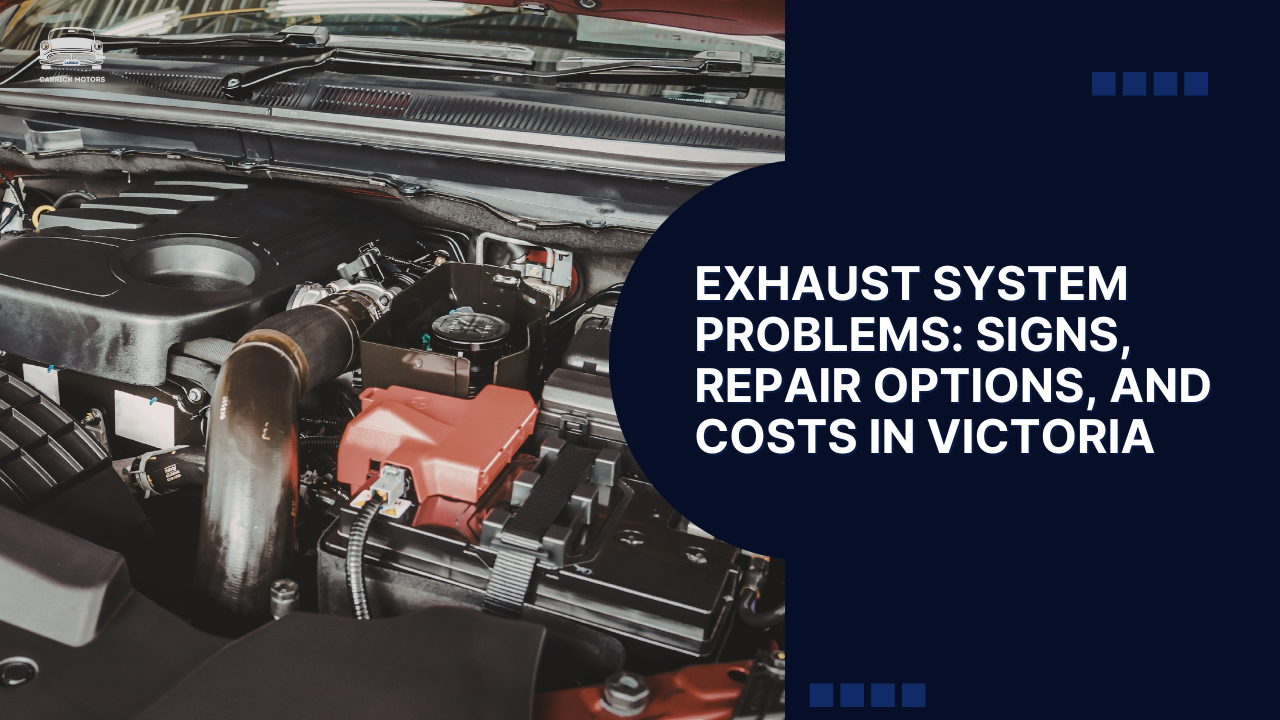
Exhaust repair in Tullamarine costs $100 to $2,500 depending on the part and the damage. A muffler runs $200 to $500, an exhaust pipe section $100 to $400, and a catalytic converter $800 to $2,500. The exhaust carries combustion gases out the back, quietens the engine, and cleans up emissions. When it fails you get noise, a smell, worse economy, and in the worst case carbon monoxide reaching the cabin. Carrick Motors on Carrick Drive diagnoses and repairs exhaust systems for drivers across Tullamarine, Airport West, and Gladstone Park. This guide covers how the system works, the warning signs, common faults, and what repair costs.
How Your Exhaust System Works
The exhaust channels hot gases from the engine to the tailpipe while cutting noise and emissions along the way. Several parts handle that in sequence.
The manifold bolts to the cylinder head and gathers the gases from every cylinder into one pipe. It takes the brunt of the heat, so cast-iron ones crack and steel ones warp over time. The catalytic converter comes next, using precious-metal catalysts to turn carbon monoxide, hydrocarbons, and nitrogen oxides into far less harmful carbon dioxide, water, and nitrogen. It is essential for registration and the most expensive part to replace. The oxygen sensors, one before and one after the converter, read the exhaust so the engine can trim its fuel mix, and worn sensors hurt economy.
Further back, the resonator tunes out certain sound frequencies, and the muffler kills most of the remaining noise through internal chambers. Pipes join it all together, and rubber hangers hold the system off the body so vibration doesn’t reach the cabin. A fault anywhere in that chain shows up as noise, a leak, or a warning light.
Signs of Exhaust Problems
Exhaust faults announce themselves through sound, smell, and feel, which makes them easier to catch early than most car problems. Watch for these:
- Loud exhaust. The engine suddenly roars or rumbles, louder under acceleration. A hole, crack, or failed joint is behind it. Noise from the front is manifold or front pipe, from the rear is muffler or tailpipe.
- Rattling underneath. A metallic rattle at idle, at certain revs, or over bumps. Usually a loose heat shield, which is cheap, or a broken hanger. A rattle from inside the converter means the converter has broken up.
- Exhaust smell in the cabin. Fumes inside the car, worse with the windows up. This is a safety emergency, since exhaust carries odourless carbon monoxide. Open the windows and get it repaired urgently.
- Rotten-egg smell. A sulphur smell from the exhaust points to a failing catalytic converter or an engine running rich.
- Worse fuel economy. A leak upsets the oxygen sensor readings and a blocked converter adds backpressure, both making the engine work harder and drink more fuel.
- Check engine light. Codes like P0420 or P0430 flag converter efficiency, and P0171 or P0174 can mean an exhaust leak fooling the sensors.
- Sluggish performance. A clogged converter restricts flow, so the engine can’t clear its gases and loses power, worst at higher revs.
- Visible rust or damage. Rust holes, drooping sections, black soot stains, or impact damage all cut performance and leak.
Any exhaust smell in the cabin, or loud noise from the front of the car, needs acting on straight away because of the carbon monoxide risk. Exhaust work sits within our all cars mechanical repairs service, where the leak is traced before quoting.
Common Exhaust Problems
Most exhaust faults fall into a few types, each with its own repair path.
Manifold cracks and leaks come from constant heat cycling stressing the metal. You get ticking or hissing from the engine bay, worse when cold, plus lost performance and sometimes a check engine light. A failed gasket is $150 to $350, a cracked manifold $300 to $800, and a broken stud adds $100 to $200 to extract.
Catalytic converter failure usually starts with an engine fault, a misfire or oil burning, poisoning the converter, though age and theft also account for many. Signs are an efficiency code, a rotten-egg smell, lost power, or an internal rattle. Replacement is the only fix: aftermarket $400 to $1,000, OEM $800 to $2,500, plus $150 to $400 labour. Fixing engine misfires early is what protects it.
Muffler deterioration happens as combustion moisture rusts it from the inside out, giving louder exhaust and rust holes. A replacement is $200 to $500. Pipe corrosion rots pipes at joints and bends, and a section replacement is $100 to $400 or a full system $600 to $1,500. Oxygen sensor failure from contamination or age throws a light and hurts economy, at $200 to $400 per sensor. And heat shield problems, a rusted mount letting the shield rattle, are a cheap $50 to $200 fix often mistaken for something worse.
Exhaust Repair Costs in Tullamarine
Cost tracks the part. Group them and it’s clear.
Cheaper jobs sit low: a heat shield $50 to $200, exhaust gaskets $100 to $300, a pipe section $100 to $400, a resonator $150 to $400, an oxygen sensor $200 to $400 each. Mid-range work runs a muffler $200 to $500 and a manifold $300 to $800. The catalytic converter is the big one at $800 to $2,500, since it holds precious metals and OEM units are dear.
A full system replacement, needed when corrosion or multiple failures run through the whole exhaust, runs $600 to $1,200 on an economy car, $800 to $1,500 mid-range, and $1,200 to $2,500 on European or performance vehicles. Two things move the price: vehicle type, since European and performance systems are more complex, and part quality, where OEM and quality aftermarket last while budget parts fail early. Stainless steel costs more than mild steel but lasts far longer. These bands line up with the wider market once labour is counted.
The Carbon Monoxide Danger
The exhaust isn’t just a noise and emissions part, it’s a safety system, and this is the reason exhaust leaks aren’t left to slide. Exhaust gas contains carbon monoxide, a gas with no colour and no smell that’s deadly in an enclosed space. A leak forward of the cabin can let it seep inside, and the early symptoms, headache, dizziness, nausea, drowsiness, are easy to mistake for tiredness until it’s dangerous.
That’s why a leak in front of the cabin is treated as urgent, not routine. If you ever smell exhaust inside the car, the smell itself is other gases, but it signals that carbon monoxide may be entering too. Drive with the windows open, stop using the car until it’s fixed, and book it in straight away. No exhaust repair is expensive next to that risk.
Exhaust and Roadworthy Compliance
A sound exhaust is a registration requirement, not just a comfort one. A roadworthy inspection checks the exhaust, and excessive noise, visible leaks, missing components, or a failed catalytic converter all cause a fail. Vehicles also have to meet the emissions standard for their build year, and a dead converter blows past those limits.
Preparing is simple. Before a roadworthy, listen for unusual noise, look underneath for rust or damage, and clear any check engine light, since converter and sensor codes are common failure points. Sorting exhaust faults before the inspection avoids a failed test and a second visit. Keeping the exhaust healthy is part of a regular car service, where it’s checked as standard.
Preventing Exhaust Problems
Most exhaust life comes down to protecting the converter and slowing corrosion. Fixing engine faults early is the big one: a misfire dumps unburnt fuel into the converter and oil burning contaminates it, so addressing check engine lights and oil consumption promptly protects the priciest exhaust part. Regular engine servicing keeps the engine running clean, which keeps the exhaust clean.
Corrosion is the other front. Short trips never let the exhaust get hot enough to dry out the combustion moisture inside it, so it rusts from within, which is why an occasional longer drive helps. Washing the undercarriage after any road-salt exposure slows external rust. And a periodic look underneath for developing rust, drooping sections, or new sounds, plus an exhaust check at each service, catches small faults before they spread through the system.
DIY or Professional?
Some exhaust jobs suit a home mechanic, but most don’t, and knowing which is which saves money and risk. The simple ones are doable with basic tools: an accessible oxygen sensor, a heat shield reattachment, or a temporary clamp-on patch on a pipe. None of those need welding or a hoist.
Everything else is a workshop job. Pipe sections, muffler fitting, and manifold work usually need welding, and a poor weld makes a weak joint that leaks again fast. The catalytic converter must be fitted correctly to work and stay compliant. And tracing an intermittent leak takes a smoke test and experience, not guesswork. Working under a car on stands is also genuinely risky, where a hoist makes it safe. For anything welded, converter-related, or hard to pin down, professional service is the sensible call.
How to Book Your Exhaust Service
Booking with Carrick Motors takes one call. Ring +61 3 9330 1082 or message the workshop on WhatsApp, and we smoke-test or inspect the exhaust to trace the real leak before quoting. We service all makes and models, weld and fit quality exhaust parts with a warranty, and offer free pick-up and drop-off within 10 km of Tullamarine. If you smell exhaust in the cabin, don’t keep driving, call us and we’ll sort it as a priority.
Frequently Asked Questions
Why is my exhaust suddenly loud?
Sudden loud exhaust means a hole, crack, or failed joint, usually a rusted-through pipe or muffler, a blown gasket, or impact damage. The location tells you where: front noise is the manifold or front pipe, rear noise is the muffler or tailpipe. Get it checked promptly, especially if the noise is from the front, where a leak can let exhaust into the cabin.
Can I drive with an exhaust leak?
A small leak at the rear can be driven briefly, but any leak forward of the cabin is dangerous because of carbon monoxide. Leaks also hurt performance and economy and can damage the oxygen sensors. They worsen over time, so repair soon. Never drive with the windows up if you can smell exhaust inside.
How long do catalytic converters last?
Catalytic converters last 150,000 to 250,000 kilometres when the engine runs properly. Misfires, oil burning, or coolant leaks destroy them far sooner. Signs of failure are an efficiency code, a rotten-egg smell, an internal rattle, and lost power. Fixing engine faults promptly is the main way to protect the converter’s life.
Why does my car smell like rotten eggs?
A rotten-egg smell means excess hydrogen sulphide in the exhaust, usually a failing catalytic converter not processing sulphur properly, or an engine running rich and overloading the converter. If it appeared suddenly, get it inspected, since it can point to an engine fault damaging the converter or the converter itself failing.
Can an exhaust leak cause a check engine light?
Yes. A leak upsets the oxygen sensor readings and makes the exhaust look leaner than it is, triggering lean codes like P0171 and P0174 or sensor codes. Leaks before the sensors let outside air in and skew the fuel mix. Fixing the leak usually clears the code.
How much does catalytic converter replacement cost?
Catalytic converter replacement costs $800 to $2,500 in Tullamarine, depending on the vehicle and part choice. Aftermarket units are $400 to $1,000, OEM $800 to $2,000-plus, with $150 to $400 labour. European vehicles and those needing two converters cost most. Converter theft is also rising because of the precious metals inside.
Is a loud exhaust a roadworthy failure?
Yes. Excessive exhaust noise fails a roadworthy inspection in Tullamarine. The system has to be reasonably quiet and properly sealed, so obvious leaks, missing parts, damaged sections, and excessive noise all fail. Fixing exhaust faults before the inspection avoids a failed test and the delay of a re-check.
What causes a rattling noise from under the car?
A rattle from underneath is most often a loose or corroded heat shield, cheap to reattach, or a broken exhaust hanger letting a section knock against the body. A rattle from inside the catalytic converter is the costly one, meaning the internal honeycomb has broken up and the converter needs replacing. A quick inspection separates the cheap fix from the expensive one.
What’s the difference between a muffler and a resonator?
The muffler does the heavy lifting on noise, using internal chambers to cancel most of the sound, and every car has one. The resonator is a smaller unit, fitted to some vehicles, that tunes out specific frequencies and smooths the exhaust note. They work together, and not all cars carry a resonator.
Why are catalytic converters stolen?
Catalytic converters contain small amounts of precious metals, platinum, palladium, and rhodium, which are valuable enough that thieves cut them off parked cars. A theft leaves a very loud exhaust and a car that fails emissions, and replacement runs $800 to $2,500. Parking off-street, marking the converter, or fitting a guard all reduce the risk on higher-target vehicles.
Exhaust problems bring noise, lost performance, worse economy, and a real carbon monoxide risk, while repairs range from $100 for a simple fix to $2,500 for a converter. Don’t ignore a sudden noise or any exhaust smell inside the car. Call Carrick Motors on +61 3 9330 1082 to book your exhaust repair in Tullamarine today.