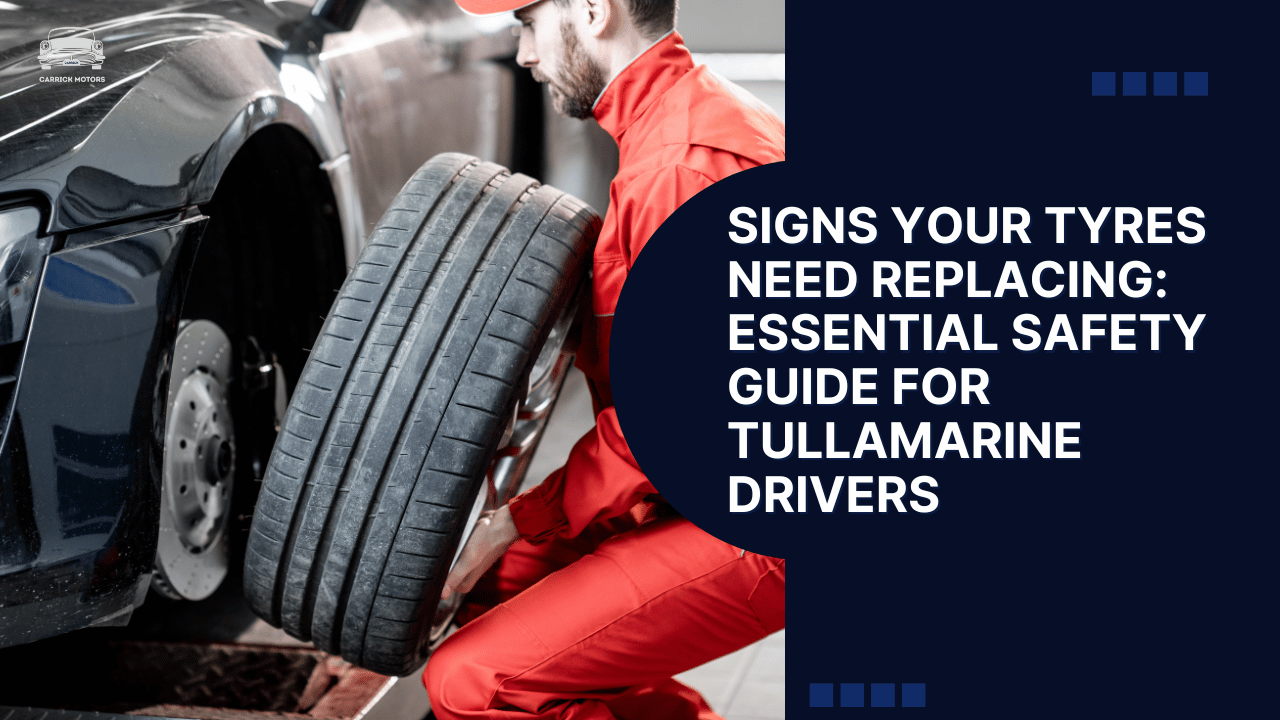
Tyres need replacing when the tread depth falls below 1.6mm, the sidewalls show cracking or bulging, the age passes six years regardless of tread, or uneven wear points to an alignment or suspension fault. Most tyres last 40,000 to 80,000 kilometres depending on driving conditions, vehicle type, and maintenance. Because your tyres are the only contact between the car and the road, worn tyres lengthen braking distances, cut wet-weather grip, and risk a failure at speed that endangers everyone in the car. Recognising the warning signs early keeps you safe and legal. Carrick Motors on Carrick Drive supplies, fits, and inspects tyres for drivers across Tullamarine, Airport West, and Gladstone Park. This guide explains every sign that replacement is due, the legal limits, the costs, and how to make a set last.
Understanding Tyre Wear and the Legal Limit
Tyres wear gradually as friction with the road removes microscopic amounts of rubber on every kilometre, and the rate depends on your driving style, the roads, the alignment, and the tyre quality. A new tyre typically starts around 8mm of tread and wears toward the legal minimum of 1.6mm, and performance falls off as it goes. From 8mm down to about 4mm the tyre holds full grip in the wet and dry, but between 4mm and 3mm wet-weather performance starts to decline noticeably and braking distances grow. From 3mm to 1.6mm the wet grip is significantly compromised with a real aquaplaning risk, and below 1.6mm the tyre is illegal and dangerous in every condition.
Victorian law requires a minimum of 1.6mm across the entire tread width, and tyres below that make the car unroadworthy and attract penalties, fines that can exceed $300 per tyre, defect notices, and complications with an insurance claim after an accident. Beyond the legal minimum, though, safety experts widely recommend replacing at 3mm for meaningfully better wet-weather braking, since the gap between “legal” and “safe” is where a lot of wet-road crashes happen. Treating 3mm as your practical replacement point rather than 1.6mm is one of the simplest safety upgrades you can make.
Tread Wear Indicators and Depth
The quickest check needs no tools. Every road tyre has built-in tread wear indicators, small raised bars moulded into the grooves at exactly 1.6mm height, and a triangle marker on the sidewall points to where they sit. When the surrounding tread wears down level with those bars, the tyre has reached the legal minimum and must be replaced immediately, whatever the rest of it looks like. A quick glance at the indicators during a regular check tells you when replacement is approaching.
For a more precise reading, measure the depth. A cheap tread-depth gauge gives an accurate figure in seconds, and the 20-cent coin test works as a rough guide, since if the outer band of the coin stays visible in the groove the tread is below about 3mm and replacement should be on your mind. As a rule of thumb, below 1.6mm means replace now (it’s illegal), 1.6 to 2mm means replace very soon, 2 to 3mm means plan replacement within weeks, 3 to 4mm means monitor closely especially before the wet season, and above 4mm is adequate. Measure at several points across the width and around the tyre, because uneven readings often reveal an alignment or suspension issue alongside the wear, which a wheel alignment check can pin down.
Sidewall Damage and Age
Tread isn’t the whole story, since the sidewall carries the structural load and can fail even when the tread looks fine. Small cracks in the sidewall rubber, called weather checking, come from UV, ozone, and heat cycling breaking down the compound, and extensive cracking signals internal deterioration regardless of tread. Bulges or blisters are more urgent, meaning the internal cords have separated after an impact with a pothole or kerb, leaving a weak point prone to sudden blowout, so a bulging tyre needs immediate replacement. Deep cuts or gouges that expose the internal cords also compromise the structure. Crucially, sidewall damage cannot be repaired, so an affected tyre is replaced no matter how much tread remains.
Age matters just as much as use, because rubber degrades through oxidation and exposure even on a car that barely moves. The manufacture date is stamped on the sidewall as a four-digit DOT code, where “2519” means the 25th week of 2019. As a guide, inspect carefully from five years, consider replacement at six years regardless of tread, and replace at ten years no matter how the tyre looks. This catches out owners of low-kilometre cars, whose tyres can show plenty of tread while the rubber has gone hard and brittle, losing grip the tread depth alone would never reveal.
Uneven Wear, Vibration, and Damage
Three more signs point to problems beyond the tyre itself. Uneven wear patterns are a diagnostic goldmine: wear in the centre with good shoulders means chronic overinflation, wear on both shoulders with a good centre means underinflation, wear on one edge only means an alignment fault, a sawtooth feathering felt across the tread means a toe-alignment problem, and a dished cupping or scalloping around the tyre points to worn shocks or unbalanced wheels. The key lesson is to fix the underlying cause before fitting new tyres, since fresh rubber on a misaligned or suspension-worn car develops the same wear prematurely, so a suspension and alignment inspection is worth doing at the same time.
Vibration and handling changes often show before any visual sign. Vibration through the steering wheel at certain speeds can mean a balance problem, a separated belt, or an out-of-round tyre, a car pulling to one side can mean uneven wear or an alignment fault, reduced grip in cornering or braking can mean worn or hardened rubber, and a change in road noise can mean irregular wear or a developing belt separation, all worth investigating promptly. Finally, puncture and impact damage may need replacement rather than repair: a small puncture under 6mm in the central tread can usually be repaired safely to Australian standards, but a sidewall puncture, damage within 25mm of the sidewall edge, a puncture over 6mm, or a tyre with multiple previous repairs cannot be repaired and needs replacing. When in doubt about whether damage is repairable, a professional assessment keeps the decision safe.
Tyre Replacement Cost in Tullamarine
Cost tracks the tyre category and the vehicle. Budget tyres run $70 to $120 each, entry-level rubber with adequate safety but shorter life, suiting low-mileage cars. Mid-range tyres at $120 to $200 each, from brands like Kumho, Hankook, and Toyo, balance performance, longevity, and value for most drivers. Premium tyres at $180 to $350 each, from Michelin, Bridgestone, Continental, and Pirelli, give superior wet and dry grip, lower noise, and longer tread life, the best long-term value for high-mileage drivers. Performance tyres at $250 to $500-plus each prioritise grip over life for sports and enthusiast cars.
On top of the tyre, budget for fitting and balancing at $20 to $40 per tyre, a wheel alignment at $80 to $150 (recommended with new tyres), valve replacement at $5 to $15 each, and old-tyre disposal at $5 to $10 each. In practice, a fitted set of four on a small car runs $400 to $880 depending on the tier, a medium car $480 to $1,040, and an SUV $560 to $1,200. For context on how tyre work fits alongside other running costs, our 2026 car service price guide breaks down local pricing. These figures line up with the wider market once fitting is counted.
How to Make Tyres Last Longer
Good maintenance can extend a set’s life by a third or more, and it starts with pressure. Incorrect pressure is one of the biggest causes of premature wear: underinflation increases edge wear, raises fuel use, overheats the tyre, and lengthens braking, while overinflation increases centre wear, harshens the ride, and cuts grip especially in the wet. Check the pressures monthly with an accurate gauge, when the tyres are cold, and set them to the figure on the driver’s door-jamb placard.
Rotation and alignment do the rest. Rotating the tyres every 10,000 km or at each service equalises wear across all four positions and can add 20 to 30 percent to the set’s life, and it’s easily bundled into a regular car service. Keeping the alignment correct, checked annually or whenever uneven wear or pulling appears, prevents the one-sided wear that quietly destroys tread, and the $80 to $150 alignment cost prevents hundreds in premature replacement. Driving habits finish the picture, since gentle acceleration, smooth progressive braking, moderate cornering, and sensible speeds all cut the heat and scrubbing that wear rubber away.
Replacing Two Tyres or Four
How many to replace depends on condition and drivetrain. Replacing all four makes sense when the tyres are worn evenly, when the car is all-wheel drive and needs matched circumferences, or when the whole set has passed six years regardless of individual tread, and it gives balanced handling and a simple rotation schedule. Replacing two is acceptable when only two are worn, when budget is tight, or when the other two have substantial tread left.
One rule matters most when fitting two: the new tyres always go on the rear axle, whatever the car’s drive type, because fresh rear tyres keep the car stable in an emergency manoeuvre and reduce the risk of the back stepping out in the wet. All-wheel-drive vehicles add a further requirement, since their systems need closely matched tyre circumferences, and a mismatch stresses the differentials, transfer case, and traction control, potentially causing expensive drivetrain damage. On an AWD car, replace all four together where possible, and if replacing two, match the remaining tyres closely, staying within the maker’s specified circumference tolerance, usually 2 to 3 percent.
How to Book Your Tyre Service
Booking with Carrick Motors takes one call. Ring +61 3 9330 1082 or message the workshop on WhatsApp, and we’ll inspect the tread, sidewalls, age, and wear pattern, help you choose the right tyre for your car and driving, and fit and balance it properly, with an alignment where needed. We supply budget through premium brands, service all makes and models across Tullamarine, Airport West, and Gladstone Park, and offer free pick-up and drop-off within 10 km of the workshop. If a tyre is showing wear bars, a bulge, or sidewall cracking, don’t wait, since a failure at speed is dangerous, so call and we’ll sort it.
Frequently Asked Questions
How long do tyres last in kilometres?
Tyres typically last 40,000 to 80,000 kilometres depending on quality, driving conditions, vehicle type, and maintenance. Front tyres on front-wheel-drive cars often wear faster than the rears, and aggressive driving, heavy loads, and poor alignment shorten life. Premium tyres generally last considerably longer than budget ones, which is part of what makes them better value for high-mileage drivers.
Can I replace just one tyre?
Single replacement is acceptable only when one tyre is unrepairably damaged and the other three are in good condition, and the new one should match the others in brand, model, and size. A significant tread-depth difference from the others affects handling. Where possible, replacing in pairs gives better handling balance than a single tyre, especially on the same axle.
Do tyres have a use-by date?
Yes. Tyres deteriorate with age regardless of use, as the rubber degrades through oxidation and exposure. Most manufacturers recommend replacement after six years from the manufacture date regardless of tread, and no tyre should be used past ten years old. Check the four-digit DOT date code on the sidewall to determine the manufacture week and year.
Should I replace tyres before a roadworthy inspection?
If the tyres show wear indicators level with the tread or have any sidewall damage, replace them before the inspection, since they’ll fail otherwise. Tyres only marginally above the legal minimum may pass but should be replaced soon for safety. Sorting obvious tyre issues before the roadworthy avoids a failed assessment and the cost of a re-inspection.
What causes tyres to wear on one side only?
One-sided wear indicates a wheel alignment problem, usually excessive camber, where the wheel tilts and loads the inner or outer edge disproportionately. Bent suspension components, worn bushings, or sagging springs can cause it too. Address the alignment before fitting new tyres, otherwise the fresh rubber develops the same one-sided wear prematurely and the money is wasted.
Are expensive tyres worth the extra cost?
Often yes. Premium tyres usually justify their price through longer tread life, better wet-weather performance, lower noise, and improved fuel economy, so the cost per kilometre frequently favours them despite the higher purchase price. High-mileage drivers benefit most, while budget tyres suit low-mileage cars or short-term ownership where longevity matters less.
How do I know what size tyres my car needs?
The size is on the placard inside the driver’s door jamb and in the owner’s manual, shown as a code like 205/55R16 that gives the width, aspect ratio, construction, and rim diameter. Always replace with tyres matching the original specification unless a professional is upgrading you, since the wrong size affects the speedometer, handling, and can foul the bodywork.
When should new tyres go on the front or rear?
New tyres always go on the rear axle, regardless of whether the car is front-, rear-, or all-wheel drive. Fresh rear tyres keep the car stable during hard braking or an emergency swerve and reduce the risk of the rear losing grip in the wet, which is far harder to control than front-end understeer. This applies even on front-wheel-drive cars.
Worn tyres lengthen your braking, cut your wet-weather grip, and risk a dangerous failure, while the warning signs, wear bars, low tread, sidewall damage, age, uneven wear, and vibration, all tell you replacement is due in good time. Don’t push a tyre past its limit. Call Carrick Motors on +61 3 9330 1082 to book your tyre inspection or replacement in Tullamarine today.