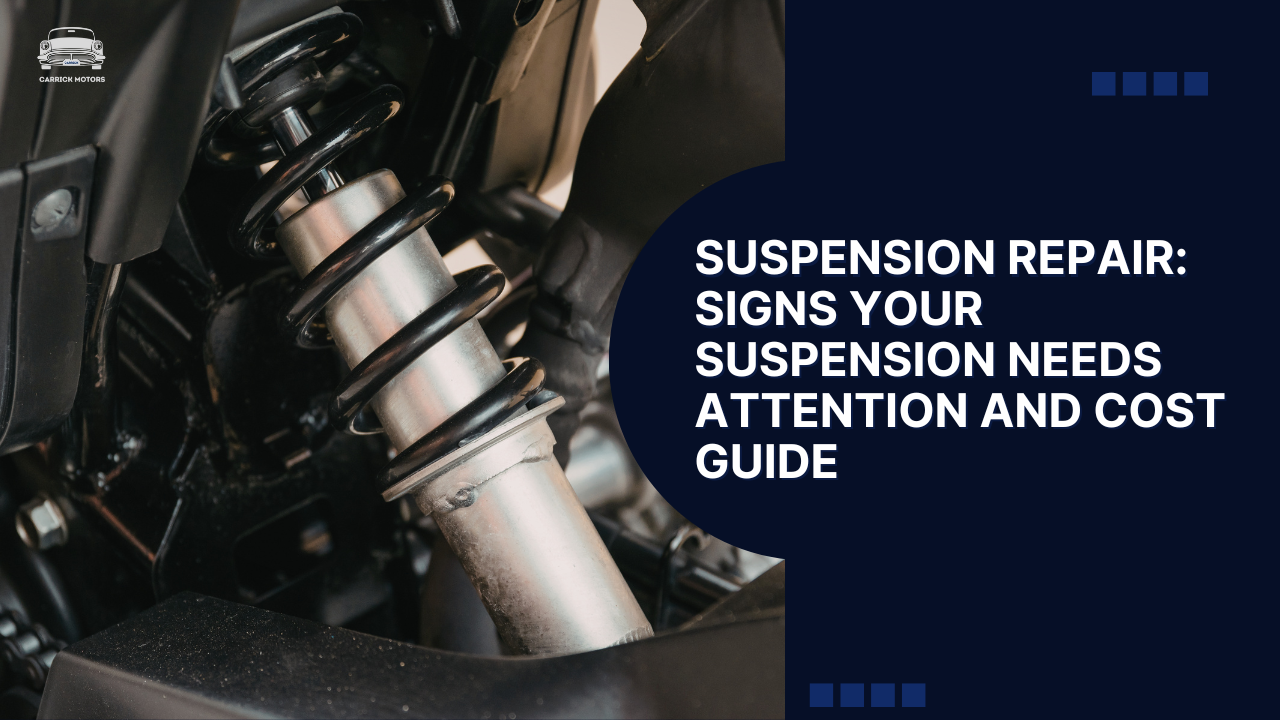
Suspension repair in Tullamarine costs $200 to $1,500 depending on which parts are worn. Shock absorbers run $300 to $800 per axle, ball joints $200 to $500 per joint, and a full overhaul across multiple worn components $1,500 to $3,000. Most suspension parts last 80,000 to 150,000 kilometres, less on rough roads. The suspension keeps your tyres on the road, soaks up bumps, and holds the car steady through corners and braking. Worn suspension ruins handling, lengthens stopping distances, chews tyres, and creates real safety risks. Carrick Motors on Carrick Drive diagnoses and repairs suspension for drivers across Tullamarine, Airport West, and Gladstone Park. This guide covers how the system works, the warning signs, component life, and repair costs.
How Your Suspension Works
The suspension is a set of parts working together to control the car’s movement and keep the wheels planted. Knowing them helps you understand where a problem sits.
Shock absorbers and struts control suspension movement, damping the bounce that would otherwise carry on after every bump. Inside, a piston forces oil through small passages, turning motion into heat and resisting it. Without working shocks the car bounces, the tyres lose contact during that bounce, braking distances grow, and handling turns unpredictable. A strut combines a shock with structural support in one unit. The springs, meanwhile, carry the car’s weight and take the first hit of each bump, compressing to absorb the energy and releasing it to return to normal height. A broken or sagged spring drops the ride height, shifts the geometry, and causes uneven tyre wear.
The joints and links tie it all together. Control arms connect the wheel assembly to the body, pivoting as the suspension travels, with rubber bushings at the pivots that flex to allow movement while soaking up vibration. Worn bushings let things move too much, causing clunks and vague handling. Ball joints connect the control arms to the steering knuckles in a ball-and-socket that allows both suspension travel and steering, and they’re safety-critical, since a failed one can let a wheel separate from the car. Sway bars cut body roll in corners by transferring force between the left and right wheels, with end links that wear and clunk. And the tie rods connect the steering rack to the wheels, transmitting your steering input and setting the wheel alignment; worn tie rod ends cause steering play and wander, and a failed one means losing steering entirely.
Signs Your Suspension Needs Repair
Suspension faults warn you through bounce, noise, handling, and tyre wear. Catching them early keeps a small repair from becoming a safety problem. Watch for these:
- Excessive bouncing. The car keeps bouncing after a bump, dives hard under braking, squats on acceleration, or rolls heavily in corners. Worn shocks are no longer controlling the movement. The bounce test confirms it: push down firmly on a corner and release, and the car should settle within one or two bounces, not keep rocking.
- Clunking or knocking. A clunk over bumps, a knock when turning, or a rattle from underneath that’s worse on rough roads. This points to worn bushings, ball joints, tie rod ends, or sway bar links. Front clunks usually mean ball joints, tie rods, or links, and rear clunks mean shock mounts or bushings. Some causes are minor, others safety-critical, so never assume a clunk is harmless.
- Pulling or wandering. The car pulls to one side, the steering feels vague, or you’re constantly correcting on a straight road. Worn tie rod ends, ball joints, sagged springs, or damaged bushings shift the alignment. Since tyres and brakes can also cause pulling, an inspection finds the real cause.
- Uneven tyre wear. Wear on one edge only, cupped or scalloped patches, or one side wearing faster than the other. Worn joints and bushings shift the alignment, and worn shocks let the tyre bounce and cup. Fix the suspension before fitting new tyres, or the new ones wear the same way.
- Nose diving or rear squatting. The front dives dramatically when braking or the rear squats on acceleration, with slow, exaggerated weight transfer. Worn shocks aren’t controlling it, and the reduced grip this causes is a real braking-safety issue.
- Leaks or visible damage. Oil on the shock bodies, cracked or torn bushings, split ball joint boots, or bent parts. Leaking shocks have failed and can’t be repaired, and torn boots let grit destroy the joint inside.
Any clunk, wander, or leak is worth investigating promptly, since some causes threaten your control of the car. Suspension work sits within our all cars mechanical repairs service, where the worn part is pinpointed before quoting.
How Long Suspension Parts Last
Knowing typical lifespans helps you plan. Shock absorbers last 80,000 to 150,000 km, worn faster by rough roads, aggressive driving, and heavy loads, and they’re replaced in pairs so the car stays balanced. Springs often last the life of the car, past 150,000 km, failing mainly through corrosion, fatigue, or gradual sagging that drops the ride height. Bushings last 100,000 to 150,000 km, though the rubber perishes with age and heat regardless of distance.
The joints run longer but matter more. Ball joints last 100,000 to 200,000 km, and torn boots that let grit in cut that sharply, so they’re replaced immediately when worn since they’re safety-critical. Tie rod ends last a similar 100,000 to 200,000 km, boot condition again being the deciding factor, and they’re replaced in pairs with an alignment afterward. Sway bar links are the shortest-lived at 80,000 to 120,000 km, but they’re cheap, so they’re simply replaced when worn rather than watched.
Suspension Repair Costs in Tullamarine
Cost tracks the part and the labour. Individual components run as follows: shock absorbers $300 to $800 per axle, a full strut assembly $400 to $1,000 per axle, coil springs $250 to $500 per axle, a control arm $250 to $600 each, bushings $100 to $300 each, ball joints $200 to $500 each including alignment, a tie rod end $150 to $350 including alignment, and sway bar links $150 to $350 a pair. A wheel alignment at $89 to $150 is needed after most suspension work.
Bundled jobs save labour. A front suspension refresh with shocks, links, and alignment runs $600 to $1,200, a rear shock replacement $300 to $600 as it’s simpler, and a complete overhaul addressing multiple worn parts $1,500 to $3,000 or more. Three things move the price: vehicle type, since European and luxury cars cost more on parts, component quality, where premium shock brands like Bilstein or Koni cost more but last longer, and labour complexity, since some suspensions give easy access while others need extensive disassembly. Doing several worn parts together is far cheaper than separate visits, and it ties in naturally with a regular car service. These bands line up with the wider market once labour is counted.
When to Replace Suspension Components
Timing balances safety, cost, and convenience, and the parts fall into three groups. Safety-critical parts are replaced immediately: ball joints with excessive play, worn tie rod ends, broken springs, and completely failed shocks. These directly affect control, and failure risks losing steering or a wheel. Performance parts are planned soon rather than urgently: worn shocks giving a bouncy ride and poor braking, worn bushings clunking and handling vaguely, and worn sway bar links knocking over bumps. These affect comfort and handling but don’t usually fail suddenly.
Preventive replacement makes sense in some cases too, on a high-mileage car with original parts, before a long trip when parts show wear, or replacing both sides when one fails since the other is the same age. And bundling always saves money: doing shocks during major suspension work, addressing bushings while a control arm is already off, and including the alignment with any steering or suspension repair.
DIY or Professional?
Some suspension jobs suit a home mechanic, but most don’t, and the difference matters because the stakes are high. The doable ones are non-strut shock absorbers on many trucks and rear suspensions, which need no spring compression, sway bar links which are a simple bolt-on, and visual inspection to spot obvious wear.
Everything else is a workshop job for good reason. Strut replacement needs a spring compressor, and a compressed spring stores dangerous energy that has injured plenty of DIYers. Ball joints and most bushings need press tools and proper procedures, and an alignment afterward needs professional equipment for an accurate setting. Beyond the tools, a technician identifies which parts actually need replacing rather than guessing, reads the wear patterns that point to multiple issues, and torques everything to spec. Given that a compressed spring is genuinely hazardous and a mistake affects your control of the car, most drivers are better served having suspension work done professionally.
Suspension and Wheel Alignment
Suspension condition and wheel alignment are tied together, which is why the order of repair matters. Alignment measures the wheel angles, and those angles are set by where the suspension components sit. When parts wear, those positions shift, and the alignment goes out with them.
That’s why aligning a car with worn suspension wastes money: as the worn parts keep moving, the fresh alignment drifts straight back out. The correct sequence is to fix the suspension wear first, then align. An alignment is needed after any ball joint, tie rod, control arm, or strut replacement, and when uneven tyre wear appears it’s worth an alignment check, but only after the suspension has been inspected. A yearly alignment check also catches developing issues early. Getting this right is part of a proper tyres, balancing and alignment service.
Preventing Suspension Problems
Suspension wears with the roads it drives, but a little attention slows it and catches faults early. Have the suspension inspected at every regular service, roughly every 10,000 to 15,000 km, and sooner if any symptom appears. A technician checking the shocks, joints, bushings, and boots during a routine visit spots developing wear before it turns into a clunk or a failure.
Driving and loading habits help too. Slowing for potholes, speed humps, and rough patches spares the shocks and joints, and avoiding overloading the car keeps the springs and shocks within their limits. Watch your tyre wear for the uneven patterns that signal a suspension issue, keep the tyre pressures correct, and act on the first clunk or change in handling rather than living with it. Since worn suspension also accelerates tyre and steering wear, addressing it early prevents a cascade of extra costs, and a scheduled engine oil and filter service is a natural time to have it all checked.
How to Book Your Suspension Service
Booking with Carrick Motors takes one call. Ring +61 3 9330 1082 or message the workshop on WhatsApp, and we road-test and inspect the suspension to pinpoint the worn part before quoting. We service all makes and models, use the right press and alignment equipment, fit quality parts, and complete every steering and suspension repair with a proper alignment. We offer free pick-up and drop-off within 10 km of Tullamarine, and we recommend only the repairs your car actually needs.
Frequently Asked Questions
How do I know if my shocks are worn out?
Worn shocks cause excessive bouncing after bumps, nose dive under braking, body roll in corners, and longer stopping distances. The bounce test helps: push down firmly on each corner and release, and the car should settle within one or two bounces. Continued bouncing means worn shocks, and oil leaking from the shock body confirms failure. Replacement is due at that point.
Is it safe to drive with worn suspension?
It depends on which part is worn. Worn shocks reduce handling and braking control but don’t usually fail suddenly, so you can drive to an appointment. Worn ball joints or tie rod ends are safety-critical and can fail without warning, causing loss of control. Have any clunking, wandering, or loose steering inspected promptly rather than driving on it.
Do I need to replace shocks in pairs?
Yes, always replace shocks in pairs, both fronts or both rears. A mismatched pair makes the car handle and brake unevenly and can cause it to pull or behave unpredictably in an emergency manoeuvre. If one shock has failed, its partner is the same age and worn similarly, so doing both keeps the car balanced and predictable.
How long does suspension repair take?
Simple jobs like a shock absorber or sway bar link take 1 to 2 hours. A ball joint or control arm with alignment takes 2 to 3 hours, and a full overhaul can take a day. The exact time depends on the vehicle and how many parts are involved, so an estimate is given once the worn components are confirmed.
Why does my car clunk over bumps?
A clunk over bumps usually means a worn suspension part, a ball joint, tie rod end, sway bar link, or bushing moving too much as the suspension travels. Front clunks tend to point to steering and suspension joints, rear clunks to shock mounts or bushings. Since some causes are minor and others safety-critical, an inspection identifies the exact part.
Can worn suspension damage other components?
Yes. Worn suspension accelerates wear across the car. Failed shocks cause uneven tyre wear and stress other suspension parts, worn bushings shift the alignment and chew tyres, and worn ball joints stress the steering. Addressing suspension wear promptly stops this cascade, which is why a small repair now is cheaper than the extra damage neglect causes.
How often should suspension be inspected?
Suspension should be inspected at every regular service, roughly every 10,000 to 15,000 kilometres, and immediately if symptoms like clunking, bouncing, wandering, or uneven tyre wear appear. Cars driven on rough roads or carrying heavy loads benefit from more frequent checks, since those conditions wear the shocks, joints, and bushings faster.
How much does suspension repair cost in Tullamarine?
Suspension repair costs $200 for a simple job up to $3,000 for a full overhaul, with most common repairs between $300 and $800. Shocks are $300 to $800 per axle, ball joints $200 to $500 each, and tie rod ends $150 to $350 each, most including the alignment. A diagnosis identifies exactly which parts are worn before you commit to any repair.
Worn suspension compromises handling, lengthens braking, chews tyres, and in the case of joints can fail dangerously, while repairs range from $200 to $3,000 depending on what’s worn. Don’t ignore clunking, bouncing, or wandering steering. Call Carrick Motors on +61 3 9330 1082 to book your suspension repair in Tullamarine today.