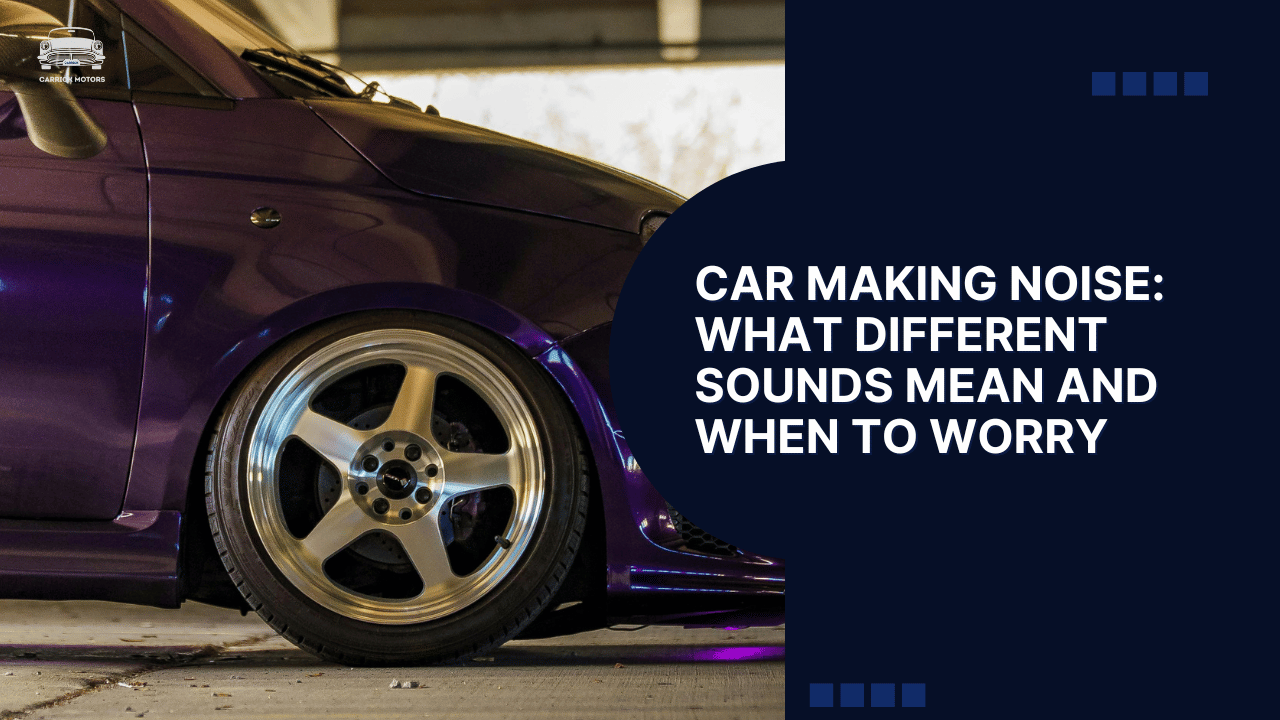
A car making a strange noise is telling you something, and reading the sound correctly is the first step to a safe, affordable fix. A squeal usually means worn brake pads, a grind means metal on metal, a knock can signal an engine problem, and a whine often points to the transmission or power steering. Catching a noise early is the difference between a minor repair and an expensive failure, and diagnosis costs just $80 to $150 before any work. Carrick Motors on Carrick Drive diagnoses and repairs unusual car noises for drivers across Tullamarine, Airport West, and Gladstone Park. This guide decodes the common sounds, explains what causes them, and tells you when to keep driving and when to stop.
How to Read a Car Noise
Before the specific sounds, a quick framework helps. The type of noise, squeal, grind, knock, tick, hum, rattle, or clunk, points to the system involved, and when it happens narrows it further. A noise that appears only when braking is almost certainly brake-related, one that changes with road speed points to wheels or tyres, one tied to steering points to the suspension or power steering, and one that rises with engine revs points to the engine or its belts. Noting the pattern, constant or intermittent, high-pitched or low, worse cold or hot, is the single most useful thing you can tell a mechanic. A phone recording of the sound while driving helps even more, since an intermittent noise rarely performs on command in the workshop.
Brake Noises
Brake sounds are among the most common and the most important to act on, because they bear directly on your ability to stop.
Squealing when braking is the noise drivers hear most. Most often it’s the wear indicator, a small metal tab built into the pad that scrapes the rotor once the pad gets thin, deliberately squealing to warn you. It can also come from glazed pads that overheated and hardened, from brake dust or grit that clears after a few stops, or simply from cheap pads that squeal their whole life. Wear-indicator squeal needs attention within a week or two, and a brake pad replacement sorts it before the pad runs out entirely.
Grinding when braking is more serious and means stop soon. When the pad wears completely through, the metal backing plate grinds against the rotor, destroying it fast and cutting your braking power. Surface rust after the car has sat can grind briefly then clear, and a trapped stone can too, but grinding from worn pads is an immediate-attention job, since driving on it turns a pad replacement into a pad-and-rotor bill and risks your safety. Scraping or rubbing that’s constant may be a bent backing plate, worn brake hardware, or a failing wheel bearing, and while some causes are minor, others are safety issues, so it’s worth prompt investigation.
Engine Noises
Engine sounds vary widely in cause and seriousness, so the type matters a great deal.
Knocking or pinging points to combustion or mechanical trouble. A light pinging under load is often just detonation from low-octane fuel or carbon buildup, sometimes cured by a better fuel. But a deep, rhythmic knock that rises with engine speed can be rod knock from worn bearings, which signals serious internal wear and a risk of engine failure, so heavy or persistent knocking means stop driving and get it inspected. Ticking or clicking is usually less alarming: check the oil level first, since low oil makes the valve train tick, and note that direct-injection engines tick normally from the injectors. A small exhaust manifold leak also ticks, worse when cold. Persistent ticking is worth checking at a service but rarely means imminent failure.
Hissing means something is escaping under pressure, a cracked vacuum hose, a pressurised coolant leak, or a small exhaust leak. Hissing with overheating needs immediate attention, while other hissing warrants prompt diagnosis. Rattling covers a range: a loose heat shield rattles annoyingly but harmlessly, while a rattle from inside the catalytic converter or from a worn timing chain, especially at startup, needs prompt diagnosis, since a timing chain failure can wreck the engine.
Transmission and Drivetrain Noises
Sounds from the gearbox and driveline usually signal developing wear worth catching early.
Whining while driving often comes from the transmission or differential. Low transmission fluid causes the pump to whine, worn bearings whine and change with speed or gear, and differential wear whines at certain speeds. A whine that rises with steering effort, though, is power steering rather than transmission. Checking fluid levels first is sensible, and persistent whining calls for a transmission service before wear becomes failure. Grinding when shifting a manual points to worn synchronisers or a clutch not fully disengaging, and continued grinding accelerates the damage, so it’s worth booking promptly even though complete failure isn’t usually imminent.
Clunking during gear changes suggests driveline play, worn CV joints that clunk on acceleration from rest, worn universal joints on rear-drive cars, or tired engine and transmission mounts letting things move. CV and U-joint failure can cause a sudden loss of drive, so clunking deserves prompt investigation. Humming or droning that changes with speed usually means a failing wheel bearing or worn tyres, and while a bad bearing isn’t immediately dangerous it worsens steadily until it becomes a safety risk, so it’s worth an inspection once you notice it.
Suspension and Steering Noises
Sounds from the suspension and steering affect both ride comfort and your control of the car.
Clunking over bumps is the classic worn-suspension noise, coming from failed shocks, worn ball joints, sway bar links, strut mounts, or perished control-arm bushings. Most aren’t immediately dangerous, but a failing ball joint can cause loss of steering control, so severe clunking should be looked at promptly. Squeaking over bumps usually means dry or perished bushings, or worn ball joints, and while often just annoying, ball-joint squeak warrants a check since it affects safety.
Creaking when turning points to the steering, worn tie rod ends, ball joints, or strut top bearings, and because these affect steering control it should be investigated promptly, often as part of a wheel alignment inspection that finds worn steering parts. Power steering whine that rises as you turn usually means low fluid, so check that first, or a wearing pump that will eventually need replacing. A failing pump makes the steering heavy but still driveable, so you can plan the repair rather than rush it.
Belt and Accessory Noises
The drive belt and the accessories it spins make their own distinctive sounds.
Squealing on startup typically means the drive belt is slipping, from a glazed or worn belt, low tension, or a tired automatic tensioner, though a brief squeal in wet weather is normal and clears quickly. Persistent startup squeal means the belt or tensioner needs attention before it fails, since that belt often runs the alternator, water pump, and power steering. Continuous squealing throughout operation points to a severely worn belt, misaligned pulleys, or a failing accessory bearing in the alternator, AC compressor, or an idler pulley, and it warrants prompt inspection before a breakdown. Chirping at a steady rhythm usually means worn belt ribs, a damaged pulley surface, or slight misalignment, less urgent than a squeal but worth addressing before it progresses.
When to Stop Driving Immediately
Most noises allow a careful drive to the workshop, but a few mean pull over. Stop driving for grinding brakes, since your ability to stop is compromised, for a loud, heavy engine knock that can precede catastrophic failure, for a sudden loud exhaust that may mean a component has separated, for scraping from under the car where something is dragging, and for grinding from a wheel that can mean a bearing about to seize. Any of these is a safety issue, not an inconvenience.
Other noises let you keep driving with care while you arrange a repair: wear-indicator brake squeal, a mild whine, intermittent suspension clunks, and ordinary belt squeal generally allow a short trip to get diagnosed. When you’re unsure how serious a sound is, treat it as the more serious option and get it checked, since professional diagnosis is what tells you the true urgency. Many of these fit naturally into a regular car service, where a technician catches developing noises before they turn into breakdowns.
How Noise Diagnosis Works
Because so many different faults can produce a similar sound, diagnosis matters, and the more you can describe, the faster it goes. Note the type of sound and its rhythm, whether it’s constant, intermittent, or tied to a specific action, and its pitch. Note when it happens, at a certain speed, when braking, turning, accelerating, or shifting, when cold or warm, and under load such as carrying passengers or climbing a hill. A smartphone recording captured during the conditions that produce the noise lets the technician hear exactly what you’re hearing, which is invaluable for an intermittent sound.
From there a workshop works systematically, road-testing to reproduce the noise, isolating the system, and inspecting the likely components rather than guessing. That structured approach is what a diagnostic fee of $80 to $150 buys, and it’s cheaper than the alternative of replacing parts on a hunch, since fitting the wrong component still leaves the noise and the bill. Accurate diagnosis the first time is the cheapest route to a quiet, safe car.
Noise Diagnosis and Repair Costs in Tullamarine
Diagnosis comes first at $80 to $150, usually credited toward the repair, and the fix depends entirely on the source. A brake pad replacement to cure wear-indicator squeal runs one figure, a wheel bearing behind a hum another, a serpentine belt for a chirp another again, and a transmission or suspension repair more. Because the cause sets the cost, the diagnosis is what tells you whether you’re facing a small job or a major one before you spend anything. The consistent theme is that early action is cheaper: a squealing brake pad caught now is a fraction of the pad-and-rotor bill that grinding creates, and a whining transmission addressed early beats a rebuilt gearbox. These figures line up with the wider market once labour is counted.
How to Book Your Diagnosis
Booking with Carrick Motors takes one call. Ring +61 3 9330 1082 or message the workshop on WhatsApp, and we road-test and systematically inspect the car to find the real source of the noise before quoting. We service all makes and models, explain what we find in plain terms, and offer free pick-up and drop-off within 10 km of Tullamarine. If the noise is a grinding brake, a heavy knock, or a scraping from underneath, don’t keep driving, since those are safety sounds, so call and we’ll bring the car in.
Frequently Asked Questions
Why does my car squeal when I start it?
Startup squealing usually means the drive belt is slipping. A worn, glazed, or loose belt slips on the pulleys when the engine starts, and a tired automatic tensioner makes it worse. The sound often eases as the belt warms. Have the belt and tensioner checked soon, since that belt drives the alternator, power steering, and air conditioning, and its failure disables all three at once.
Is it safe to drive with grinding brakes?
No. Grinding means the brake pads have worn through to the metal backing plates, which are now grinding against the rotors. This cuts your braking power and rapidly destroys the rotors, so what would have been a pad replacement becomes a pad-and-rotor job. Stop driving and get the brakes inspected immediately, since it’s both a safety risk and a fast-growing repair.
Why does my car make a noise when turning?
It depends on the sound. Clicking during turns often means worn CV joints, common on front-wheel-drive cars. Creaking points to worn tie rod ends, ball joints, or strut bearings. Groaning or whining that rises with steering effort indicates a power steering problem, usually low fluid or a wearing pump. Because some of these affect steering control, turning noises are worth prompt inspection.
What does a bad wheel bearing sound like?
A failing wheel bearing makes a humming, droning, or rumbling that grows with road speed and often changes when you turn, since cornering shifts load onto or off the bearing. Severe wear turns to grinding. Unlike tyre noise, which tends to be more rhythmic, bearing noise is fairly constant at a given speed. A bad bearing worsens steadily and eventually becomes a safety issue, so book an inspection once you notice it.
Why is my engine ticking?
Engine ticking has several causes. Check the oil level first, since low oil makes the valve train tick, and top it up or investigate promptly. Direct-injection engines tick normally from the injectors, a small exhaust manifold leak ticks more when cold, and hydraulic lifter wear ticks and may ease as the engine warms. Persistent ticking is worth checking at a service, though it rarely signals imminent failure.
Should I worry about a rattling sound?
It depends on the source. A loose heat shield rattles annoyingly but isn’t dangerous. Exhaust rattles can mean failing mounts, and an interior rattle affects only comfort. The one to act on is an engine rattle at startup, which can point to a worn timing chain or tensioner and needs prompt diagnosis, since a timing chain failure can cause serious engine damage. Identifying the source tells you the urgency.
What does rod knock sound like, and is it serious?
Rod knock is a deep, rhythmic knocking from the engine that rises and falls with engine speed, caused by worn connecting-rod bearings. It’s one of the most serious engine noises, since it signals internal wear that can lead to engine failure. If you hear a heavy, repetitive knock that tracks with the revs, stop driving and arrange an inspection, because continuing risks destroying the engine.
How much does it cost to diagnose a car noise?
Noise diagnosis typically costs $80 to $150 for the inspection time. A straightforward noise may be identified quickly, while an intermittent one can take longer to reproduce and trace. Many workshops, including Carrick Motors, credit the diagnostic fee toward the repair. Because accurate diagnosis prevents paying for the wrong parts, it’s well worth it for any persistent or concerning sound.
A strange car noise is an early warning, and reading it correctly, then acting promptly, keeps a small repair from becoming a major one. Some sounds allow a careful drive to the workshop, but grinding brakes, heavy knocking, and scraping from underneath mean stop now. Call Carrick Motors on +61 3 9330 1082 to book your noise diagnosis in Tullamarine today.