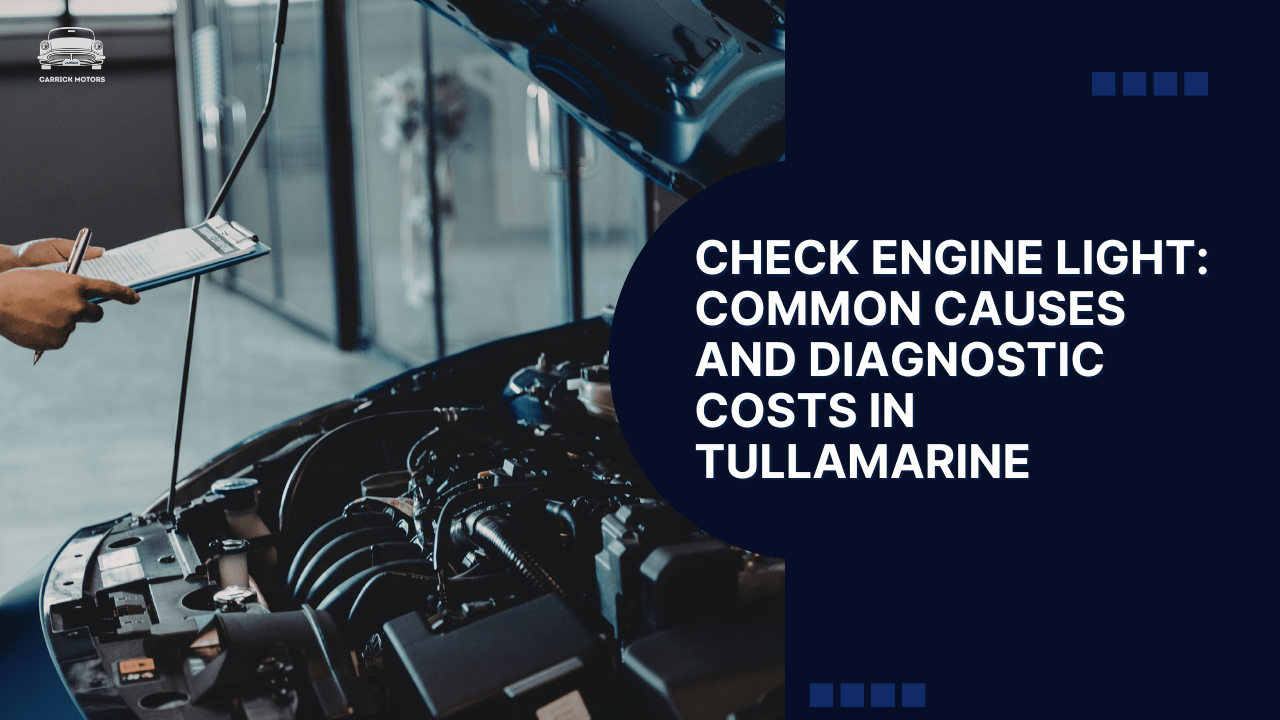
Check engine light diagnosis in Tullamarine costs $80 to $150 for a basic scan and $100 to $250 for full diagnosis. The repair that follows depends entirely on the fault, from a $20 fuel cap to a $2,500 catalytic converter. That light on your dash is not a verdict. It is a signal that the engine computer has logged a fault in the emissions or engine management system, and the fault could be trivial or serious. Carrick Motors on Carrick Drive diagnoses and repairs check engine light faults for drivers across Tullamarine, Airport West, and Gladstone Park. This guide covers what the light means, the common causes ranked by cost, how proper diagnosis works, when to stop driving, and what each repair runs.
What the Check Engine Light Means
The check engine light reports a fault the onboard computer has already detected. Your car runs an onboard diagnostic system, OBD2, that watches sensors across the engine and emissions systems. When a reading falls outside its expected range, the computer logs a code and turns on the light. The light is the symptom. The stored code points to the system at fault.
How the light behaves tells you how urgent the fault is. A steady light means a problem has been detected but the car is usually safe to drive carefully to a workshop. A flashing light means a severe fault, almost always an engine misfire dumping raw fuel into the exhaust, and that damages the catalytic converter within minutes. Stop driving on a flashing light as soon as it is safe to pull over.
The codes themselves follow a set pattern. Powertrain codes start with P and cover the engine and transmission, and these are the most common. Codes starting with B, C, or U cover the body, chassis, and network systems. A code such as P0301 names a misfire on cylinder one, while P0420 flags catalytic converter efficiency. The code narrows the search. It does not name the exact failed part, which is why the next step is testing, not guessing.
Steady Light vs Flashing Light
Light behaviour decides your next move, so read it before anything else.
A steady amber light points to a detected fault that is not an emergency. The car can usually be driven to a workshop within a few days, provided nothing else changes. Keep an eye on the temperature gauge and listen for anything unusual on the way.
A flashing light is a different situation. It signals an active misfire severe enough to harm the catalytic converter, one of the most expensive emissions parts on the car. Continuing to drive turns a spark plug or coil repair into a converter replacement costing thousands. If the light flashes, or a steady light appears alongside overheating, power loss, or smoke, stop driving and arrange for the car to be brought in. The difference between reacting now and driving on is often the difference between a $200 repair and a $2,000 one.
Common Check Engine Light Causes
Causes range from a loose cap to a failed converter. The list below runs roughly from cheapest to most expensive, so you can gauge where a fault might land before diagnosis confirms it.
- Loose or faulty fuel cap costs $0 to $50. The evaporative system detects escaping fuel vapour and trips the light. Tighten the cap first. Replace it if the seal is cracked.
- Vacuum hose leak costs $50 to $150. A split hose upsets the air-fuel mix and can throw a lean-running code.
- EVAP purge valve costs $150 to $300. This valve controls fuel vapour flow and sticks or fails with age.
- Thermostat costs $150 to $350. A stuck thermostat gives the computer wrong temperature data and hurts fuel economy.
- Oxygen sensor costs $200 to $400 per sensor. It reads exhaust oxygen to trim the fuel mix, and most cars carry two to four.
- Mass airflow sensor costs $250 to $500. It measures incoming air, and a dirty air filter is a frequent culprit behind its failure.
- EGR valve costs $250 to $600. Carbon buildup makes it stick, causing rough idle and poor acceleration.
- Ignition coil costs $150 to $400 per coil, with spark plugs at $100 to $400 for a set.
- Catalytic converter costs $800 to $2,500. It is the most expensive common repair, and national data from CarMD ranks it the single most frequent check engine fix.
The catalytic converter is worth a closer look, because it rarely fails on its own. Most converter failures trace back to an ignored upstream fault, a misfiring cylinder or an oil-burning engine that poisons the converter over time. Fix the small fault early and you protect the expensive part downstream.
The Oxygen Sensor and Fuel Efficiency
Oxygen sensors fail more than any other single sensor, and they cost you at the pump long before the light appears. The sensor sits in the exhaust and measures how much oxygen is left after combustion. The computer uses that reading to adjust the fuel mix on the fly. When the sensor drifts or dies, the mix runs rich, fuel economy drops, and emissions climb.
A failing oxygen sensor often shows no dramatic symptom beyond worse mileage and a lit dash. That is exactly why some drivers ignore it. But a rich-running engine sends unburnt fuel into the catalytic converter, and over months that shortens the converter’s life. A $300 sensor left alone can end up costing a $2,000 converter. Replacing the sensor when the code appears is the cheaper path by a wide margin.
How Check Engine Light Diagnosis Works
Diagnosis is a two-stage job, and skipping the second stage is where drivers waste money. The first stage is the scan.
A scan tool plugs into the OBD2 port under the dash and pulls the stored codes. The scan tells you which system logged the fault and, on many cars, the sensor readings captured at the moment the code set. That costs $80 to $150 and gives a starting point. Free scans at parts stores read the same code, but they stop there.
The second stage is the actual diagnosis. A code names a system, not a broken part. Take P0171, a common lean-running code. The cause could be a vacuum leak, a failing mass airflow sensor, a weak fuel pump, or a tired oxygen sensor. A scanner cannot tell which. A technician isolates the real fault with voltage and resistance tests, live data checks, and visual inspection. That work costs $100 to $250 and is the step that saves money. Paying $150 to find the true cause beats spending $500 on guessed parts that never fix the problem. Many workshops, Carrick Motors included, put the diagnostic fee toward the repair when you go ahead with the work. This diagnostic care is part of our all cars mechanical repairs service.
Check Engine Light Repair Costs in Tullamarine
Repair cost tracks the fault, and the spread is wide. Group the outcomes into three tiers and the picture gets clearer.
Minor repairs land between $0 and $350. A fuel cap, a vacuum hose, an EVAP purge valve, or a thermostat all sit here. These are the best-case results and the most common when the light appears without any driveability change.
Moderate repairs run $150 to $600. Oxygen sensors, mass airflow sensors, EGR valves, spark plugs, and ignition coils fall in this band. Most check engine faults that do affect how the car drives resolve somewhere in this range.
Major repairs reach $800 to $2,500 and beyond. A catalytic converter, a fuel pump at $400 to $1,000, or a package of failed sensors sits at the top end. National figures put the average check engine repair around $415 once parts and labour are combined, which shows most faults are moderate rather than catastrophic. On top of the repair, budget $80 to $250 for diagnosis, often credited back against the work. Ask about the diagnostic fee upfront so there are no surprises. If the fault turns out to be severe enough to threaten the engine itself, we can advise on car engine replacement options.
Should You Keep Driving?
Whether to keep driving comes down to how the light behaves and what else the car is doing. Three situations cover almost every case.
Stop driving immediately if the light is flashing. A flashing light means an active misfire damaging the catalytic converter, and every kilometre adds to the bill. The same applies if a steady light comes with overheating, loss of power, strange sounds, or smoke. Pull over safely and arrange towing rather than pushing on.
Drive carefully to a workshop if the light is steady and nothing else has changed. The car running normally with no odd sounds or smells can usually make a short trip to get diagnosed. Watch the temperature gauge and note any change in behaviour on the way. Get it looked at within a few days, not a few weeks.
Address it soon, without panic, if the light is intermittent or you already know it is a minor issue such as a loose cap. An intermittent light still needs a scan, because the code is stored even when the light is off. A confirmed minor fault can be booked in at your convenience. What you should not do is ignore it indefinitely, because a small fault left running can grow into a large one.
Preventing Check Engine Light Faults
Most check engine faults trace back to wear that regular servicing catches early. Prevention is not complicated, and it is far cheaper than reacting to a failure.
Regular servicing does the heavy lifting. A scheduled engine oil and filter replacement keeps the engine clean and gives a technician the chance to inspect sensors, hoses, and the air filter before any of them trip the light. Replacing spark plugs and filters at the intervals in your handbook stops the common misfire and airflow faults before they start.
Fuel system care matters too. Use fuel from reputable stations, run an occasional fuel system cleaner, and always tighten the fuel cap until it clicks. A cracked cap seal is a five-minute fix that prevents a needless EVAP code.
Acting early on any warning sign is the last piece. A new sound, a faint smell, or a change in how the car drives is worth checking before it escalates. Related systems play a part as well: a car transmission service keeps the drivetrain healthy, since transmission faults can also trigger the light, and staying on top of brake pad replacement keeps the wider safety system sound.
Common Check Engine Light Myths
Plenty of bad advice circulates about the check engine light. Four myths cause the most trouble.
The first is that the light always means a serious problem. In reality it can mean anything from a loose cap to a failed converter, and most causes are moderate repairs. Only diagnosis reveals the severity.
The second is that you can ignore it if the car drives fine. Some faults, a slow oxygen sensor for one, produce no obvious symptom while quietly raising emissions and threatening the converter. Running fine today does not mean no damage is accruing.
The third is that clearing the code fixes the fault. Clearing a code only resets the warning. If the underlying fault remains, the light returns, often after more damage has been done.
The fourth is that a free parts-store scan is a full diagnosis. A free scan reads the code, which is useful, but it does not test which component actually failed. Professional diagnosis is what identifies the real cause and prevents guessed repairs.
How to Book Your Diagnosis at Carrick Motors
Booking a check engine light diagnosis takes one call. Ring +61 3 9330 1082 or message the workshop on WhatsApp, and we scan the codes, run the testing needed to find the real fault, and quote the repair before any work begins. We service all makes and models, apply the diagnostic fee toward the repair when you proceed, and offer free pick-up and drop-off within 10 km of Tullamarine. Expert technicians use professional diagnostic equipment to find the exact cause, not just read a code off a screen.
Frequently Asked Questions
What does a steady check engine light mean?
A steady check engine light means the computer has detected a fault in the emissions or engine management system. It is usually not an emergency, and the car can typically be driven carefully to a workshop within a few days. Watch for any added symptoms such as rough running, overheating, or unusual sounds, and get it diagnosed rather than leaving it for weeks.
What does a flashing check engine light mean?
A flashing check engine light means a severe fault, almost always a misfire damaging the catalytic converter. Stop driving as soon as it is safe. Continuing can add thousands of dollars in converter damage to what may have started as a simple spark plug or coil repair. Have the car towed if needed rather than driving it.
How much does check engine light diagnosis cost in Tullamarine?
Check engine light diagnosis costs $80 to $150 for a basic scan and $100 to $250 for full diagnosis that identifies the exact fault. Many workshops, including Carrick Motors, credit the diagnostic fee toward the repair if you have the work done there. The repair itself ranges from $50 for a fuel cap to $2,500 for a catalytic converter.
Can I drive with the check engine light on?
Yes, if the light is steady and the car shows no other symptoms, you can usually drive a short distance to get it diagnosed. Monitor the temperature gauge and performance on the way. If the light is flashing, stop driving straight away to prevent catalytic converter or engine damage. Do not ignore the light for long periods, because minor faults grow into major ones.
Why did my check engine light come on after refuelling?
A check engine light straight after refuelling usually points to a loose fuel cap. The evaporative emissions system detects the vapour leak and trips the light. Tighten the cap until it clicks. The light may take several drive cycles to clear on its own, or the code can be cleared for you. If it stays on, the cap seal is likely damaged and needs replacing.
What are the most common check engine light causes?
The most common causes are a loose or faulty fuel cap, oxygen sensor failure, catalytic converter problems, mass airflow sensor faults, spark plug or ignition coil failure, EVAP system leaks, and EGR faults. National repair data ranks catalytic converter replacement the most frequent check engine repair overall. Diagnosis confirms which one applies to your car.
Will the check engine light clear itself?
Sometimes. If the fault was temporary, such as a cap that is now tight, the light clears after several drive cycles once the system re-tests and passes. If the underlying fault remains, the light stays on. Clearing the code manually resets the warning but fixes nothing, so the light returns if the real problem is still there.
Should I replace parts based on the code alone?
No. A trouble code names the affected system, not the specific failed part. Replacing parts off the code alone often means buying components that were never the problem. A single lean-running code can have five different causes. Proper testing isolates the real fault, which is why professional diagnosis saves money against a parts-swapping approach.
Do you diagnose hybrid and modern vehicles?
Yes. Carrick Motors diagnoses check engine faults on petrol, diesel, and hybrid vehicles across all makes and models. Modern and hybrid cars carry more complex engine management and high-voltage systems, so professional equipment and testing matter even more. The workshop on Carrick Drive covers Tullamarine, Airport West, Gladstone Park, and the northern suburbs.
A check engine light can mean a $20 fix or a $2,500 repair, and only proper diagnosis tells you which. Ignoring it lets small faults become expensive ones, especially where the catalytic converter is at risk. Call Carrick Motors on +61 3 9330 1082 to book your check engine light diagnosis in Tullamarine today.