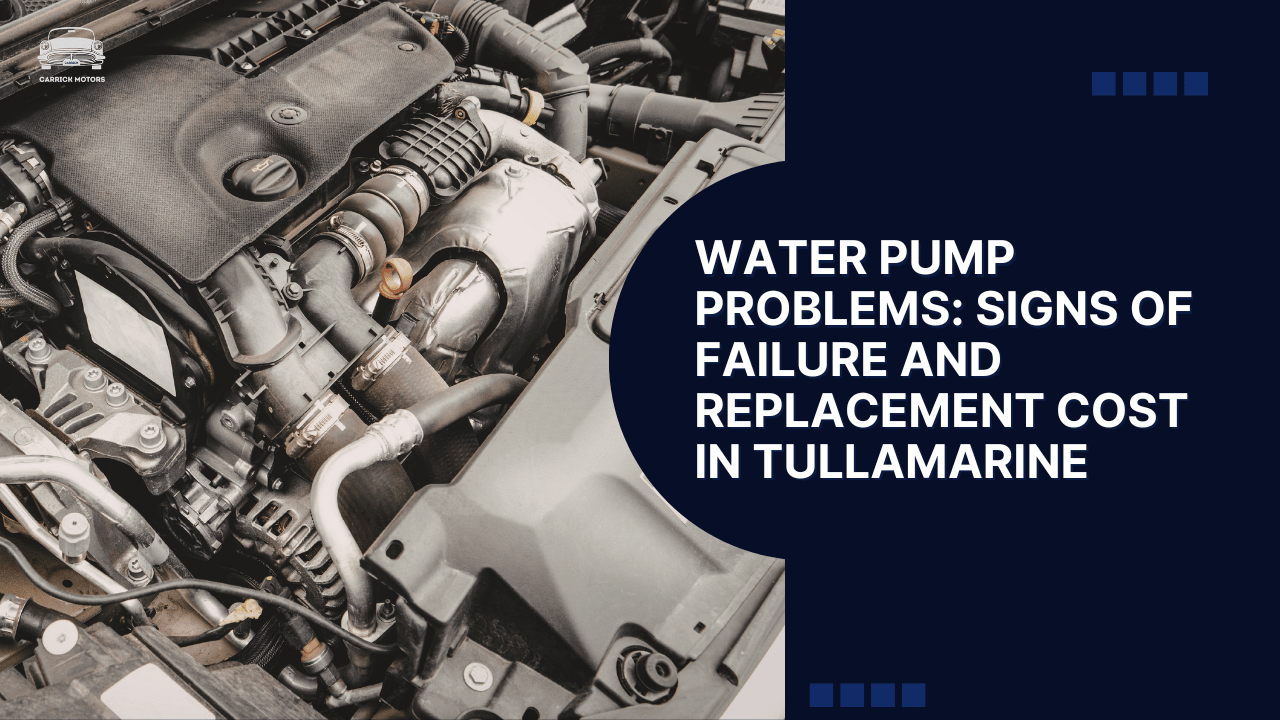
Water pump replacement in Tullamarine costs $400 to $900 for most vehicles, rising to $700 to $1,300 for European models and timing belt-driven pumps. Combined with a timing belt service the job runs $800 to $1,800, which is the smarter option when the pump sits behind the belt. Most water pumps last 100,000 to 200,000 kilometres. The pump moves coolant through the engine and off to the radiator, and when it fails the engine overheats within minutes. That overheating warps heads, blows gaskets, and can seize the engine entirely. Carrick Motors on Carrick Drive diagnoses and replaces water pumps for drivers across Tullamarine, Airport West, and Gladstone Park. This guide covers how the pump works, the warning signs, what causes failure, and what replacement costs.
How Your Water Pump Works
The water pump keeps coolant moving so the engine never overheats. Driven by a belt off the engine, its impeller spins and pushes coolant from the radiator through the block and cylinder head, then back to the radiator to shed the heat. That loop runs constantly, moving thousands of litres an hour, and it speeds up as the engine works harder.
A few parts make up the pump. The impeller does the pumping. The bearing carries the spinning shaft, the seal keeps coolant from escaping past that shaft, and the housing bolts the whole assembly to the engine. The seal is the part that usually goes first, because coolant additives and heat wear it down over time.
How the pump is driven decides how hard it is to replace. A serpentine belt pump sits on the outside of the engine, easy to reach and cheaper to swap. A timing belt pump hides behind the timing covers and comes out only when the belt does, which is why the two jobs are paired. A timing chain pump is rarer and buried deep, lasting long but costing more in labour when it does fail.
Signs Your Water Pump Is Failing
Failure gives warning before it turns catastrophic, so knowing the signs saves an engine. Watch for these:
- Coolant leak at the front of the engine. A green, orange, or pink puddle under the front points to the pump. Many pumps have a weep hole that drips first as the seal starts to go.
- Engine overheating. The temperature gauge climbs past normal or the warning light comes on. A pump that has stopped circulating coolant lets heat build fast.
- Whining or grinding noise. A worn bearing lets the shaft wobble, and the noise rises with engine speed until the bearing seizes.
- Steam from the radiator. Coolant hitting a hot engine gives off steam and a sweet smell. Never open the radiator cap while hot.
- Fluctuating temperature gauge. The needle drifts up and down when the pump works only intermittently or air has entered the system.
- Rust or crust around the pump. Dried coolant deposits show slow seepage that has been going a while.
Any leak or noise from the pump needs attention straight away. Overheating in particular is not something to drive through, because the damage that follows dwarfs the cost of the pump. If the gauge climbs, stop and let the engine cool before going further. Ignoring it risks a full car engine replacement at $5,000 to $15,000.
What Causes Water Pump Failure
Most failures trace back to seal or bearing wear, and both are made worse by neglect. Understanding the cause helps you avoid a repeat.
Seal wear is the top cause. The seal that stops coolant escaping past the shaft breaks down under heat and chemical exposure, and old or wrong-spec coolant speeds that up. Once the seal goes, coolant weeps and the pump is on its way out.
Bearing failure comes next. The bearing carries the shaft, and normal wear, contaminated coolant, or an overtight belt loads it until it fails. A worn bearing announces itself with noise before it seizes. Impeller damage is another path: plastic impellers can crack or spin loose on the shaft, and metal ones corrode, both cutting the pump’s flow.
Two habits cause a lot of avoidable failures. Contaminated coolant, from mixing types or using tap water, attacks seals and bearings and clogs passages. Incorrect belt tension does its own damage, an overtight belt overloading the bearing while a loose one lets the pump slip and the engine run hot. Regular servicing catches both before they end the pump.
Water Pump Replacement Cost in Tullamarine
Cost tracks the vehicle and how the pump is driven. The pump part itself is $150 to $600, and labour carries the rest depending on how buried the pump is.
Small cars like a Yaris or Mazda 2 run $350 to $700 all in. Medium cars such as a Corolla or i30 sit at $430 to $800. Larger sedans and SUVs like a Camry or RAV4 land at $500 to $1,000. European vehicles from BMW, Audi, Volkswagen, or Mercedes reach $700 to $1,300, because the parts cost more and the pumps are harder to reach.
These figures line up with the wider market. National estimators such as RepairPal put a typical water pump job in a similar band once labour is counted. On top of the pump, budget for coolant at $50 to $100, a thermostat at $100 to $250 if it is replaced at the same time, and hoses at $50 to $200 if they have perished. Doing the related parts together while the system is open avoids paying the same labour twice.
Water Pump and Timing Belt
On many engines the pump lives behind the timing belt, which changes the whole cost equation. When the belt has to come off to reach the pump, the labour is the same whether you replace one part or both.
That is why the two are paired. A combined water pump and timing belt service runs $800 to $1,800, far less than paying for the belt removal twice. Both parts also last around the same distance, so if one is due the other usually is too. Skip the pump now and a later failure means paying that belt labour all over again.
There is a safety angle as well. A seized pump can snap the timing belt, and on an interference engine a broken belt lets the pistons hit the valves and wrecks the engine. Replacing the pump with the belt removes that risk. If you are replacing a timing belt, replace the pump. If you are replacing a timing belt-driven pump, replace the belt.
Preventing Water Pump Problems
Most pump failures come down to coolant neglect, so prevention is mostly about the coolant. Keep it fresh and correct and the pump lasts far longer.
Coolant care does the heavy lifting. Change the coolant at the interval in your handbook, use the exact type your vehicle needs, and mix it 50/50 with distilled water rather than tap water. Fresh coolant protects the seal and bearing, while old or wrong coolant eats them. A scheduled engine oil and filter service is a good time to have the coolant and pump checked together.
Belt tension and monitoring finish the job. Correct belt tension, set during regular servicing, stops the bearing being overloaded or the pump slipping. Watch the temperature gauge and never drive through overheating. A regular mechanical service that includes a pump inspection catches early seepage before it becomes a breakdown.
How to Book Your Water Pump Service
Booking with Carrick Motors takes one call. Ring +61 3 9330 1082 or message the workshop on WhatsApp, and we pressure-test the cooling system to confirm the pump is the fault before quoting. We service all makes and models, fit quality pumps with a warranty, and offer free pick-up and drop-off within 10 km of Tullamarine. If your pump is timing belt-driven, we can do both together and save you the double labour.
Frequently Asked Questions
How do I know if my water pump is bad?
A bad water pump shows coolant leaking from the front of the engine, overheating, a whining or grinding noise, and rust or deposits around the pump. A coolant puddle under the front of the car is the clearest sign. A mechanic confirms it with a pressure test and by checking the pump bearing for play, since a thermostat or hose can cause similar symptoms.
Can I drive with a bad water pump?
No, not safely. A failing pump leads to overheating that can destroy the engine within minutes. If you spot minor seepage you may reach a workshop while watching the temperature closely, but if the gauge is rising or the pump is noisy, have the car towed. The repair bill for a seized engine is many times the price of a pump.
How long do water pumps last?
Water pumps last 100,000 to 200,000 kilometres depending on coolant maintenance, belt tension, and driving conditions. Timing belt-driven pumps are usually replaced at the belt interval of 80,000 to 120,000 km, whether or not they have failed, because the labour is shared. Fresh coolant at the right intervals adds a lot of life.
Should I replace the water pump with the timing belt?
Yes, if the pump is timing belt-driven. The labour to reach it is identical to the belt job you are already paying for. Replace only the belt and a later pump failure means paying that labour twice, plus the risk that a seized pump snaps the new belt. Doing both together costs only the extra pump part.
How much does water pump replacement cost in Tullamarine?
Water pump replacement costs $400 to $900 for most vehicles in Tullamarine, or $700 to $1,300 for European models. Combined with a timing belt service it runs $800 to $1,800, which is recommended when the pump sits behind the belt. The pump part is $150 to $600, and labour makes up the rest depending on access.
What does a failing water pump sound like?
A failing water pump makes a whining, grinding, or growling noise from the front of the engine that rises with engine speed. The sound comes from a worn bearing letting the shaft wobble. Left alone the bearing seizes, which can cause sudden overheating or snap the timing belt if the pump is belt-driven.
Why is my car overheating if the water pump seems fine?
Overheating with a working pump usually points to a stuck thermostat, a blocked radiator, a coolant leak elsewhere, a failed radiator fan, or air trapped in the system. Every cooling part has to work together. A pressure test and diagnosis identify the real cause before any part is replaced, which avoids paying for the wrong repair.
Can a water pump cause the temperature gauge to fluctuate?
Yes. A pump working only part of the time, or air drawn in through a failing seal, makes the temperature gauge drift up and down instead of holding steady. It is an early warning rather than a full failure, so book an inspection while the fault is small. Catching it here is far cheaper than waiting for the pump to seize.
Do you use OEM or aftermarket water pumps?
Both, depending on what you prefer. We fit OEM pumps where you want factory parts and quality aftermarket brands such as Aisin or Gates where value matters more. Every pump we install carries a warranty on parts and labour, and we tell you which brand is going in before the work starts. Sticking to known brands avoids the repeat labour that cheap pumps often cause.
Is it worth repairing a water pump instead of replacing it?
No, replacing is the better choice almost every time. A water pump is a sealed unit, and once the seal, bearing, or impeller wears there is no reliable way to rebuild it in place. Fitting a new pump costs little more than the labour to remove the old one, and it comes with a warranty. A patched pump tends to fail again within months.
Water pump failure causes overheating that can destroy an engine in minutes, while replacement costs $400 to $900 and prevents the whole scenario. Don’t drive through a coolant leak or a rising temperature gauge. Call Carrick Motors on +61 3 9330 1082 to book your water pump replacement in Tullamarine today.