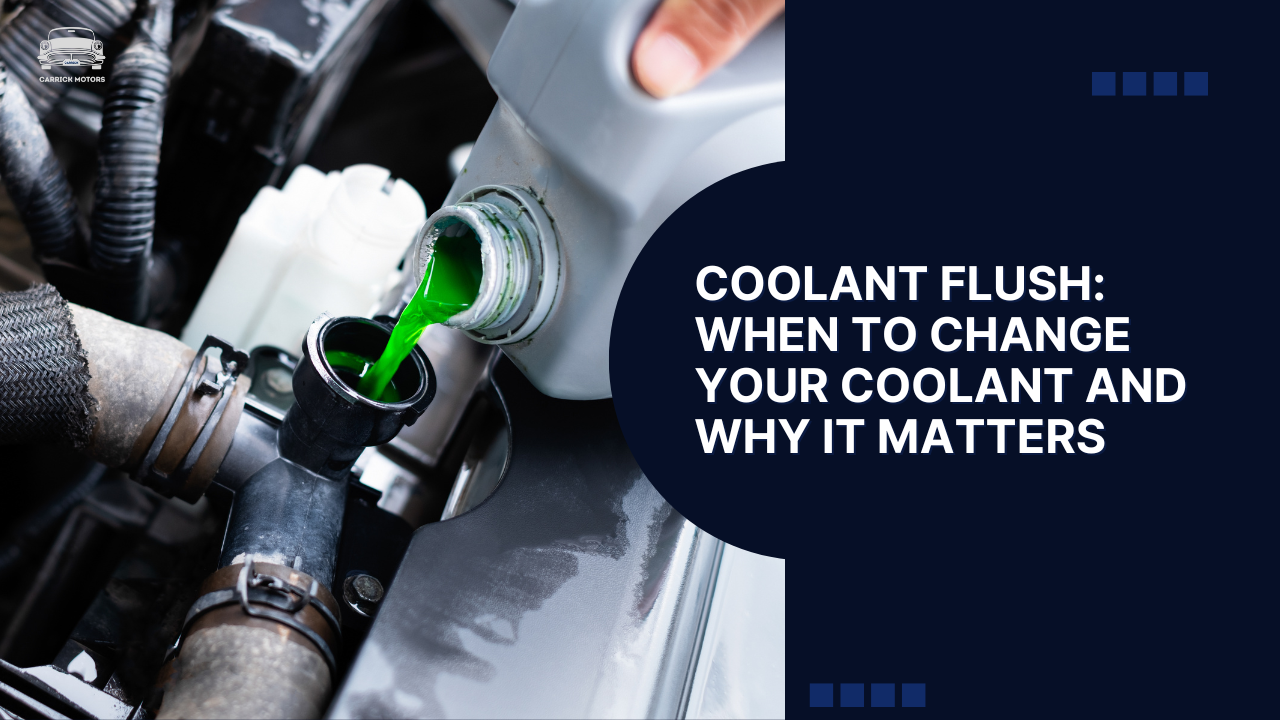
A coolant flush in Tullamarine costs $100 to $200 for most vehicles, with some European models up to $250. Manufacturers call for coolant replacement every 40,000 to 100,000 kilometres or 2 to 5 years, depending on the coolant type. Coolant absorbs the enormous heat combustion makes and carries it to the radiator, and over time it degrades and loses the properties that protect your engine. Skipping this cheap service invites overheating, corrosion, and repairs that run into the thousands. Carrick Motors on Carrick Drive services cooling systems for drivers across Tullamarine, Airport West, and Gladstone Park. This guide explains what coolant does, the types, replacement timing, warning signs, and costs.
What Coolant Does
Coolant, also called antifreeze, does five jobs at once, which is why letting it degrade causes so much trouble.
Its main task is heat transfer. It absorbs heat from the cylinder walls, head, and combustion chambers and carries it to the radiator, where airflow sheds it to the air. An engine turns only about a quarter of its fuel energy into motion, and most of the rest becomes heat the cooling system has to remove, a load equivalent to several household heaters running non-stop. Without that transfer the engine overheats, warping the head, blowing the gasket, and risking total failure.
The other four jobs matter just as much. Coolant lowers the freezing point, so the water in the system doesn’t freeze and crack the block on Tullamarine’s coldest winter nights, with a standard 50/50 mix protecting to around -37°C. It raises the boiling point, which combined with system pressure stops boil-over as temperatures reach 90 to 105°C in summer traffic. It carries corrosion inhibitors that coat the mix of aluminium, iron, copper, and steel inside the engine and stop galvanic corrosion, though those inhibitors deplete over time, which is the core reason coolant needs changing. And it lubricates the water pump seals and bearings and keeps the rubber seals supple, extending pump life and preventing leaks.
Types of Coolant
The coolant type sets how long it lasts and which engines it suits, and using the wrong one causes real damage.
IAT (inorganic acid technology) is the traditional bright-green coolant, using silicates and phosphates for protection. It needs changing every 2 years or 40,000 km, the shortest life of any type, and suits older cars built before about 2000. OAT (organic acid technology) is an extended-life coolant using organic acids instead, lasting 5 years or 150,000-plus km. It comes in orange, red, or pink and is specified by many GM, Volkswagen, and European vehicles.
HOAT (hybrid organic acid technology) blends organic acids with some silicates, balancing long life with strong protection, and also lasts around 5 years or 150,000 km. It shows up in various colours, yellow, turquoise, pink, blue, on many Toyota, Honda, and Hyundai models, and colour alone won’t identify it. Above all, the coolant must match the manufacturer’s spec, since a formula made for aluminium engines differs from one for cast iron, and the wrong coolant may not protect your metals or can gel when mixed and block the passages. The reservoir cap or owner’s manual states the correct type, and log-book servicing selects it automatically.
When to Replace Coolant
Replacement timing follows the coolant type and the manufacturer’s schedule. As a guide, traditional IAT goes every 2 years or 40,000 km, and extended-life OAT and HOAT every 5 years or 150,000 km. Some makers list a “lifetime” fill, but even that needs periodic testing rather than being left forever. Your owner’s manual holds the exact interval, and log-book servicing tracks the history.
Time matters as much as distance. Coolant breaks down through oxidation and chemical reaction regardless of how far you drive, so a low-kilometre car still needs replacement on the time schedule. Beyond the interval, condition can call for an earlier change: coolant that has turned rusty or discoloured, that fails a protection test, or that shows visible contamination should be replaced whatever the odometer says. A refractometer or test strip measures the freeze point and pH to give an accurate read. Coolant should also be replaced after any repair that drained a lot of it, such as a head gasket, radiator, or water pump job, to clear any contamination and restore full protection.
Signs Your Coolant Needs Attention
Cooling problems warn you before they wreck the engine, so catching the signs early is what keeps a $150 service from becoming a $3,000 repair. Watch for these:
- Temperature gauge changes. The gauge reads higher than normal, fluctuates oddly, or an overheating warning lights up. This can mean low coolant from a leak or degraded coolant that no longer transfers heat well.
- Discoloured coolant. Healthy coolant is bright and clear. Rusty brown means internal corrosion, a milky look means oil contamination, and floating particles or a muddy appearance all signal it needs attention.
- A sweet smell. Coolant has a distinctive sweet odour, so smelling it inside the car points to a heater core leak, in the engine bay to various leaks, and under the car after parking to a leak somewhere in the system.
- Low coolant level. The reservoir keeps dropping below the minimum. Coolant doesn’t evaporate in normal use, so a falling level means a leak that needs investigating rather than just topping up.
- Visible leaks. Green, orange, or pink puddles under the car, staining around the radiator, hoses, or water pump, or white dried-coolant residue all point to where the system is losing fluid.
Any overheating, a colour change, or a leak is worth acting on promptly, because low coolant and degraded coolant both lead to the overheating that damages engines. Cooling system work sits within our all cars mechanical repairs service, where the fault is confirmed before quoting.
Coolant Flush vs Drain and Fill
Two service methods exist, and the right one depends on the system’s condition. A drain and fill opens the radiator drain, removes the coolant it can reach, and refills with fresh, leaving some old coolant in the block and heater core. It only exchanges 40 to 60 percent of the total, so a little old coolant mixes with the new, but at $80 to $150 it’s the cheaper option and it’s fine for a well-maintained system changed on schedule.
A complete flush uses a machine to push new coolant through the whole system as the old is forced out, exchanging 90 to 95 percent and clearing accumulated contaminants. At $120 to $200 it costs more but restores maximum protection, and it’s the right choice for overdue or contaminated coolant, or when switching coolant types. For a heavily fouled system with scale or deposits, a chemical flush adds a cleaner that dissolves the buildup before the fresh fill, adding $30 to $50. Matching the method to the system’s state is part of getting the service right, and it’s checked as standard during a car service.
Coolant Flush Cost in Tullamarine
Cost tracks the method, the coolant, and the engine. A basic drain and fill runs $80 to $150, including the correct coolant and system bleeding. A complete machine flush is $120 to $200, exchanging the full volume. A flush with a chemical clean for a contaminated system is $150 to $250.
Three things move the price. The coolant type matters, since standard coolants cost less than manufacturer-specific or premium European ones. The volume matters, as larger V6, V8, and SUV engines hold more coolant than a four-cylinder. And system complexity matters, because some vehicles need specific bleeding procedures to clear air pockets, which takes extra time. The value case is stark against what neglect costs: a coolant service is $100 to $200, while a radiator from corrosion is $400 to $900, a water pump $300 to $700, a head gasket from overheating $1,500 to $3,500, and an engine replacement $5,000 to $12,000. Regular coolant maintenance is among the cheapest insurance on a car.
DIY or Professional?
A basic drain and fill is within reach for a confident home mechanic, since drain plugs are accessible on most cars and the coolant itself is only $20 to $50. But the pitfalls are real. Selecting the correct coolant is critical, and the wrong type damages the engine. A DIY drain only clears part of the system, leaving old coolant behind, and block drains are often seized or hard to reach. Many vehicles need a specific bleeding procedure, sometimes with a scan tool, to clear air pockets that otherwise cause overheating. And used coolant is toxic to animals and the environment, so it needs proper disposal, not the drain.
Professional service makes sense where the system needs a full flush, where the correct coolant is uncertain, where contamination calls for chemical cleaning, or simply where time and disposal are a hassle. A workshop matches the exact coolant to your vehicle, exchanges the full volume, bleeds the system properly, and disposes of the old coolant correctly, which removes the main risks of the DIY route.
Preventing Cooling System Problems
Most cooling failures trace back to neglected coolant, so prevention is mostly routine attention. Check the coolant level monthly, confirming it sits between the min and max marks, and investigate any consistent drop rather than just topping up, since a stable level is the sign of a healthy system. Note the colour and clarity while you’re there, and glance over the hoses for soft spots, cracks, or swelling, replacing any that have perished before they fail.
Keep the concentration right, since too much water weakens protection and pre-mixed coolant removes the guesswork of getting a 50/50 ratio. Address leaks the moment you notice them, because a small seep becomes a big leak and the low coolant that follows causes overheating damage. And keep to the replacement interval rather than trusting “lifetime” coolant to look after itself. Bundling these checks into a regular engine oil and filter service keeps the whole cooling system on the workshop’s radar.
Coolant and Head Gasket Failures
Contaminated coolant can be the first sign of a serious engine problem, which is why a colour change is never ignored. The tell-tale signs of a head gasket fault are a milky look on the oil cap or dipstick, meaning coolant has entered the oil, an oily film or brown contamination in the coolant reservoir, meaning oil has entered the coolant, bubbling in the reservoir with the engine running, meaning combustion gases are leaking into the system, and white exhaust smoke with a sweet smell, meaning coolant is being burnt.
Confirming it is straightforward. A block test detects combustion gases in the coolant with a colour-change chemical, a pressure test shows whether the system holds pressure or leaks, and a compression test reveals a cylinder losing pressure past the gasket. The repair is significant, a head gasket replacement runs $1,500 to $3,500 and needs the cylinder head removed, often with machining if it has warped. The reassuring part is that proper coolant maintenance, by preventing the overheating that destroys gaskets in the first place, avoids many of these failures entirely.
How to Book Your Coolant Service
Booking with Carrick Motors takes one call. Ring +61 3 9330 1082 or message the workshop on WhatsApp. We select the correct coolant for your specific vehicle, carry out a drain and fill or a complete flush as the system needs, bleed it properly to clear air pockets, inspect for leaks, and dispose of the old coolant correctly. We service all makes and models and offer free pick-up and drop-off within 10 km of Tullamarine, protecting your engine through maintenance that costs a fraction of the failures it prevents.
Frequently Asked Questions
How often should I change my coolant?
It depends on the coolant type. Traditional green IAT coolant needs replacing every 2 years or 40,000 kilometres, while extended-life OAT and HOAT coolants last 5 years or 150,000-plus kilometres. Check your owner’s manual for the exact figure. Time-based replacement applies even to low-kilometre cars, since coolant degrades chemically with age regardless of how far you drive.
Can I mix different coolant types?
No, mixing types is not recommended. Different formulations can be incompatible and form gel-like deposits that block the cooling passages. If you must top up and don’t know the type, use distilled water temporarily and have the system flushed and filled with the correct coolant soon after. Never mix by colour assuming compatibility, since colour doesn’t reliably indicate the type.
Why is my coolant brown or rusty?
Brown or rusty coolant means corrosion inside the cooling system. The corrosion inhibitors have depleted, letting the internal metal surfaces oxidise, which cuts cooling efficiency and can damage components. A flush with chemical cleaning followed by fresh coolant is the fix, and the underlying cause, usually an overdue service, should be corrected so it doesn’t recur.
Is it OK to use water instead of coolant?
Only in an emergency to reach a workshop. Water has no freeze protection, no boil-over protection, and no corrosion inhibitors, so even in a mild climate it lets the internal corrosion that damages components run unchecked. After any emergency water top-up, have the system drained and refilled with the correct coolant promptly.
What colour should my coolant be?
It depends on the type: green for traditional IAT, orange for many GM OAT coolants, pink or red for various OAT formulas, and blue, yellow, or turquoise for HOAT types. The key point isn’t the specific colour but that the coolant keeps its original colour and clarity without particles. A significant colour change signals degradation or contamination.
Can low coolant cause overheating?
Yes, low coolant is a leading cause of overheating. Too little coolant can’t absorb and move enough heat, and air pockets form where coolant is missing and block heat transfer from those areas. Even slightly low coolant creates local hot spots. Keep the level correct and investigate any consistent loss, since it points to a leak.
How do I know if my coolant is still good?
Good coolant keeps its original colour and clarity with no particles or contamination. Professional testing measures the pH and freeze-point protection for an accurate read, and DIY test strips give a basic check. When the service history is uncertain or the interval has passed, replacing the coolant is the safe call and restores full protection.
What does a coolant flush include at Carrick Motors?
A coolant service includes selecting the correct coolant for your vehicle, draining or machine-flushing the old coolant, refilling and bleeding the system to clear air pockets, and a leak and cooling-system inspection. Used coolant is disposed of properly, since it’s toxic. We advise whether a drain and fill or a full flush suits your system’s condition before starting.
Coolant protects your engine from overheating, freezing, and internal corrosion, and neglecting it invites failures costing thousands, while a flush runs just $100 to $200. Don’t ignore a rising temperature gauge, discoloured coolant, or a sweet smell. Call Carrick Motors on +61 3 9330 1082 to book your coolant flush in Tullamarine today.