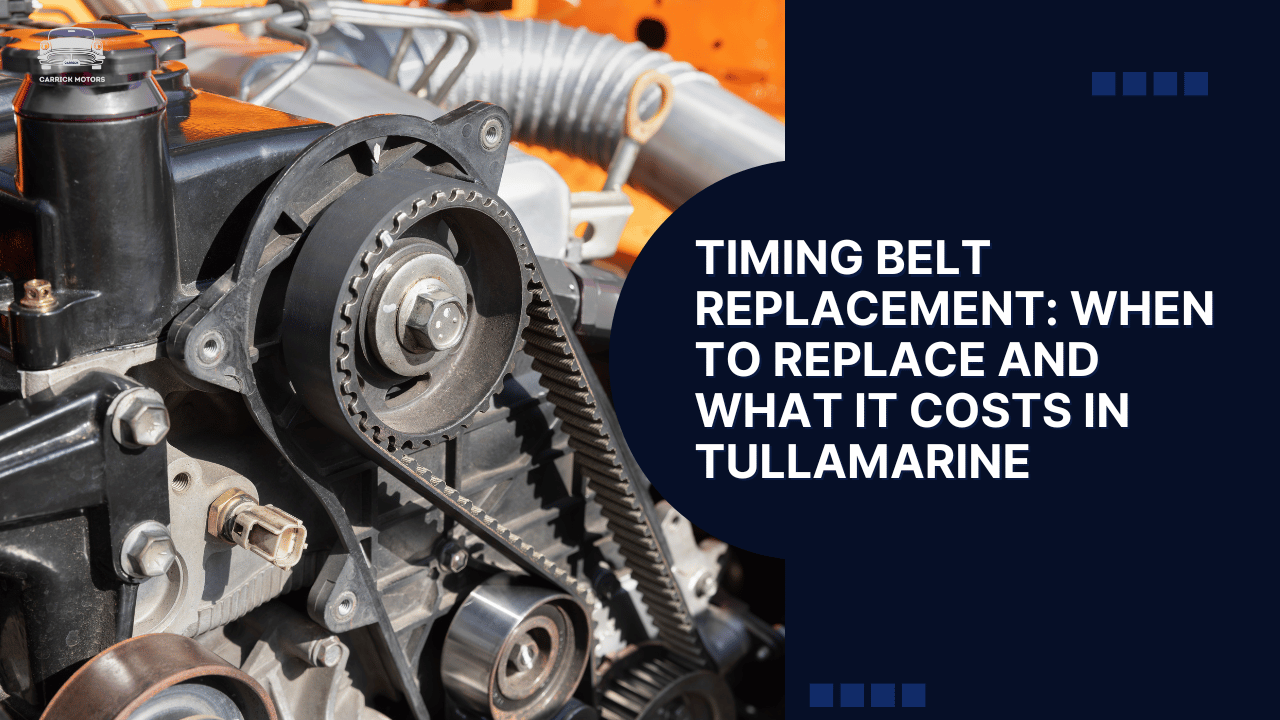
Timing belt replacement in Tullamarine costs $500 to $1,200 for most four-cylinder vehicles, and $800 to $2,000 for V6 and European models. The belt needs replacing every 60,000 to 100,000 kilometres or 5 to 7 years, whichever comes first, and ignoring that interval risks engine damage costing $3,000 to $8,000 or more. The timing belt keeps the crankshaft and camshaft turning in sync so the valves open and close at the exact right moment. When it fails the engine stops instantly and, on most modern engines, wrecks itself in the process. Carrick Motors on Carrick Drive handles timing belt replacement for drivers across Tullamarine, Airport West, and Gladstone Park. This guide focuses on the schedule, the warning signs, and the costs, so you replace the belt before it fails rather than after.
What the Timing Belt Does
The timing belt coordinates the two shafts that make the engine run. The crankshaft turns the pistons’ up-and-down motion into rotation, and the camshaft opens and closes the valves that let air-fuel in and exhaust out. These have to move in perfect step, and the belt is what keeps them there. It wraps around toothed sprockets on both shafts, its teeth locking into the sprocket teeth so nothing slips, and it holds the timing to a fraction of a degree. Any slip or break destroys that synchronisation instantly.
Whether that matters catastrophically depends on your engine design. Most engines built since 2000 are interference designs, where the valve and piston paths overlap and correct timing is the only thing keeping them apart. When the belt fails on an interference engine, the pistons strike open valves, bending valves, damaging pistons, and sometimes cracking the cylinder head. Non-interference engines leave clearance between the two, so a belt failure just stops the engine without internal harm, but these are increasingly rare. Assume yours is an interference engine unless a mechanic confirms otherwise, because the cost of guessing wrong runs into thousands.
The Timing Belt Replacement Schedule
Replacement is based on the schedule, not on how the belt looks, because the belt is sealed inside covers and can’t be inspected during a normal service. Most manufacturers specify 60,000 to 100,000 kilometres or 5 to 7 years, with some high-performance and European engines calling for replacement as early as 40,000 to 60,000 km. The figures vary by brand: Toyota generally lists 100,000 km or 7 years, Honda 100,000 to 160,000 km depending on the model, Hyundai and Kia 60,000 to 100,000 km, Subaru 100,000 to 160,000 km, and Volkswagen and Audi 60,000 to 120,000 km. Your owner’s manual holds the exact figure for your engine, and log-book servicing tracks the history.
Two points make this schedule non-negotiable. First, time counts as much as distance, since rubber hardens and cracks with age regardless of mileage, so a ten-year-old car with only 40,000 km still needs a fresh belt. Second, timing belt replacement is preventive maintenance in the truest sense: you replace the belt *before* it shows any problem, not after, because by the time a symptom appears the belt is usually about to fail. Treat the interval as a hard deadline, not a rough suggestion. If you’re unsure where your car sits, our team can confirm it during a routine car service.
Why You Can’t Wait for Warning Signs
Unlike a squealing accessory belt, a timing belt usually gives no warning before it lets go, which is exactly why the schedule matters more than symptoms. That said, a few signs occasionally appear, and any of them means immediate inspection.
The clearest is an engine that cranks but won’t start, which points to a belt that has already snapped. If the starter spins the engine faster and lighter than normal, with no attempt to fire, stop cranking, since continued cranking on a failed belt in an interference engine adds to the damage, and arrange for the car to be brought in. Short of total failure, a worn belt can skip a tooth on the sprocket and momentarily lose timing, causing misfires, rough running, hesitation, or a check engine light. A belt that has jumped even one tooth is minutes from failure, so treat this as urgent.
Two other signs are worth watching. A rhythmic ticking from the front of the engine can mean a worn belt, a failing tensioner, or loose timing cover parts, and while not every tick is the belt, it’s worth confirming. And oil seeping from around the timing cover, from a leaking cam or crank seal, rots the rubber from the outside and shortens the belt’s life, so a leak near the timing area should be addressed and the belt inspected. The most reliable warning of all, though, is simply the odometer and the calendar reaching the interval.
What’s Included in Timing Belt Replacement
A proper service replaces more than the belt, because several parts share its workload and its lifespan. The belt itself goes in with the correct tension and the timing marks aligned precisely, and quality matters here: genuine or reputable aftermarket belts from Gates, Continental, or Dayco meet the specification, while unknown budget belts are a false economy given what failure costs.
The tensioner and idler pulleys are replaced at the same time as standard. The tensioner holds the belt tight, and a worn one will wreck a brand-new belt, while the idler pulleys guide the belt and their bearings are the same age as everything else. Replacing them with the belt costs little extra labour, whereas doing them separately means repeating the whole job. The water pump is the other key addition, since on many engines it sits behind the timing covers and is driven by the belt. Reaching it takes the same labour as the belt itself, so adding a pump costs $100 to $200 in parts now versus $400 to $700 in labour later. The front crankshaft seal, camshaft seals, and timing cover gaskets are usually renewed too, stopping oil leaks onto the fresh belt. Doing it all together is simply the economical way to reach the next interval with no surprises.
Timing Belt Replacement Cost in Tullamarine
Price tracks the vehicle and how buried the belt is. Small four-cylinders like a Corolla, Mazda 3, or i30 run $400 to $700 for the belt kit, or $500 to $900 with the water pump. Medium four-cylinders such as a Camry, Accord, or Impreza sit at $500 to $900 on the kit and $600 to $1,100 with the pump. V6 vehicles like a Kluger, Commodore, or Odyssey run $700 to $1,200 on the kit and $900 to $1,500 with the pump. European four-cylinders from Volkswagen, Audi, or BMW reach $700 to $1,200 and $900 to $1,600, and European V6 and V8 engines $1,000 to $1,800 on the kit alone, $1,200 to $2,200 with the pump.
The parts are the cheap part, at $150 to $400 for a belt kit. Labour carries the cost, from 2 to 8-plus hours depending on the engine, because reaching the belt means stripping back a good deal of the front of the engine. Access is the biggest single factor, followed by the number of camshafts, since a dual-cam or V-configuration engine has more sprockets to align than a single-cam unit. Set against the alternatives, the case for replacement is stark: a timing belt job costs $500 to $1,500, engine damage from a snapped belt runs $3,000 to $8,000, and a full engine replacement $5,000 to $12,000. Prevention is a fraction of the cost of failure. These figures line up with the wider market once labour is counted.
Timing Belt vs Timing Chain
Not every engine uses a belt, and knowing which you have decides whether this schedule even applies to you. A timing chain is a metal chain, much like a bicycle chain, that runs in engine oil and is often designed to last the life of the engine, though some need replacing at 200,000 to 300,000 km. Chains tend to fail more gradually than belts, usually giving a rattle first, but they cost more to replace when they do, typically $1,000 to $3,000, because of the deeper disassembly involved.
Which one you have depends on the engine. Many modern vehicles have moved to chains, including most current Toyota and Mazda models and many BMW and Mercedes engines, while plenty of four-cylinders still use belts. Your owner’s manual settles it: a listed timing belt replacement interval means a belt, and no such entry usually points to a chain. If a chain is showing its age with a startup rattle, timing fault codes, or oil-pressure issues affecting the tensioner, that’s a job for our all cars mechanical repairs team rather than a routine belt service.
Choosing a Workshop
Timing belt work demands precision, since a small alignment error can damage the engine, so the workshop matters. Look for technicians experienced with your specific engine and its timing procedure, the proper camshaft and crankshaft locking tools for accurate alignment, and quality parts rather than budget kits on a job where failure is catastrophic. It’s fair to ask a few questions before booking: which brand of parts they use, whether the water pump is included, what warranty covers the work, and how long the job will take.
A few red flags are worth heeding too. A quote far below the market can signal budget parts or an inexperienced technician, reluctance to name the parts brand is a concern on a critical job, and no warranty offered points to a lack of confidence in the work. After the service, keep a record of the date and mileage and note the next interval, since replacement resets the clock and the next change is due at the standard interval from now, not an extended one. For related upkeep, it’s worth reading our guide on car service costs in Tullamarine to plan the rest of your maintenance around it.
How to Book Your Timing Belt Service
Booking with Carrick Motors takes one call. Ring +61 3 9330 1082 or message the workshop on WhatsApp, and we confirm whether your engine runs a belt or a chain before quoting. We service all makes and models, supply quality OEM or aftermarket kits with tensioners, idlers, and optional water pump, verify the timing properly on reassembly, and back the work with a warranty. We offer free pick-up and drop-off within 10 km of Tullamarine. If your belt is at or past its interval, don’t gamble on a few more kilometres, since the cost of waiting is measured in engines, not dollars.
Frequently Asked Questions
How do I know if my car has a timing belt or chain?
Check your owner’s manual maintenance schedule, which lists timing belt replacement if your car has a belt, usually as a major service item at a 60,000 to 100,000 km interval. No such entry typically means a timing chain. You can also ask your mechanic to confirm during a service, or look up your specific engine code online. Getting this right tells you whether the replacement schedule applies to you.
What happens if my timing belt breaks while driving?
On an interference engine, which is most modern cars, the belt breaking lets the pistons hit open valves, bending valves, damaging pistons, and sometimes cracking the cylinder head. The engine stops immediately and won’t restart. Repairs run $3,000 to $8,000 depending on the damage, and severe cases need a full engine replacement. Non-interference engines simply stop without internal harm, but they’re rare now.
How often should a timing belt be replaced?
A timing belt should be replaced every 60,000 to 100,000 kilometres or 5 to 7 years, whichever comes first, with some European and performance engines needing it as early as 40,000 to 60,000 km. Your owner’s manual holds the exact figure. Age matters as much as distance, so a low-kilometre car still needs replacement on the time interval, since the rubber degrades regardless of use.
Why can’t the mechanic just inspect the belt instead of replacing it?
The timing belt sits sealed inside protective covers, so it can’t be seen during a normal service without significant disassembly, and even then wear isn’t reliably visible until it’s severe. Belts also give little warning before failing. That’s why replacement is scheduled by interval rather than inspection, you change the belt preventively at the recommended point rather than waiting for a problem to show.
Should I replace the water pump with the timing belt?
Yes, in most cases. If the water pump is driven by the timing belt, the labour to reach it is identical to the belt job you’re already paying for. Adding the pump costs $100 to $200 in parts now, against $400 to $700 in labour if it fails later and the whole front of the engine has to come apart again. The exception is a water pump replaced very recently.
Why is timing belt replacement so expensive?
Labour is the reason. Reaching the belt means removing drive belts, pulleys, covers, and sometimes engine mounts, a job of 3 to 8 hours depending on the vehicle. The belt kit itself is only $150 to $400. Replacing the tensioner, idlers, water pump, and seals at the same time adds parts cost but saves repeating that big labour charge later, so bundling is the economical choice.
Is timing belt replacement worth it on an older car?
Usually yes, if the car is otherwise sound. Weigh the $500 to $1,500 replacement against the car’s value and remaining life. A $6,000 car in good mechanical condition clearly warrants the investment, while a car with several other major faults may not. Think in terms of total ownership cost rather than this single repair, since a snapped belt can end the car entirely.
How long does timing belt replacement take?
Timing belt replacement takes 3 to 8 hours depending on the vehicle. A simple four-cylinder with good access runs 3 to 4 hours, while a V6 or a European engine needing extensive disassembly takes 5 to 8. Most workshops finish within one day, with the more complex European vehicles occasionally needing longer.
Timing belt failure destroys engines in seconds and costs thousands to repair, while scheduled replacement costs $500 to $1,500 and prevents the whole scenario. Treat the 60,000 to 100,000 km or 5 to 7 year interval as a deadline, not a suggestion. Call Carrick Motors on +61 3 9330 1082 to book your timing belt replacement in Tullamarine today.