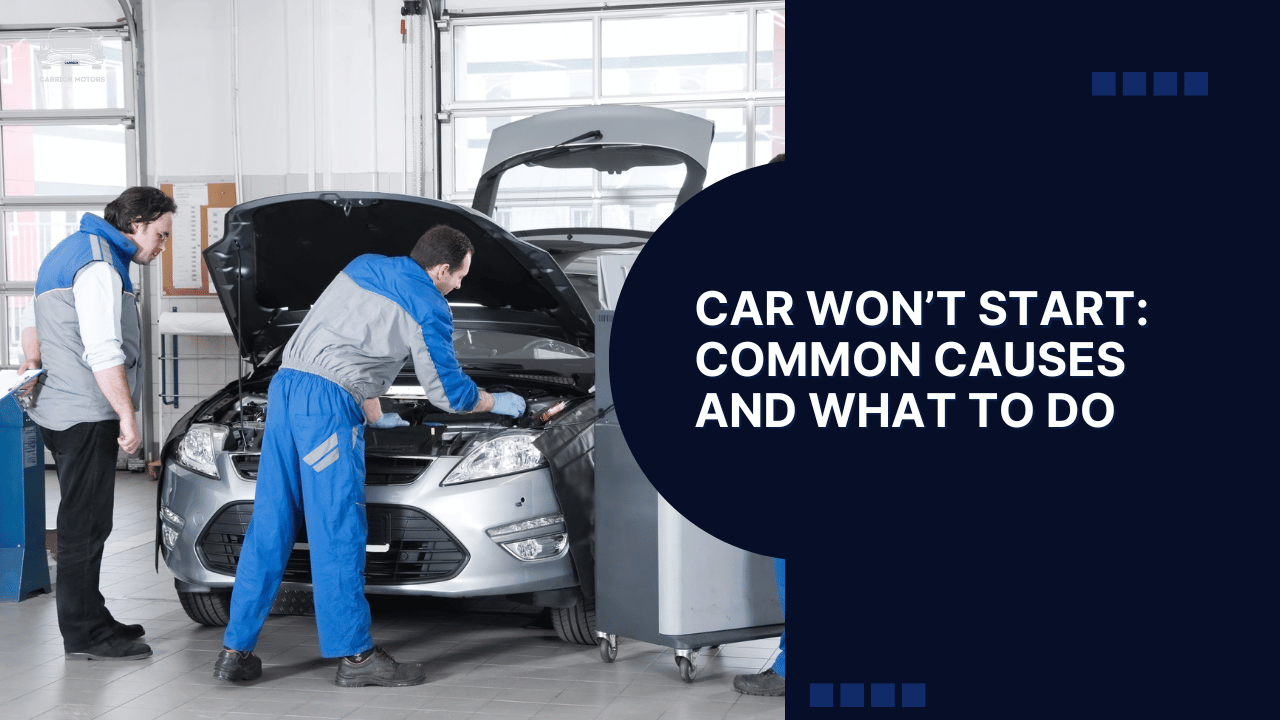
A car that won’t start in Tullamarine usually comes down to the battery, the starter motor, the fuel system, or the ignition, and diagnosis costs $80 to $150 before any repair. The sound the car makes when you turn the key, silence, clicking, cranking without firing, points straight at the cause. A dead battery is behind most no-starts, but the fix ranges from a $20 clean of a corroded terminal to a $900 fuel pump. Carrick Motors on Carrick Drive diagnoses and repairs starting problems for drivers across Tullamarine, Airport West, and Gladstone Park. This guide walks through reading the symptoms, the common causes, what to do at the roadside, and what repairs cost.
Diagnose by the Sound
What happens when you turn the key is the single most useful clue, so start there before assuming anything.
Complete silence, no lights, no sound, no response, usually means the battery is fully dead or the connection to it has failed. A completely flat battery can’t power anything, so the dashboard stays dark. Corroded terminals, white, blue, or green buildup, block the current even when the battery has charge, and loose cables do the same despite looking tight. Less often, a failed ignition switch or an activated immobiliser cuts the start signal while some electrics still work. The first check is whether the dashboard lights come on with the key in the “on” position: no lights points to the battery or its connections.
Clicking points to an electrical shortfall. Rapid clicking means a weak battery with just enough charge to trigger the starter solenoid but not to spin the motor, often with the dashboard lights dimming as you try. A single loud click usually means the starter motor itself has failed, the solenoid engages but the motor won’t turn. Cranking without firing, where the starter spins the engine normally but it never catches, moves the problem away from the battery to fuel, ignition, or timing. And an engine that starts then dies points to a fuel delivery fault, an idle-control problem, or an immobiliser allowing a brief start before cutting the fuel. Reading these patterns is what a technician does first, and it’s what turns a vague “it won’t start” into a targeted repair.
Battery Problems
The battery causes more no-starts than everything else combined, which is why it’s the first suspect. A battery goes flat from lights left on overnight, a parasitic drain from a faulty component, simple old age, extreme temperature, or an alternator that hasn’t been charging it. The warning signs usually show first: cranking that slows over weeks, headlights dim at idle, a battery light on the dash, or simply a battery over three or four years old.
Most batteries last three to five years, and replacing a weak one before it dies completely is far less hassle than a roadside failure. A jump-start gets you going temporarily, but if the battery has reached the end of its life rather than just discharged, it won’t hold the charge, which is why a battery test after any jump matters. Replacement runs $150 to $400 depending on the vehicle, more for AGM or European batteries. Getting the battery and charging system checked during a regular car service catches a weak battery before it strands you, and we cover the full picture in our car service cost guide.
Starter Motor Problems
When the battery is sound but the engine won’t turn, the starter is the usual culprit. Starters wear out from use: the carbon brushes lose contact, the solenoid contacts burn and pit, the bearings drag, and the Bendix gear stops engaging cleanly. Because they wear gradually, they tend to warn you first with intermittent starting, a grinding noise, a starter that keeps spinning after the engine fires, or a burning smell from the starter area.
The classic sign is a single loud click with no crank, the solenoid trying but the motor failing to turn. Repeatedly turning the key at that point risks chewing the flywheel teeth, which turns a starter job into a much bigger one, so it’s better to stop and get it diagnosed. Replacement runs $300 to $700 including labour, varying with how buried the starter is. Some starters can be rebuilt more cheaply, but a replacement with a warranty is usually the more reliable fix. Starter work falls under our all cars mechanical repairs service.
Fuel System Problems
If the engine cranks strongly but won’t fire, the fuel system is a prime suspect. The most common fault is a failing fuel pump, which wears with mileage and much faster if the car is habitually run near empty, since the fuel cools the pump and a low tank leaves it running hot. The tell-tale sign is no whine from the tank area when you turn the key to “on”, where a healthy pump primes for a second or two, along with long cranking before starting and trouble when the fuel is low.
Other fuel faults follow the same pattern. A clogged fuel filter restricts flow and can be the whole problem, or contaminated fuel with water or dirt stops clean combustion. And the simplest cause of all is an empty tank with an inaccurate gauge, worth ruling out first. A fuel pump replacement runs $400 to $900, and a fuel filter $100 to $200, which sometimes restores flow on its own if a blockage was the issue. Because several faults share the cranks-but-won’t-start symptom, a proper diagnosis confirms the pump with a pressure test rather than replacing it on a guess.
Ignition System Problems
The ignition has to deliver a spark at the right moment, and when it can’t, the engine cranks normally but won’t fire, sometimes catching briefly then dying. The common failures are a dead ignition coil, worn or fouled spark plugs, a failed crankshaft position sensor that stops signalling the timing, or an ignition module fault. A check engine light often accompanies these, and the stored code usually points to the system involved.
The fixes vary with the part. Spark plugs run $100 to $300 for a set, ignition coils $150 to $400 each, and sensors $200 to $500. Diagnosis identifies which component has actually failed, which matters because fitting a $400 coil that wasn’t the fault, then a $300 set of plugs that weren’t either, costs far more than paying once to find the real cause. If the engine cranks differently than usual, lighter or faster than normal, that can signal a timing belt or chain failure, and continued cranking risks serious engine damage on an interference engine, so stop and get it inspected.
The Alternator Connection
The alternator doesn’t stop the car starting directly, but it’s a sneaky cause of no-starts worth understanding. Its job is to recharge the battery while you drive, so when it fails the battery slowly discharges over a trip or two. The car runs fine on the existing charge until you switch off, and then the next start fails because the battery has been quietly drained rather than charged.
The clues are a battery warning light while driving, dimming headlights, electrical accessories behaving erratically, or a battery that keeps needing jump-starts despite being fairly new. This is exactly why a repeat no-start after a jump shouldn’t be blamed on the battery alone: if the alternator isn’t charging, a new battery will end up flat too. Testing separates the two, and alternator replacement runs $400 to $800, usually with the drive belt checked at the same time. Chasing the real cause here saves buying battery after battery.
What to Do at the Roadside
A calm, systematic check at the roadside often identifies the problem and tells you whether a jump-start will help. Start with the immediate assessment: turn the key to “on” and see if the dashboard lights come up normally, since no lights suggests a battery or connection fault. Listen to what happens on start, silence, clicking, cranking, or a brief catch, and match it to the patterns above. Glance at the fuel gauge, since a failed gauge can read full on an empty tank, and check the security light isn’t flashing, which would point to a key-recognition fault.
A jump-start helps with battery-related symptoms, dead or weak battery, rapid clicking, or slow cranking, but it won’t fix an engine that cranks fine but won’t fire, or a single-click starter failure. If you jump the car, connect the red cables to both positive terminals, the black cable to the good battery’s negative and then to an engine ground on the dead car, start the good vehicle, wait a few minutes, then try the dead one. Afterward, drive 20 to 30 minutes to recharge and have the battery tested, since needing a jump means something is wrong. If the jump fails, the car is in an unsafe spot, or you’d rather not diagnose it yourself, call for roadside assistance or arrange towing to a workshop. We accept towed vehicles for diagnosis, so you can nominate us as the destination.
Preventing Starting Problems
Most no-starts are preventable with a little routine attention, and the battery is where it starts. Have it tested during scheduled servicing, yearly once it’s over two years old, and replace a weak one proactively rather than waiting for it to die. Keep the terminals clean and tight, since corrosion is a common and easily avoided cause, and address any charging warning light promptly.
The fuel and ignition systems round it out. Keep the tank reasonably full so the fuel pump stays cool and doesn’t draw sediment from the bottom, use fuel from reputable stations, and replace the fuel filter at the recommended interval. Have the spark plugs and ignition components checked at service so a developing misfire is caught early. A comprehensive engine service that tests the battery, starter, charging system, and ignition together is the most reliable way to spot a starting problem before it leaves you stranded on a cold Tullamarine morning.
Starting Problem Repair Costs in Tullamarine
Diagnosis comes first at $80 to $150, and it’s usually credited toward the repair, because systematic testing to find the real cause is what prevents wasted spending. From there, the common repairs sort out clearly: a battery replacement $150 to $400, a starter motor $300 to $700, an alternator $400 to $800, a fuel pump $400 to $900, an ignition coil $150 to $400 each, a set of spark plugs $100 to $300, and key programming $200 to $500 if the immobiliser isn’t recognising the key.
The single biggest saving is accurate diagnosis. Guessing at a no-start and throwing parts at it, a battery, then a starter, then a pump, costs far more than paying once to identify the actual fault. It’s also worth addressing related items during the repair: replacing a starter is a good moment to test the battery, and replacing a battery is a good moment to check the alternator output, so you’re not back within weeks for the next link in the chain. These figures line up with the wider market once labour is counted.
How to Book Your Diagnosis
Booking with Carrick Motors takes one call. Ring +61 3 9330 1082 or message the workshop on WhatsApp, and we systematically test the battery, starter, charging system, fuel, and ignition to find the real cause before quoting. We service all makes and models, accept towed vehicles, use professional diagnostic equipment, and offer free pick-up and drop-off within 10 km of Tullamarine. If your car won’t start, don’t keep cranking it, since that can damage the starter or flywheel, so call and we’ll get you back on the road.
Frequently Asked Questions
Why does my car click but not start?
Clicking without starting points to an electrical shortfall, usually the battery. Rapid clicking means a weak battery with too little power to spin the starter, and a jump-start often helps temporarily. A single loud click usually means starter motor failure, where the solenoid engages but the motor won’t turn, and that needs the starter tested. Don’t keep turning the key on a single click, since it can damage the flywheel.
How do I know if it’s the battery or the starter?
The battery shows electrical symptoms, dim lights, slow cranking, or no response at all, while the starter shows normal electrics but no engine rotation, so the lights work and the solenoid clicks but the engine won’t turn. The quickest test is a jump-start: if it helps, the battery or charging system is the issue; if it doesn’t and the lights are normal, the starter is more likely. A proper test confirms it before any part is replaced.
Can a bad alternator stop my car starting?
Yes, indirectly. A failed alternator doesn’t recharge the battery while you drive, so the battery slowly drains and the car may run fine until you switch it off, then fail to start next time. The signs are a battery light while driving, dimming lights, and a battery that keeps going flat despite being newish. Testing separates the alternator from the battery, since replacing one when the other is at fault leaves you stranded again.
Why won’t my car start after sitting overnight?
Overnight no-starts usually mean a weak battery or a parasitic drain. A tired battery loses charge overnight, especially in the cold, and a faulty module, aftermarket accessory, or failing component can quietly drain a good battery while the car sits. An interior light left on does it obviously. If it keeps happening, have the battery tested and a parasitic-drain check done to find what’s pulling power with the car off.
Is it safe to keep trying to start my car?
No, repeated attempts can cause damage. Cranking on a single-click starter fault can chew the flywheel teeth, turning a $300 to $700 starter job into a much larger repair, and long cranking on a suspected timing fault risks serious engine damage on an interference engine. If the engine cranks differently than normal or won’t fire after a few proper attempts, stop and get it diagnosed rather than forcing it.
Can I drive after jump starting my car?
Yes, and you should, to recharge the battery. Drive 20 to 30 minutes continuously, ideally on the highway where the alternator charges hardest. But if the battery has failed rather than just discharged, it may not hold the charge, and if the alternator is the fault the car will drain again regardless. Have the battery tested after any jump-start to find out which it is.
How long do starter motors last?
Starter motors last 150,000 to 300,000 kilometres, with frequent short trips and their many start cycles wearing them faster than highway driving, and heat adding stress. They rarely fail without warning, usually giving slow cranking, grinding, or intermittent starting first. Acting on those early signs lets you replace the starter on your schedule rather than being stranded when it finally quits.
Why does my car start sometimes but not others?
Intermittent starting has several possible causes: loose or corroded battery connections that work sometimes, a starter engaging inconsistently, a worn ignition switch, an intermittent crankshaft position sensor, or a security system randomly not recognising the key. The pattern usually worsens over time, which actually makes diagnosis easier once the fault becomes consistent. Getting it tested while it’s still intermittent can save a roadside breakdown.
A car that won’t start comes down to the battery, starter, fuel, or ignition, and the sound it makes tells you where to look, but only proper diagnosis confirms it. Fixes range from a $20 terminal clean to a $900 fuel pump, and accurate diagnosis is what stops you paying for guessed parts. Call Carrick Motors on +61 3 9330 1082 to book your starting diagnosis in Tullamarine today.