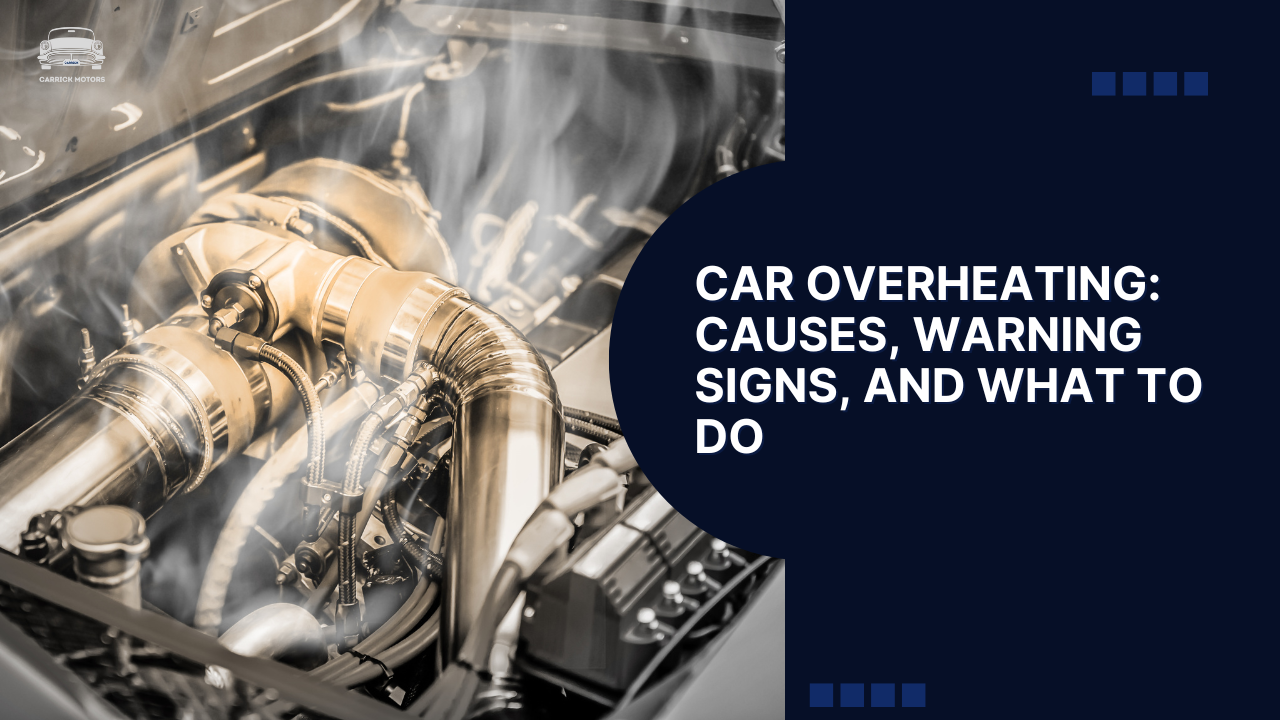
A car overheating almost always comes down to the cooling system, low coolant, a stuck thermostat, a failing water pump, a blocked radiator, a dead fan, or a head gasket fault, and how you respond decides whether it costs you a $200 repair or a $6,000 engine. When the temperature gauge climbs into the red or the warning light comes on, the right move is to pull over safely and switch off, because driving on an overheating engine causes damage that grows by the minute. Melbourne’s summer heat pushes cooling systems harder, so Tullamarine drivers see overheating most in the hot months. Carrick Motors on Carrick Drive diagnoses and repairs overheating for drivers across Tullamarine, Airport West, and Gladstone Park. This guide explains the warning signs, the causes, exactly what to do at the roadside, and how to prevent it.
Warning Signs Your Car Is Overheating
Spotting overheating early is what lets you act before the damage is done, and the signs build in a fairly predictable order.
The clearest is the temperature gauge climbing past its normal centre position toward the red, or an erratic needle that swings up and down. Most cars back this up with a temperature warning light, usually a red thermometer or wavy-lines symbol, and once that light is on, temperature has passed safe limits and damage may already be starting, so it should never be ignored. Steam from the engine bay, white and rising from the bonnet edges or grille, means coolant has boiled and is escaping, and it calls for an immediate stop, though the bonnet must stay shut until things cool, since pressurised steam causes serious burns.
The subtler signs matter too. A sweet, syrupy smell points to leaking or boiling coolant, while a burning smell means oil, rubber, or plastic is getting too hot. Reduced engine power, where the car deliberately goes sluggish, is the engine protecting itself by limiting heat, and it means find a safe stop promptly. And counterintuitively, a heater blowing cold despite being turned up can signal severe coolant loss, since the heater runs off the same coolant, so cold air plus a rising gauge is a warning of imminent overheating. Reading any of these early is the difference between pulling over in time and cooking the engine.
Common Causes of Overheating
Overheating traces back to a handful of cooling-system faults, and knowing them helps both prevention and diagnosis.
Low coolant is the most common cause and often the simplest. Since coolant doesn’t burn off in normal use, a low level means a slow leak, a failed hose or connection, or loss from a previous overheat, and once it’s low the system can’t absorb enough heat and air pockets block circulation. Checking the level monthly and addressing leaks early prevents most cases, and it’s covered in a coolant flush and cooling system service. A stuck thermostat is next: this valve regulates coolant flow, and stuck closed it blocks coolant from reaching the radiator, causing rapid overheating soon after starting. It’s a cheap fix at $100 to $250, which makes catching it early well worth it.
Water pump failure removes the force that circulates the coolant, so a seized or leaking pump overheats the engine regardless of coolant level, often with a whine or a leak from the pump area and overheating worst at low speed. Replacement runs $300 to $700, frequently done alongside a timing belt. Radiator problems, an internal blockage from corrosion or an external one from leaves and debris, or physical damage and leaks, cut the heat exchange and cause overheating worst at highway speed, and a radiator repair or replacement restores it. A failed cooling fan causes the classic overheating-in-traffic-but-fine-on-the-highway pattern, since the fan supplies airflow only at low speed. And a head gasket failure, the most serious, lets combustion gases into the coolant or coolant into the cylinders, causing persistent overheating, white exhaust smoke, and a milky oil cap, a major repair at $1,500 to $3,500 that often follows an earlier ignored overheat.
What to Do When Your Car Overheats
Responding correctly minimises the damage and keeps you safe, and the first steps buy you time. Turn off the air conditioning, which adds engine load and heat, then turn the heater to maximum, which sounds backwards but actually pulls heat out of the engine and into the cabin, giving the cooling system extra capacity. Then find a safe place to pull over, never stopping in a traffic lane, and once safely off the road put the car in park or neutral.
From there, judge the severity. If the temperature is elevated but not critical, idling with the heater on may let it stabilise. If it’s critical, gauge pegged or steam showing, switch the engine off at once. After stopping, wait at least 15 to 30 minutes before opening the bonnet, because the system is under pressure and hot coolant or steam causes severe burns, and never open the radiator cap while hot. Once cooled, check the coolant reservoir, and if it’s low and you have water, add it to the reservoir, not a hot radiator, as a temporary measure to reach help. If the temperature stabilises you may be able to drive cautiously to a mechanic while watching the gauge, stopping again the moment it rises. Call for help or a tow if the temperature won’t settle, steam continues, fluid is pooling under the car, or you’re simply unsure, since a tow costs far less than an engine.
Why You Can’t Keep Driving
The reason overheating is treated as an emergency, not an inconvenience, is how fast the damage escalates. A brief temperature spike caught early usually does no harm, as modern engines tolerate occasional heat within limits. But sustained overheating starts damaging hoses, seals, and gaskets, and can warp the cylinder head, while continued driving during severe overheating destroys the engine, warping the head and block, breaking down the oil until the bearings fail, and expanding the pistons until they seize.
The cost gap tells the story. Stopping in time might mean a $200 thermostat, while driving on can mean a $1,500 to $3,500 head gasket, a warped cylinder head or a full engine replacement at $3,500 to $8,000 or more. Every minute of driving on a hot engine moves you along that scale, which is why the safe move is always to stop and let it cool rather than push on to reach your destination.
Preventing Overheating
Most overheating is prevented by keeping the cooling system in good order, and the checks are simple. Look at the coolant level monthly, confirming it sits between the min and max marks and investigating any consistent drop rather than just topping up, and note the coolant’s colour, since rusty or murky coolant needs replacing. Change the coolant on the manufacturer’s schedule, typically every 40,000 to 100,000 km or 2 to 5 years depending on type, which is included in regular servicing.
The rest is inspection and habits. Have the hoses checked for soft spots, cracks, or swelling and the belts for wear, since a failed hose or a slipping water-pump belt both lead straight to overheating, and these are covered in a routine car service. Because Melbourne summers stress cooling systems hardest, a pre-summer inspection of the coolant, hoses, fan, and radiator is cheap insurance against a hot-weather failure. On the road, watch the gauge in traffic and on hot days, avoid long idling in extreme heat where you can, and keep in mind that towing and heavy loads generate more heat, so monitor the temperature more closely when the car is loaded.
Overheating Repair Costs in Tullamarine
Diagnosis comes first, and the repair depends entirely on the cause. A thermostat is $100 to $250, a water pump $300 to $700, a radiator $400 to $900, a cooling fan $250 to $600, a head gasket $1,500 to $3,500, and cylinder head work $800 to $2,000. If overheating has already destroyed the engine, replacement runs $3,500 to $8,000 or more.
The pattern across all of these is that prompt action is dramatically cheaper than delay. A $200 thermostat replacement stands against a $6,000 engine, a $100 coolant service against a $2,500 head gasket, and a $150 hose replacement against $3,000-plus in overheating damage. Addressing cooling faults early, through regular servicing and prompt response to warning signs, is among the best-value maintenance on any car. These figures line up with the wider market once labour is counted.
How Overheating Diagnosis Works
Because so many different faults produce the same overheating, diagnosis confirms the real cause before any part is replaced, which prevents paying for the wrong repair. The check runs in a few stages. A visual inspection comes first, looking for leaks, checking the coolant level and condition, and examining the hoses, belts, and radiator for obvious damage. A pressure test then seals the system and holds pressure, revealing leaks that aren’t visible externally and confirming whether the cap holds pressure as it should.
From there the specific components are tested. The thermostat is checked for correct opening, the water pump for circulation and bearing play, and the cooling fan for operation once the engine is hot. Where a head gasket is suspected, a block test detects combustion gases in the coolant with a colour-change chemical, distinguishing a gasket fault from a simpler cooling problem. That structured approach is what separates a $200 thermostat fix from an unnecessary radiator or pump replacement, since the symptoms alone rarely point to a single cause. Accurate diagnosis is the cheapest route to a properly fixed cooling system.
How to Book Your Cooling System Service
Booking with Carrick Motors takes one call. Ring +61 3 9330 1082 or message the workshop on WhatsApp, and we pressure-test and inspect the whole cooling system, coolant, thermostat, pump, radiator, fan, and hoses, to find the real cause before quoting. We service all makes and models, offer pre-summer cooling inspections, and provide free pick-up and drop-off within 10 km of Tullamarine. If your car is overheating, don’t drive it in, since that’s how a small fault becomes an engine, so call and we’ll arrange to bring it to us.
Frequently Asked Questions
Can I drive my car if it’s overheating?
No. Driving an overheating car causes progressive damage that quickly turns catastrophic, warped cylinder heads, blown head gaskets, and seized pistons, all costing thousands. Pull over safely as soon as possible and let the engine cool. If the temperature won’t stabilise after cooling, have the car towed rather than driven, since a tow costs far less than the engine damage continued driving causes.
Why does my car overheat in traffic but not on the highway?
This pattern almost always means a cooling fan fault. At highway speed, airflow through the radiator cools the engine naturally, but at idle and low speed the electric fan has to provide that airflow. A failed fan motor, temperature sensor, or relay stops the fan running, so the engine overheats in traffic while staying fine on the open road. Have the fan and its sensor tested.
How long should I wait before opening the bonnet?
Wait at least 15 to 30 minutes after overheating before opening the bonnet. The cooling system is pressurised, and escaping hot coolant or steam causes severe burns. Never open the radiator cap while the engine is hot, since pressurised coolant can spray out. Let everything cool fully before checking levels or adding coolant.
Why does my car overheat when the AC is on?
Air conditioning adds load and heat to the engine while its condenser, mounted in front of the radiator, slightly reduces airflow to the radiator. A cooling system that’s already marginal copes normally but tips into overheating with the AC running. This usually means the system’s capacity is barely meeting demand, so it’s worth an inspection before a component fails completely.
Can low oil cause overheating?
Low oil can contribute to overheating through added friction and reduced heat transfer inside the engine, but the main cooling job belongs to the coolant system. Low oil more typically causes bearing wear and engine damage than a rising temperature gauge. Keep both oil and coolant at correct levels, and treat a rising gauge as a cooling-system issue first.
What does a sweet smell from my car mean?
A sweet, syrupy smell is coolant, and smelling it means coolant is leaking or boiling. Inside the cabin it points to a heater core leak, in the engine bay to a leak in the cooling system, and under the car after parking to a leak somewhere in the system. Combined with a rising temperature gauge, a sweet smell confirms overheating and needs prompt inspection.
How much does it cost to fix an overheating car?
Overheating repairs range from $100 for a thermostat to $8,000-plus for an engine replacement after severe damage. Common fixes are a thermostat ($100-$250), water pump ($300-$700), radiator ($400-$900), and head gasket ($1,500-$3,500). Because the cost depends entirely on the cause, a proper diagnosis identifies the fault before you commit to any repair.
Is overheating covered by pre-summer servicing?
Yes. A pre-summer cooling system inspection checks the coolant level and condition, pressure-tests for leaks, inspects the hoses and belts, and confirms the cooling fan operates. Because Melbourne’s summer heat stresses cooling systems hardest, catching a weak component in spring prevents the hot-weather breakdown it would otherwise cause. It’s one of the most cost-effective checks you can book before summer.
Car overheating comes down to the cooling system, and how quickly you respond decides whether it costs you a cheap repair or an engine. Stop at the first warning, let it cool, and get the cause diagnosed. Call Carrick Motors on +61 3 9330 1082 to book your cooling system inspection in Tullamarine today.