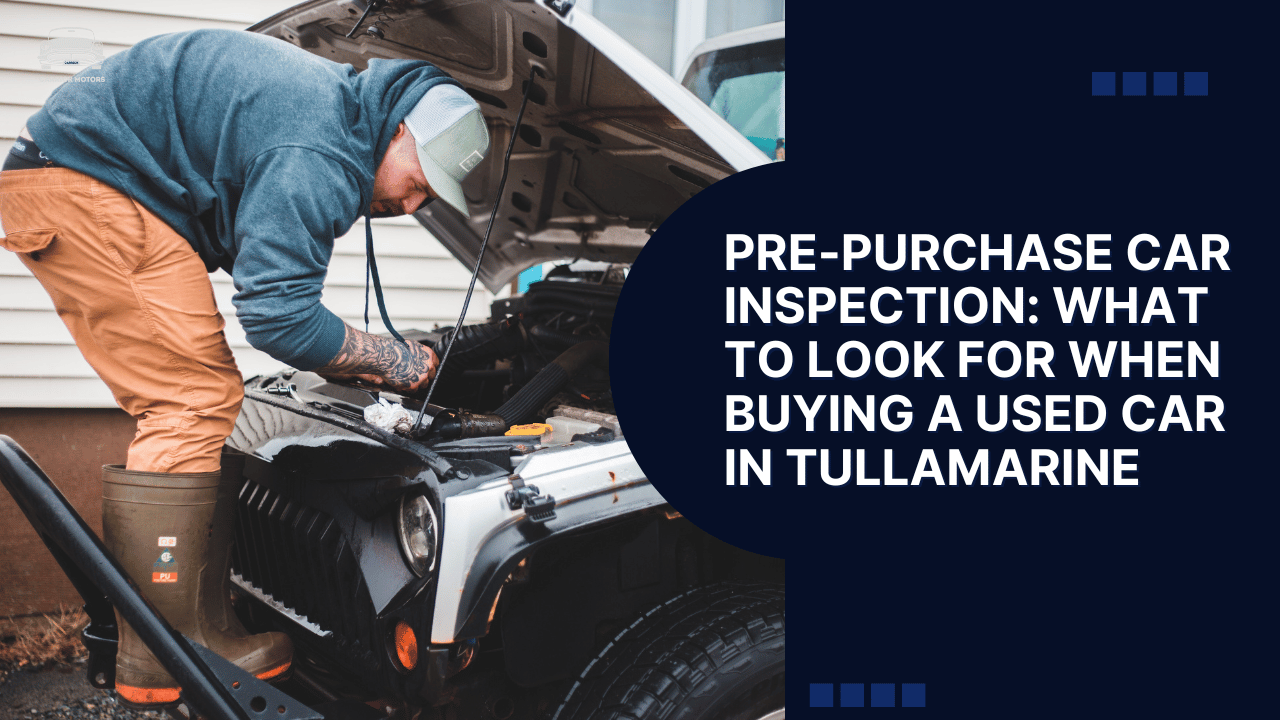
A pre-purchase car inspection in Tullamarine costs $150 to $350 and takes one to two hours, examining the mechanical systems, structure, electrics, and documentation of a used car to reveal problems before you commit. That modest fee routinely saves thousands, because a single hidden fault, a tired engine, a slipping transmission, or repaired accident damage, can cost far more than the inspection itself. Buying privately offers none of the warranty protection that comes with a new car, and a test drive alone can’t reveal a masked oil leak, an intermittent electrical fault, or a rolled-back odometer. Carrick Motors on Carrick Drive carries out thorough pre-purchase inspections for buyers across Tullamarine, Airport West, and Gladstone Park. This guide explains what a proper inspection covers, what it commonly finds, and how to use the findings to negotiate.
Why a Pre-Purchase Inspection Matters
A used car is a significant outlay with none of the safety net a new-car warranty provides, so an independent assessment of the car’s true condition is the smartest money you can spend before buying. Its value comes from what it protects you against, and there are four main risks it addresses.
The first is hidden mechanical problems. Many faults never show during a brief test drive, an engine issue masked by fresh oil or an additive, a transmission that shifts fine cold but slips when hot, suspension wear that only bites under certain conditions, or a cooling problem that appears only under sustained load. Sellers sometimes genuinely don’t know about a developing fault, and sometimes conceal a known one, and a professional inspection protects you against both. The second is accident history. Repaired collision damage isn’t always obvious, but panel gaps that vary from factory spec, slight paint colour or texture differences between panels, welding marks, or overspray on rubber seals all point to past structural repair, and a car sold as accident-free at a premium price can be renegotiated or walked away from once the damage is found.
The third risk is odometer tampering, still a persistent problem, where a rolled-back reading inflates the price and hides the true wear. Inspectors compare wear across the brake and clutch pedals, the seats, and the service history against the displayed mileage, and inconsistencies flag likely tampering. The fourth is simply financial protection: the inspection fee is tiny against the repair bills it can uncover, since an engine replacement runs $2,000 to $8,000, a transmission $2,500 to $6,000, structural repair $1,500 to $5,000, and a suspension overhaul $1,000 to $3,000. A single identified fault usually exceeds the inspection cost many times over, so the check effectively pays for itself.
What a Professional Inspection Covers
A comprehensive inspection works through every major system methodically, and understanding the scope helps you judge whether an inspection was thorough.
The engine and drivetrain come first. The oil and coolant are assessed for level and condition, the engine is checked for leaks from gaskets and seals, the belts and hoses for wear, the timing components where accessible, and the mounts for deterioration, with a compression test where the condition warrants it and any unusual noise noted during operation. On the drivetrain, the clutch life is estimated on a manual, the automatic’s shift quality assessed, and the differential, CV joints, and driveshaft inspected. The transmission gets particular attention because it’s so costly to repair: the fluid’s colour, level, and smell are checked, and the shift quality, engagement timing, and, on a manual, the synchronisers and clutch slippage are all tested through the gears.
The brakes and suspension follow. Pad thickness is measured at all four wheels, the rotors checked for scoring and thickness, and the callipers, lines, master cylinder, and fluid assessed, with a remaining-life estimate that doubles as negotiation leverage. On the suspension, the shocks are tested for function and leaks, the springs and ride height checked, and the safety-critical ball joints and tie rod ends tested for play, since worn suspension often signals broader neglect. Related tyre and alignment condition is read too, which connects to any wheel alignment need the car may have.
The remaining systems complete the picture. The electrics are checked across the battery, charging system, starter, alternator output, all lighting, the windows, locks, climate control, and warning lights. The body and structure are examined for panel alignment, paint matching, rust including hidden areas, and any welding or frame irregularity that points to accident repair. The interior is assessed for seat and seatbelt function, working accessories, and any odour suggesting water damage or smoking. And the undercarriage is inspected from below for exhaust condition, fuel and brake lines, corrosion, fluid leaks, and impact damage, the kind of problems invisible from above.
Common Problems Inspections Find
Knowing what inspectors most often uncover helps you anticipate findings and their cost implications. On the engine, oil leaks from deteriorated gaskets and seals are common and range from minor seepage to significant loss, cooling faults like a failing head gasket create overheating risk, timing components approaching their interval flag a looming maintenance cost, and compression loss, oil consumption, or unusual noises point to an engine nearing the end of its life. On the transmission, burnt or contaminated fluid signals internal wear, delayed or harsh shifting and slipping indicate developing problems, and a worn manual clutch adds real cost to ownership. A slipping automatic in particular is worth a proper transmission assessment, since it’s one of the most expensive faults to fix after purchase.
The chassis systems tell their own story. Brake findings usually mean immediate spending, worn pads, rotors, or a hydraulic leak, while suspension wear, tired shocks, perished bushings, or worn ball joints, degrades handling and safety. Rust is the one that can end a purchase outright: structural corrosion in load-bearing sections compromises safety and roadworthiness, while surface rust signals neglect and hidden rust in the wheel arches, sills, and floor pan often stays invisible until advanced. And accident evidence, welding, panel replacement, paint mismatches, or a car that pulls to one side, points to a collision history that affects both safety and value. Sorting these into what needs fixing now versus later is exactly what a full mechanical inspection delivers.
Reading the Inspection Report
The report is how you turn the findings into a decision, so it should be clear and detailed. A good one sorts every finding by severity: safety-critical issues needing attention before the car is driven, such as brake or steering faults or structural damage; requires attention soon, meaning repair within weeks like worn pads or an oil leak; monitor, for developing issues not yet needing repair; and information, for cosmetic or normal-wear observations. That grading tells you at a glance whether you’re looking at a sound car or a money pit.
The report should also estimate repair costs, which lets you calculate the car’s true price. The simple formula is the asking price plus required repairs plus soon-needed repairs, and comparing that total against the market value of an equivalent car in better condition tells you whether the deal makes sense. Those documented findings then become your negotiating tool, letting you request a reduction matching the repair costs, ask the seller to fix the issues before settlement, or walk away if they won’t budge on a significant fault. Sellers who expect informed buyers usually price with negotiation in mind, and a report gives you specific, justified figures rather than an arbitrary lowball.
What an Inspection Can’t Guarantee
Keeping realistic expectations matters, because a non-destructive inspection has limits. Intermittent faults that appear only when cold, only when hot, only under load, or at random may not surface during the inspection window. Internal component condition can’t be fully assessed without disassembly, so engine bearing wear, transmission clutch-pack condition, and sealed units remain partly hidden. Future reliability can’t be predicted precisely either, since a remaining-life estimate carries uncertainty and no one can say exactly when a marginal part will fail. And an inspection can’t verify the quality of past maintenance, whether good or substandard parts were fitted, whether correct procedures were followed, or whether a claimed service history genuinely happened.
None of this undermines the value of an inspection, it dramatically shifts the odds in your favour, but it’s an assessment of current condition rather than a guarantee against every possible future problem. Understanding that helps you weigh the findings sensibly rather than treating the report as a warranty.
Pre-Purchase Inspection Cost in Tullamarine
Pricing scales with the depth of the inspection. A basic visual inspection at $80 to $120 covers obvious issues only and suits an initial screen of several cars. A standard mechanical inspection at $150 to $220 assesses all the major systems without diagnostic scanning, while a comprehensive inspection with diagnostics at $220 to $350 adds an electronic scan that reveals stored fault codes. A specialist inspection at $280 to $450 covers European, performance, or complex vehicles needing specific expertise.
Whatever the tier, the cost is a small fraction of the purchase price, roughly 2 percent on a $10,000 car, 1.25 percent on a $20,000 car, and 1 percent on a $30,000 car, against protection from repairs that can run into the thousands. There are a few situations where you might reasonably skip it: a car still under comprehensive warranty, one bought from family with a fully known history, or one priced below the inspection cost itself. Even then, an inspection buys peace of mind and flags any immediate safety concern. For context on what the repairs an inspection uncovers actually cost, our 2026 car service price guide breaks down local pricing.
Choosing an Inspection Provider
The quality of the inspection depends heavily on who does it, so a few things are worth checking. Look for a qualified mechanic with the relevant trade certificates and genuine experience, since an experienced inspector spots the subtle indicators a less seasoned one misses, and confirm they have proper diagnostic equipment and compression testers for a thorough assessment. Independence is essential: choose an inspector with no connection to the seller, and avoid any inspection offered or arranged by the selling dealer.
On format, a mobile inspection travels to the car, which is convenient for private sales or distant sellers, while a workshop inspection benefits from hoist access and full equipment, and both are valuable when done by a qualified inspector. Before booking, it’s worth asking what the inspection includes, how long it takes (a thorough one runs 60 to 120 minutes, so a very brief inspection suggests limited scope), whether you’ll get a written report, whether repair cost estimates are provided, and how much experience they have with your specific type of vehicle. Straight answers to all of these mark a provider worth using.
How to Book Your Inspection
Booking with Carrick Motors takes one call. Ring +61 3 9330 1082 or message the workshop on WhatsApp once you’ve found a specific car worth serious consideration, and we’ll carry out a comprehensive independent inspection, examine every major system, run a diagnostic scan, and give you a detailed report with repair cost estimates. We inspect all makes and models across Tullamarine, Airport West, and Gladstone Park, our findings reflect the car’s actual condition with no seller influence, and we offer free pick-up and drop-off within 10 km of the workshop. An independent inspection gives you both confidence in the purchase and leverage to negotiate a fair price, and it pairs naturally with a first car service once the car is yours.
Frequently Asked Questions
Can I do a pre-purchase inspection myself?
You can do a useful preliminary check yourself, but a professional inspection is far more thorough. Trained inspectors recognise subtle indicators that are invisible to an untrained eye, use tools like compression testers that reveal problems no visual check can, and draw on experience to spot patterns pointing to specific faults. Self-inspection suits screening several cars, then a professional assessment for the one you’re serious about.
Should I get an inspection if the car has a roadworthy certificate?
Yes. A roadworthy certificate confirms only minimum safety standards at a point in time, it doesn’t assess overall mechanical condition, predict reliability, or identify every problem. Many issues that pass roadworthy still affect a car’s value and future repair costs. A pre-purchase inspection goes well beyond roadworthy scope, giving you the full mechanical picture the certificate never covers.
What if the seller refuses to allow an inspection?
Refusal is a serious warning sign. A legitimate seller confident in their car welcomes an independent inspection, so resistance suggests awareness of problems they’d rather keep hidden. Unless there’s a satisfactory explanation, treat a refusal as a reason to walk away, since buying an uninspected car from a reluctant seller is a significant gamble you don’t need to take.
Should I include an inspection condition in my offer?
Yes. When making an offer, add a condition such as “subject to a satisfactory pre-purchase inspection.” This lets you withdraw without penalty if the inspection reveals significant problems. An unconditional agreement may not allow withdrawal based on later findings, so the condition protects you. It’s a standard, reasonable request that most genuine sellers accept without issue.
What happens if I find problems after buying?
In a private sale, problems found after purchase generally become your responsibility unless fraud occurred, since private sales carry no statutory warranty. Dealer purchases may have limited statutory coverage depending on the circumstances. This is exactly why the inspection matters: it identifies problems before ownership transfers, when you still have the leverage to renegotiate or walk away, rather than after when you’re stuck with them.
Is a mobile inspection as good as a workshop one?
For most cars, a mobile inspection by an experienced inspector carrying the right equipment provides a comprehensive assessment at the seller’s location. A workshop inspection has the edge for complex or European vehicles that benefit from hoist access and extensive diagnostic gear. Either is valuable when performed by a qualified inspector, so the choice often comes down to convenience and the type of car.
How far ahead should I book an inspection?
Book once you’ve personally viewed and test-driven a specific car worth serious consideration, rather than paying to inspect cars you haven’t seen. Most providers offer an appointment within two to three days. Screen cars yourself first, then commit to a professional inspection for the strong candidate, which keeps your inspection spending focused on cars you’re genuinely likely to buy.
How long does a pre-purchase inspection take?
A thorough pre-purchase inspection takes 60 to 120 minutes depending on the vehicle and the depth of the assessment. A comprehensive inspection with diagnostic scanning sits at the longer end. A very brief inspection of only 20 or 30 minutes suggests limited scope, so the time taken is itself a useful signal of how thorough the assessment really is.
A pre-purchase inspection turns a used-car gamble into an informed decision, revealing the hidden faults, accident damage, and true condition that a test drive can’t, for a fee that’s tiny against the repairs it uncovers. Don’t commit to a used car without one. Call Carrick Motors on +61 3 9330 1082 to book your pre-purchase inspection in Tullamarine today.