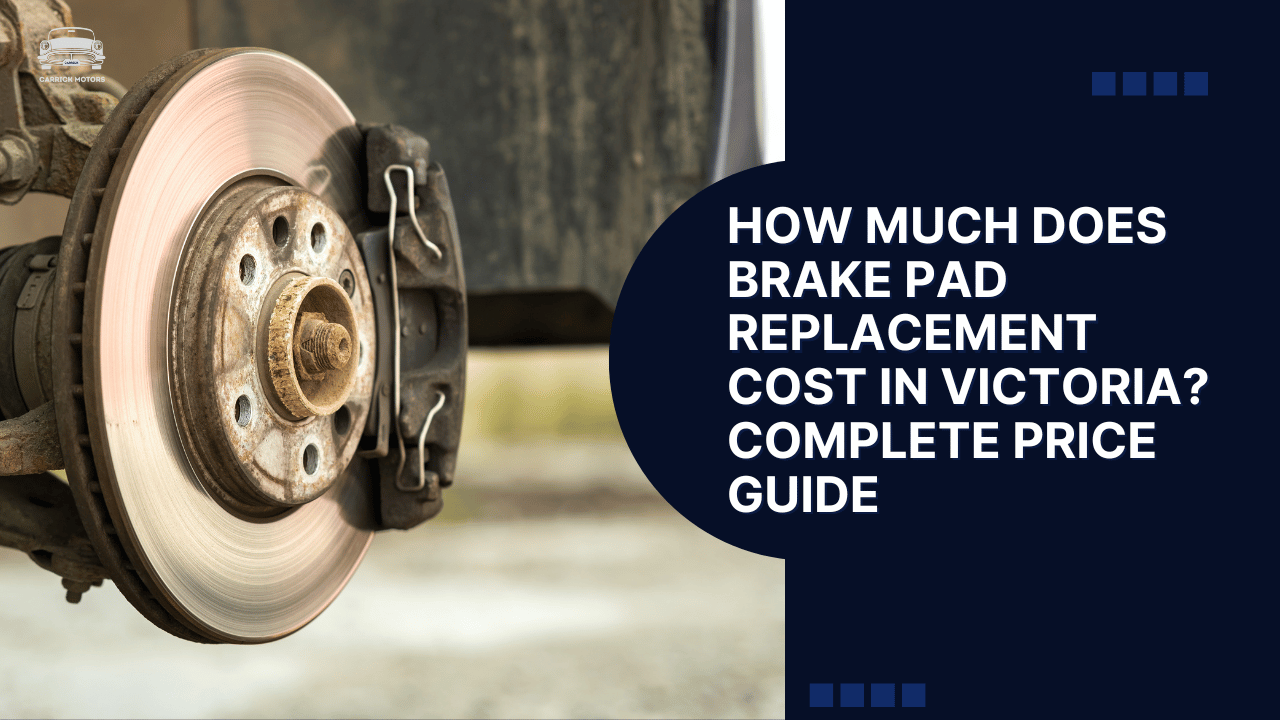
Brake pad replacement in Tullamarine costs $150 to $350 per axle for standard passenger vehicles, with front pads at $180 to $350 and rear pads at $150 to $300, while European and luxury cars run $280 to $500 per axle on specialised parts and extra labour. The final figure depends on the vehicle, the pad quality, and whether related work like rotor machining is needed at the same time. Understanding how the price is built helps you budget properly and judge a quote fairly rather than guessing whether you’re being charged reasonably. Carrick Motors on Carrick Drive supplies and fits brake pads for drivers across Tullamarine, Airport West, and Gladstone Park. This guide breaks down the parts, the labour, the factors that move the price, and how to save without cutting safety.
How the Cost Is Built
A brake pad quote combines three things: the pads themselves, the labour to fit them, and any related brake work the system turns out to need. Knowing how each part is priced lets you read a quote line by line.
On the parts side, pad price scales with quality. Economy pads at $30 to $60 per axle set use basic friction material with adequate stopping power but a shorter life and more dust, suiting a car near sale or a low-mileage driver watching cost. Mid-range aftermarket pads at $60 to $120 from brands like Bendix, RDA, and TRW meet or beat the original specification and offer the best value for most drivers. Premium ceramic and semi-metallic pads at $100 to $200 from names like Brembo and EBC deliver quieter, lower-dust, longer-lasting braking, and genuine manufacturer pads at $120 to $300 guarantee exact factory specification where that matters.
On the labour side, the rate reflects the workshop type. An independent workshop charges $80 to $150 per axle thanks to lower overheads, a dealership $150 to $250 for its higher costs and brand-specific expertise, and a mobile mechanic $100 to $180 for the convenience of coming to you. Independent workshops in outer suburbs like Tullamarine consistently undercut inner-city and dealer rates for equivalent work, which is a large part of why a local brake pad replacement costs less than the same job at a CBD workshop.
Cost by Vehicle Type
The vehicle sets the baseline, since parts availability and access vary widely. As a 2026 guide for a fitted job:
- Small cars (Yaris, Mazda 2, i20): front pads $150 to $250, rear $130 to $220, all four $250 to $420.
- Medium cars (Camry, Mazda 3, i30): front $180 to $300, rear $150 to $260, all four $300 to $500.
- SUVs and crossovers (RAV4, CX-5, Tucson): front $200 to $350, rear $170 to $300, all four $350 to $580.
- Large SUVs and 4WDs (LandCruiser, Ranger, Patrol): front $250 to $400, rear $200 to $350, all four $400 to $680.
- European vehicles (BMW 3 Series, C-Class, Audi A4): front $300 to $500, rear $250 to $450, all four $500 to $850.
Common Japanese and Korean cars sit at the lower end thanks to cheap, plentiful parts, while European models cost more on specialised pads, larger brake systems, and the electronic parking-brake service mode many now require. These figures line up with the wider market once fitting is counted, and they’re broken down further alongside other running costs in our 2026 car service price guide.
What Moves the Price
Beyond the base vehicle and pad choice, a few factors explain why two quotes for the “same” job can differ. Component access matters, since some cars allow quick pad access while others need extensive dismantling, and complex calliper designs add time. Technical requirements add cost on modern cars, where an electronic parking brake needs a service-mode activation, wear sensors need replacing, and diagnostic resets take time. Brake system condition is often the biggest swing: worn rotors may need machining or replacement, seized callipers need service or replacement, and worn hardware clips and shims may need renewing, all of which add to a pad-only quote.
Pad quality selection is the factor you control most. Ceramic pads cost more upfront but can last 50 to 100 percent longer than economy pads while running quieter and cleaner, so their cost per kilometre often works out lower for a daily driver. Semi-metallic pads give strong bite and heat handling at a moderate price but produce more dust, and organic pads are cheapest to buy but wear fastest, often costing more over time through frequent replacement. And location plays a part, with inner-city workshops charging 10 to 20 percent premiums over outer-suburban ones like those around Tullamarine.
Related Brake Work to Expect
Brake pad replacement often coincides with related services, and understanding them helps you anticipate the full cost rather than being surprised. Rotor machining at $50 to $100 per axle resurfaces lightly scored or glazed rotors to give the new pads a flat, smooth surface, and it’s worthwhile when the rotors are within their thickness spec but not perfectly smooth. Rotor replacement at $100 to $300 per axle for standard cars, or $200 to $500 for European and performance vehicles, becomes necessary when rotors wear below minimum thickness, develop deep grooves, warp, or crack, since a machined rotor that’s too thin isn’t safe.
The other common additions are smaller but worth knowing. A brake fluid flush at $80 to $150 restores the hydraulic performance of fluid that has absorbed moisture over time, and a pad change is a natural moment to do it if the fluid is over two years old. Calliper service at $50 to $100 per axle covers slide-pin lubrication and seal inspection, while a seized or leaking calliper needs replacement at $200 to $500 per unit. And wear sensors at $20 to $80 each are single-use items on many modern cars that must be replaced with the pads, since they’re destroyed once they contact the rotor. A full brake system inspection identifies which of these your car actually needs before any work starts.
How to Save Without Cutting Safety
Brake costs can be managed sensibly, and the biggest saving of all costs nothing: acting promptly. Replacing pads before they wear through is a $150 to $350 per axle job, but letting them grind into the rotors turns it into a $350 to $700 pad-and-rotor bill, so responding to a squeal or a warning light early is the single most effective way to keep the cost down.
Beyond timing, a few strategies help. Compare a few itemised quotes, since prices for identical work can vary by more than 50 percent, and an itemised breakdown shows exactly where the difference sits and confirms the pad quality is comparable. Match the pad quality to your ownership: premium pads pay off on a car you’ll keep for years, while economy pads make sense on one you’re selling soon. Ask about package deals, since some workshops bundle pads, machining, a fluid flush, and inspection at a lower combined price. And choose a quality independent workshop, which typically delivers equivalent work at 30 to 50 percent less than a dealership. Bundling a brake check into a regular car service also catches wear early, before it becomes expensive.
How to Read a Brake Quote
Evaluating a quote well protects you from both overpaying and under-servicing. A good quote specifies the pad brand, type, and quality, states the rotor treatment if any, itemises the labour hours and rate, lists any hardware, sensors, or fluid included, and sets out the warranty on parts and labour. That detail lets you compare quotes fairly and know exactly what you’re buying.
A few red flags warrant caution. Vague descriptions that don’t name the pad brand or quality may hide inferior parts, an unusually low price often signals economy parts or hidden charges that appear later, pressure to approve work immediately suggests profit motivation over your interest, and a refusal to itemise can obscure high markups or unnecessary inclusions. It’s fair to ask a few questions before approving: what pad brand and type will be fitted, what condition the rotors are in, whether sensors are included if your car has them, what warranty applies, and whether you can see the old parts afterward. A workshop confident in its work answers all of these openly.
When Brake Pads Need Replacing
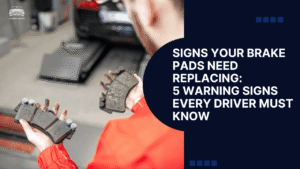
Knowing when replacement is due prevents both safety risks and the secondary rotor damage that inflates the cost. The warning signs are worth acting on quickly: a high-pitched squeal during braking means the wear indicator is contacting the rotor and pads are near their limit, a metal-on-metal grind means they’ve worn through completely and the rotors are being damaged right now, vibration through the pedal or wheel points to rotor problems often accompanying pad wear, noticeably longer stopping distances signal reduced braking effectiveness, and a dashboard brake warning on sensor-equipped cars flags minimum thickness directly. Our guide to the five warning signs your brake pads need replacing covers these in more depth.
Measurement gives an objective picture beyond the symptoms. New pads start around 10 to 12mm thick, replacement is recommended below 3 to 4mm, and the minimum safe thickness is 1.5 to 2mm. A brake inspection during routine servicing measures the remaining thickness and predicts replacement timing before any warning sign appears, which is the whole point of preventive maintenance, letting you plan the job rather than react to a grinding noise on the freeway.
How to Book Your Brake Service
Booking with Carrick Motors takes one call. Ring +61 3 9330 1082 or message the workshop on WhatsApp, and we’ll inspect the pads, rotors, callipers, and fluid, give you an itemised quote covering exactly what your brakes need, and fit quality pads matched to your car and driving. We service all makes and models across Tullamarine, Airport West, and Gladstone Park, show you the old parts, back our work with a warranty, and offer free pick-up and drop-off within 10 km of the workshop. If your brakes are squealing, grinding, or showing a warning light, don’t delay, since worn pads quickly damage the rotors, so call and we’ll sort it before the cost grows.
Frequently Asked Questions
Should I replace all four brake pads at once?
Not necessarily. Front pads wear two to three times faster than rears, so they often need replacing on their own. Replace pads by axle based on actual wear measurements, and always do both pads on an axle together to keep braking balanced, never just one side. Replacing all four at once only makes sense when they’ve all reached minimum thickness together.
Is it cheaper to buy brake pads myself and have them fitted?
Sometimes, but the saving is often modest. Workshop parts include a markup, but sourcing your own means verifying the exact specification yourself, and some workshops won’t fit customer-supplied parts or will void the labour warranty if they do. A potential saving of $20 to $50 may not justify the complications, so it’s worth discussing with the workshop before buying parts independently.
Why do European car brake pads cost more?
European vehicles need pads meeting specific manufacturer certifications, which limits supplier options and reduces competition. The premium compounds they use cost more, their brake systems are often larger and use more material per pad, and the parts distribution networks add supply-chain cost. Together these push European pad prices to $280 to $500 per axle against $150 to $350 for common Asian models.
How long should brake pads last?
Brake pads typically last 40,000 to 70,000 kilometres under normal driving. Front pads may need replacing every 30,000 to 50,000 km, while rear pads often last 60,000 to 100,000 km. Driving style, vehicle weight, and traffic conditions all affect it, so aggressive braking, heavy loads, and stop-start city driving wear pads noticeably faster than gentle highway use.
What happens if I delay brake pad replacement?
Delaying gets progressively worse and more expensive. Early on, stopping distances lengthen and braking confidence drops. Left longer, the metal backing plates contact the rotors and cause damage that turns a $150 to $350 pad job into a $350 to $700 pad-and-rotor bill. Severe delay risks pad separation or brake failure, so prompt replacement is both safer and cheaper.
Are ceramic brake pads worth the extra cost?
For many drivers, yes. Ceramic pads last 50 to 100 percent longer than economy alternatives, which lowers the cost per kilometre despite the higher purchase price, and they produce far less dust, run quieter, and treat the rotors more gently. Daily drivers covering average distances usually benefit, while a car being sold soon may not justify the premium.
Can I negotiate brake pad prices?
There’s usually some room, especially on larger jobs. Presenting a competitor’s itemised quote can encourage price matching, and it’s reasonable to ask about current promotions, package discounts, or a pad-quality upgrade at the original price. A long-term customer relationship helps too. Keep it respectful, since excessive haggling can lead to declined work or corners cut.
How do I know if the rotors need replacing too?
Rotors need replacing rather than machining when they’re below minimum thickness (stamped on the rotor), deeply grooved beyond what machining can remove, warped enough to cause vibration, or cracked. A workshop measures the thickness and inspects the surface during the brake job. If the rotors are within spec and only lightly scored, machining at $50 to $100 per axle restores them instead.
Brake pad replacement runs $150 to $350 per axle for most Tullamarine vehicles, with the final price set by your car, the pad quality, and any rotor or calliper work needed alongside. Acting promptly on worn pads is the single biggest saving, since it prevents the rotor damage that doubles the bill. Call Carrick Motors on +61 3 9330 1082 to book your brake inspection or pad replacement in Tullamarine today.