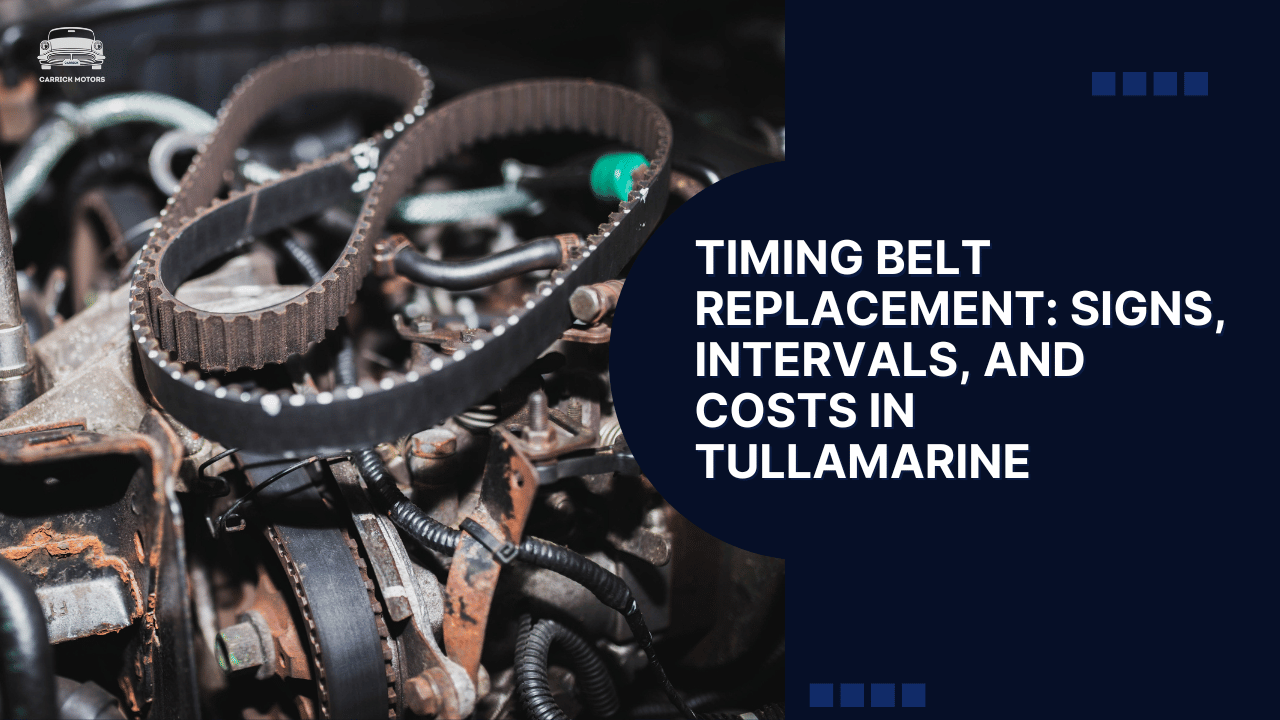
Timing belt replacement in Tullamarine costs between $600 and $1,200 for most vehicles, with European and complex engines reaching $900-1,800. Timing belts require replacement every 80,000-120,000 kilometres or 5-7 years, whichever comes first. A snapped timing belt destroys engines instantly—this is one service you cannot afford to skip or delay.
The timing belt synchronises your engine’s internal components, ensuring valves open and close at precisely the right moment. When it breaks, pistons collide with valves, causing catastrophic damage requiring engine rebuild or replacement. This guide explains timing belt function, replacement intervals, and costs for Tullamarine drivers.
How Your Timing Belt Works
Understanding timing belt function explains why replacement is critical.
What the Timing Belt Does
Synchronisation: Connects crankshaft to camshaft(s). Ensures valves open when pistons are in correct position. Maintains precise engine timing.
Critical Timing: Valves must open and close at exact moments. Pistons move up and down in cylinders. Without synchronisation, components collide.
Continuous Operation: Belt rotates thousands of times per minute. Constant stress and heat exposure. Eventually wears and breaks.
Timing Belt Components
Timing Belt: Reinforced rubber belt with teeth. Teeth mesh with sprockets. Stretches and wears over time.
Tensioner: Maintains proper belt tension. Spring-loaded or hydraulic. Failure causes belt to slip or break.
Idler Pulleys: Guide belt around components. Bearings can fail. Usually replaced with belt.
Water Pump (Often): Many engines have timing belt-driven water pump. Replaced during timing belt service. Saves significant labour cost.
Interference vs Non-Interference Engines
Interference Engines: Pistons and valves occupy same space at different times. Belt failure causes collision. Severe engine damage results. Most modern engines are interference design.
Non-Interference Engines: Pistons and valves don’t share space. Belt failure causes engine to stop. No internal damage. Rare in modern vehicles.
Assumption: Assume your engine is interference design. The consequences of being wrong are catastrophic.
When to Replace Your Timing Belt
Timing belt replacement is interval-based, not condition-based.
Manufacturer Intervals
Typical Intervals: Most vehicles: 80,000-100,000 km Some vehicles: 100,000-120,000 km Time-based: 5-7 years regardless of kilometres
Examples: Toyota: 100,000 km or 5 years Honda: 100,000 km or 7 years Volkswagen: 90,000-120,000 km Subaru: 100,000 km
Check Your Manual: Intervals vary by manufacturer and engine. Check owner’s manual for specific interval. Professional service can confirm.
Time-Based Replacement
Why Time Matters: Rubber deteriorates with age. Heat cycling causes cracking. Belt weakens even with low kilometres.
Example: Vehicle with 50,000 km but 8 years old needs timing belt. Age has degraded rubber regardless of use.
Don’t Wait for Symptoms
No Warning Signs: Timing belts rarely show symptoms before breaking. Visual inspection is limited (belt often hidden). Don’t wait for problems—replace on schedule.
Consequences of Waiting: Belt breaks without warning. Engine destroys itself instantly. Engine replacement costs $5,000-15,000.
Signs of Timing Belt Problems
While most belts fail without warning, some symptoms may appear.
Engine Won’t Start
What Happens: Engine cranks but won’t fire. Sounds different than normal cranking. No compression.
If Belt Has Broken: Engine cannot run. Internal damage likely occurred. Do not continue cranking.
Ticking Noise from Engine
What You’ll Hear: Rhythmic ticking from engine. Different from normal engine sounds.
Possible Cause: Worn belt or tensioner. Belt teeth wearing. Requires inspection.
Engine Misfires
What Happens: Rough running. Loss of power. Check engine light.
Connection: Worn belt may slip teeth. Timing becomes incorrect. Misfires result.
Urgency: Slipped belt is about to break. Immediate replacement required.
Oil Leak from Timing Cover
What You’ll See: Oil leaking from front of engine. Wet timing cover area.
Concern: Oil can damage timing belt rubber. Accelerates deterioration. Leak should be repaired during belt service.
Engine Vibration
What You’ll Feel: Unusual engine vibration. May occur at idle or under load.
Cause: Belt may be wearing unevenly. Tensioner may be failing.
What’s Included in Timing Belt Service
Comprehensive service ensures reliability until next interval.
Standard Replacement
Timing Belt: New belt installed. Correct tension set. Timing marks aligned precisely.
Tensioner: Always replaced with belt. Tensioner failure common. Prevents premature belt failure.
Idler Pulleys: Replaced as part of kit. Bearings wear over time. Inexpensive during service.
Recommended Additional Items
Water Pump: Highly recommended on timing belt-driven pumps. Same labour required. Prevents future cooling problems.
Seals: Camshaft and crankshaft seals often replaced. Prevents oil leaking onto new belt. Minor additional cost.
Drive Belts: Serpentine/accessory belts often due. Convenient time to replace. Must be removed anyway.
Why Replace Everything Together
Labour Cost: Accessing timing belt requires significant disassembly. Labour is major expense. Adding components minimal extra cost.
Reliability: All components same age. Replacing only belt risks tensioner failure. Complete kit ensures interval reached.
Cost Comparison: Belt only: $500-800 Complete kit with water pump: $800-1,500 Water pump failure later: Additional $400-700 in labour
Timing Belt Replacement Cost in Tullamarine
Understanding costs helps budget appropriately.
By Vehicle Type
Small Cars (Yaris, Mazda 2, i20): Belt kit only: $500-700 With water pump: $700-1,000
Medium Cars (Corolla, Mazda 3, i30): Belt kit only: $600-900 With water pump: $800-1,200
Large Cars (Camry, Mazda 6): Belt kit only: $700-1,000 With water pump: $900-1,400
SUVs (RAV4, CX-5, Tucson): Belt kit only: $700-1,100 With water pump: $900-1,500
European Vehicles (VW, Audi, BMW): Belt kit only: $900-1,400 With water pump: $1,200-1,800
Cost Breakdown
Parts: Timing belt kit: $150-400 Water pump: $100-300 Seals: $30-100 Coolant: $30-50
Labour: Simple engines: $300-500 Complex engines: $500-900 European vehicles: $600-1,000
Factors Affecting Cost
Engine Complexity: DOHC engines have more components. V6 engines may have two belts. Transverse mounting affects access.
Vehicle Age: Older vehicles may need additional parts. Seized bolts increase labour. Unexpected issues add cost.
Additional Repairs: Oil leaks should be fixed. Worn drive belts replaced. Cooling system service recommended.
Timing Belt vs Timing Chain
Not all engines have timing belts.
Timing Chains
Construction: Metal chain similar to bicycle chain. Runs in oil for lubrication. Generally longer lasting.
Replacement: Some chains last engine lifetime. Others require replacement at 150,000-250,000 km. Symptoms include rattling noise.
Cost: More expensive than belt replacement. $1,000-3,000 typical. Less frequent service.
How to Know Which You Have
Check Manual: Owner’s manual specifies belt or chain. Service schedule indicates belt intervals.
Ask a professional: Mechanics can confirm your engine type. Important for maintenance planning.
General Guide: Most 4-cylinder engines: Often belt Many V6 engines: Often chain European vehicles: Varies widely Recent vehicles (2010+): Increasing chain use
Consequences of Timing Belt Failure
Understanding consequences emphasises replacement importance.
Immediate Effects
Engine Stops: Vehicle immediately loses power. Engine stops running. Cannot be restarted.
Internal Damage (Interference Engines)
Valve Damage: Pistons strike open valves. Valves bend or break. Valve guides damaged.
Piston Damage: Piston crowns may be damaged. Connecting rods can bend. Cylinder walls may be scored.
Cylinder Head Damage: Head may crack. Camshaft can be damaged. Complete head replacement needed.
Repair Costs
Minimum Damage: New belt + bent valves: $2,000-4,000
Moderate Damage: Head rebuild + belt: $3,000-5,000
Severe Damage: Engine replacement: $5,000-15,000
Prevention vs Repair
Timing Belt Service: $600-1,500 Engine Repair/Replacement: $3,000-15,000
The mathematics are clear, scheduled replacement is dramatically cheaper than failure repair.
Choosing a Timing Belt Service Provider
Quality service ensures reliable results.
What to Look For
Experience: Technicians familiar with your vehicle type. Proper tools and equipment. Understanding of timing procedures.
Quality Parts: OEM or quality aftermarket components. Complete kits, not just belt. Warranty on parts and labour.
Comprehensive Service: Inspection of related components. Recommendation for water pump. Proper documentation.
Questions to Ask
What’s Included: Belt, tensioner, idler pulleys? Water pump recommended? Seals included?
Parts Quality: OEM or aftermarket brand? Warranty coverage?
Additional Findings: Will they report other issues? Oil leaks? Drive belt condition?
Frequently Asked Questions About Timing Belts
How do I know if my car has a timing belt or chain?
Check your owner’s manual—it will specify belt or chain and replacement intervals. Alternatively, ask a mechanic. Generally, if your service schedule mentions timing belt replacement at 80,000-120,000 km, you have a belt. No mention of timing service often indicates a chain. Professional inspection can confirm.
What happens if timing belt breaks while driving?
On interference engines (most modern vehicles), the engine destroys itself instantly. Pistons collide with valves, bending valves and potentially damaging pistons, cylinder head, and other components. The vehicle stops immediately and cannot be restarted. Repair costs typically $3,000-15,000, far exceeding scheduled belt replacement cost.
Can I drive with a worn timing belt?
If the belt hasn’t broken, yes, but this is extremely risky. Timing belts fail without warning—there’s no “slightly worn” safe period. If your belt is due or overdue for replacement, every drive risks catastrophic failure. Have it replaced immediately rather than risking engine destruction.
How much does timing belt replacement cost?
Timing belt replacement costs $600-1,200 for most vehicles in Tullamarine, or $900-1,800 for European vehicles. This includes belt, tensioner, and idler pulleys. Adding water pump (recommended) adds $150-400. The cost is primarily labour—the belt itself is relatively inexpensive.
Should I replace water pump with timing belt?
Yes, strongly recommended if your water pump is timing belt-driven. The labour to access the water pump is the same as the timing belt—you’re already paying for it. If the pump fails later, you’ll pay the same labour again plus risk overheating damage. Adding the pump during belt service costs only the part price.
How long does timing belt replacement take?
Timing belt replacement typically takes 3-6 hours depending on engine complexity. Simple 4-cylinder engines may take 3-4 hours. Complex V6 or European engines may take 5-8 hours. Most shops complete the service in one day.
Can I replace my timing belt myself?
Technically possible but not recommended unless you’re an experienced mechanic. Incorrect timing causes engine damage. Special tools are often required. The consequences of errors are severe. Given the critical nature of this service, professional installation is strongly advised.
Professional Timing Belt Service at Carrick Motors
Timing belt failure destroys engines instantly, costing $3,000-15,000 to repair. Scheduled replacement costs $600-1,500 and prevents catastrophic damage. Don’t delay this critical service, the consequences of “just a few more kilometres” can be devastating.
Carrick Motors provides professional timing belt replacement throughout Tullamarine, Airport West, Gladstone Park, and Tullamarine’s northern suburbs. Comprehensive service includes belt, tensioner, idler pulleys, and water pump recommendations for complete reliability.