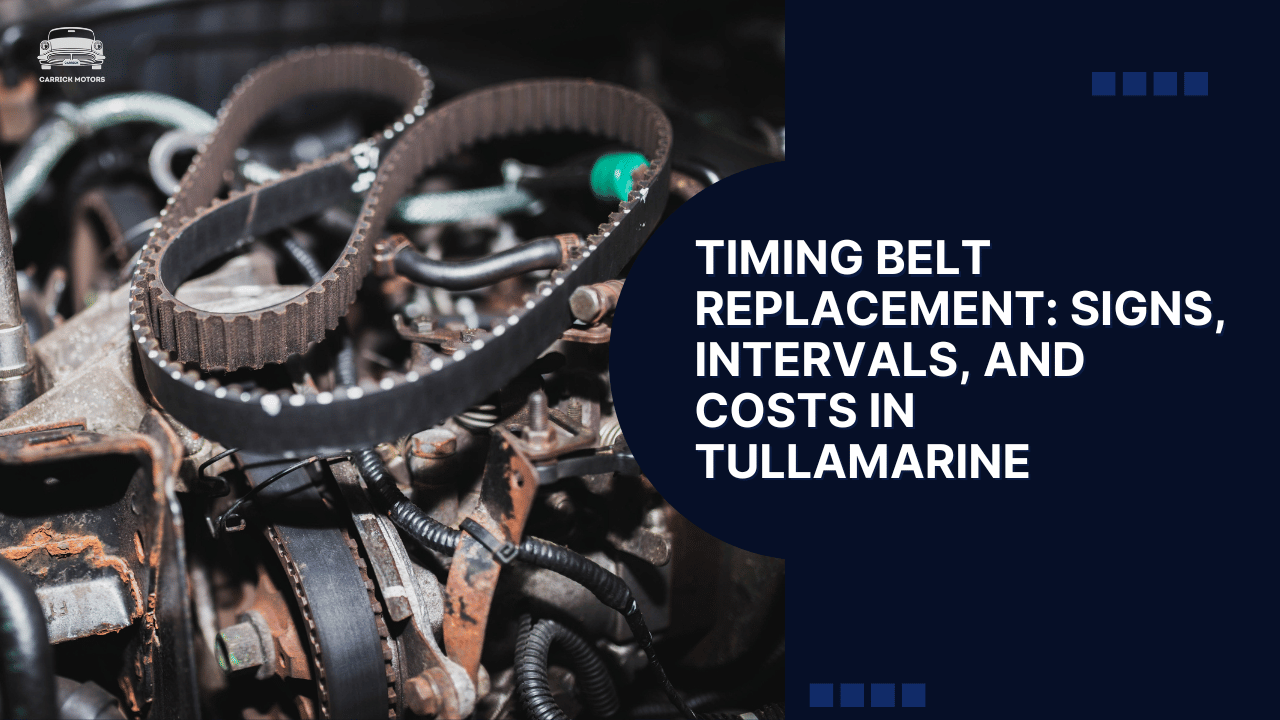
Timing belt replacement in Tullamarine costs $600 to $1,200 for most vehicles, and $900 to $1,800 for European or complex engines. Manufacturers set the interval at 80,000 to 120,000 kilometres or 5 to 7 years, whichever arrives first. The belt is a reinforced rubber component that keeps your crankshaft and camshaft turning in sync, so the valves open and close at the exact moment the pistons need them to. When it snaps, the timing collapses and the engine can destroy itself in seconds. Carrick Motors on Carrick Drive handles this service for drivers across Tullamarine, Airport West, and Gladstone Park, and this guide walks through how the belt works, when to replace it, the warning signs, and what the job actually costs.
How Your Timing Belt Works
The timing belt links the crankshaft to the camshaft and holds engine timing to a fraction of a degree. As the crank spins, the belt drives the cam, and the valves open in step with the pistons. On many engines the same belt also turns the water pump, which is why the pump is usually replaced at the same time.
A few parts work alongside the belt. The tensioner keeps it tight so it never slips a tooth. Idler pulleys guide it around the front of the engine, and their bearings wear with age. Because these components share the belt’s workload, a good service replaces them together as a kit rather than one at a time.
Most engines built today are interference designs, which means the pistons and valves pass through the same space at different moments. If the belt fails on an interference engine, the two collide and the damage is severe. Non-interference engines simply stop without internal harm, but they are rare now. Assume yours is an interference engine unless a mechanic confirms otherwise, because the cost of guessing wrong runs into thousands.
The belt itself spins thousands of times a minute under constant heat and load. Every rotation flexes the rubber and wears the teeth a little more, so failure is a question of when, not if. That steady wear is exactly why manufacturers tie replacement to a fixed interval rather than a warning light, and why the belt sits at the centre of preventive engine care.
When to Replace Your Timing Belt
Replacement is based on the schedule, not on how the belt looks. Toyota lists 100,000 km or 5 years on many models, Honda often allows 100,000 km or 7 years, and Volkswagen sits around 90,000 to 120,000 km. Your owner’s manual holds the figure for your exact engine.
Age matters as much as distance. Rubber hardens and cracks with heat cycling even on a car that barely moves. A vehicle with only 50,000 km but eight years on the clock still needs a fresh belt, because time has already weakened the old one. Waiting for a symptom is the wrong strategy here. Timing belts give almost no warning before they let go, and by the time you hear a problem the belt is often about to break. If your belt is due, a booking with our team for all cars mechanical repairs sorts it before the interval runs out.
Signs of Timing Belt Problems
Warning signs are the exception, not the rule, but a few do show up. Watch for these:
- Cranking without firing, which points to a belt that has already snapped
- Rhythmic ticking from the front of the engine as the belt or tensioner wears
- Rough running, lost power, or a check engine light when the belt slips a tooth
- Oil seeping from the timing cover, which rots the rubber from the outside
- Unusual vibration at idle caused by an uneven or failing tensioner
Any one of these means the engine needs inspection straight away. A belt that has jumped even a single tooth is minutes from failure, so treat these signs as urgent rather than something to monitor.
What’s Included in Timing Belt Service
A proper service covers more than the belt itself. The belt goes in with the correct tension and the timing marks aligned precisely, and the tensioner is always swapped at the same time because a worn tensioner will wreck a brand-new belt. Idler pulleys come as part of the kit since their bearings are the same age as everything else.
Two extras are worth adding while the front of the engine is open. A water pump driven by the belt should go in now, because the labour to reach it is already paid for. Camshaft and crankshaft seals are often renewed too, stopping oil from leaking onto the fresh belt. Replacing everything together makes sense: the disassembly is the expensive part, and adding parts while you are already in there costs little. A belt-only job runs $500 to $800, while a full kit with water pump sits at $800 to $1,500 and reaches the next interval with no surprises.
Timing Belt Replacement Cost in Tullamarine
Price tracks the vehicle. Small cars like a Yaris or Mazda 2 run $500 to $700 for the belt kit, or $700 to $1,000 with the water pump. Medium cars such as a Corolla or i30 sit at $600 to $900, rising to $800 to $1,200 with the pump. Larger sedans and SUVs push higher, and European models from Volkswagen, Audi, or BMW reach $900 to $1,400 on the kit alone and $1,200 to $1,800 with the pump.
The parts are the cheap part. A belt kit is $150 to $400, a water pump $100 to $300, seals and coolant add another $60 to $150. Labour carries the cost, from $300 to $500 on simple engines up to $600 to $1,000 on European vehicles, because reaching the belt means stripping back a good deal of the front of the engine. These figures line up with the wider market, where national estimators such as RepairPal and Kelley Blue Book put a typical belt job in the same band once labour is counted.
Three things move the price within those ranges. Engine layout comes first: a DOHC engine has more to strip back than a single-cam unit, and some V6 engines run two belts instead of one. Vehicle age is the second factor, since older cars can hide seized bolts and perished seals that add time to the job. The third is condition. If an oil leak or a worn drive belt turns up during the work, fixing it then is cheaper than a second visit later. We quote the full picture before starting, so the number you approve is the number you pay.
Timing Belt vs Timing Chain
Not every engine uses a belt. A timing chain is a metal component that runs in engine oil and often lasts the life of the car, though some chains need replacing at 150,000 to 250,000 km and rattle when they wear. Chains cost more to replace, usually $1,000 to $3,000, but they do the job far less often.
Which one you have depends on the engine. Many four-cylinder engines use a belt, a lot of V6 engines use a chain, and European vehicles vary widely. Cars from 2010 onward increasingly use chains. Your manual settles it: a listed timing belt interval means a belt, while no timing service entry usually points to a chain. If you are unsure, our team confirms it during a car service.
Consequences of Timing Belt Failure
When a belt breaks the engine stops instantly and cannot be restarted. On an interference engine the pistons then strike the open valves, bending or snapping them, and the damage can spread to the piston crowns, connecting rods, cylinder walls, and the cylinder head itself.
The repair bill scales with the harm. A belt plus a few bent valves lands around $2,000 to $4,000. A head rebuild with the belt runs $3,000 to $5,000. Severe cases need a full car engine replacement at $5,000 to $15,000. Set against a scheduled service of $600 to $1,500, the maths makes the decision for you. Prevention is a fraction of the cost of failure.
How to Book Your Timing Belt Service
Booking with Carrick Motors takes one call. Ring +61 3 9330 1082 or message the workshop on WhatsApp, and we confirm whether your engine runs a belt or a chain before quoting. We service all makes and models, supply OEM or quality aftermarket kits with a warranty, and offer free pick-up and drop-off within 10 km of Tullamarine. If your car is also due for related work, we can check the brake pads or engine oil and filter while it is in the workshop.
Frequently Asked Questions
How do I know if my car has a timing belt or chain?
Check the owner’s manual, which states belt or chain and lists the replacement interval. A schedule that mentions timing belt replacement at 80,000 to 120,000 km means you have a belt. No timing service entry usually points to a chain. A mechanic can confirm it in a few minutes if the manual is missing.
What happens if the timing belt breaks while driving?
On an interference engine the engine destroys itself immediately. Pistons collide with open valves, bending the valves and often damaging the pistons and cylinder head. The car stops at once and will not restart, and the repair typically costs $3,000 to $15,000, far beyond the price of scheduled replacement.
How much does timing belt replacement cost in Tullamarine?
Timing belt replacement costs $600 to $1,200 for most vehicles in Tullamarine, or $900 to $1,800 for European engines. That covers the belt, tensioner, and idler pulleys. Adding the water pump, which we recommend, adds $150 to $400. Most of the price is labour rather than the belt itself.
Should I replace the water pump with the timing belt?
Yes, if the water pump is driven by the timing belt. The labour to reach the pump is identical to the belt job you are already paying for. Skip it now and a later pump failure means paying that same labour again, plus the risk of overheating damage. Adding the pump during the service costs little more than the part.
How long does timing belt replacement take?
Timing belt replacement takes 3 to 6 hours for most vehicles. A simple four-cylinder engine runs 3 to 4 hours, while a complex V6 or European engine can take 5 to 8 hours. Most workshops finish the job within one day.
Can I drive with a worn timing belt?
Only if it has not broken, and even then it is a serious risk. Timing belts fail without warning and have no safe worn-but-fine stage. A belt that is due or overdue puts the engine in danger on every trip, so replace it right away rather than gambling on a few more kilometres.
Which vehicles do you service in Tullamarine?
Carrick Motors services all makes and models, from small hatchbacks like the Yaris and Mazda 2 to sedans, SUVs, and European vehicles from Volkswagen, Audi, and BMW. The workshop on Carrick Drive covers Tullamarine, Airport West, Gladstone Park, and the northern suburbs.
Can I replace the timing belt myself?
It is possible but not advised unless you are an experienced mechanic. Incorrect timing damages the engine, special camshaft-holding tools are often needed, and a small error carries a catastrophic cost. Given what is at stake, professional installation is the safer choice.
Is a timing chain better than a timing belt?
A timing chain lasts longer, often the life of the engine, so it wins on service frequency. A belt is quieter and cheaper to replace when the time comes. Neither is better in every case: chains suit owners who want fewer service visits, while belts keep individual repair bills lower. The engine you own already decides which one you get.
Do you use OEM or aftermarket parts?
Both, depending on what you prefer. We fit OEM kits where you want factory parts, and quality aftermarket brands such as Aisin or Gates where value matters more. Every belt kit we install comes with a warranty on parts and labour, and we tell you which brand is going in before the work starts.
Timing belt failure destroys engines in seconds and costs thousands to repair, while scheduled replacement costs $600 to $1,500 and prevents the whole scenario. Don’t stretch this service past its interval. Call Carrick Motors on +61 3 9330 1082 to book your timing belt replacement in Tullamarine today.