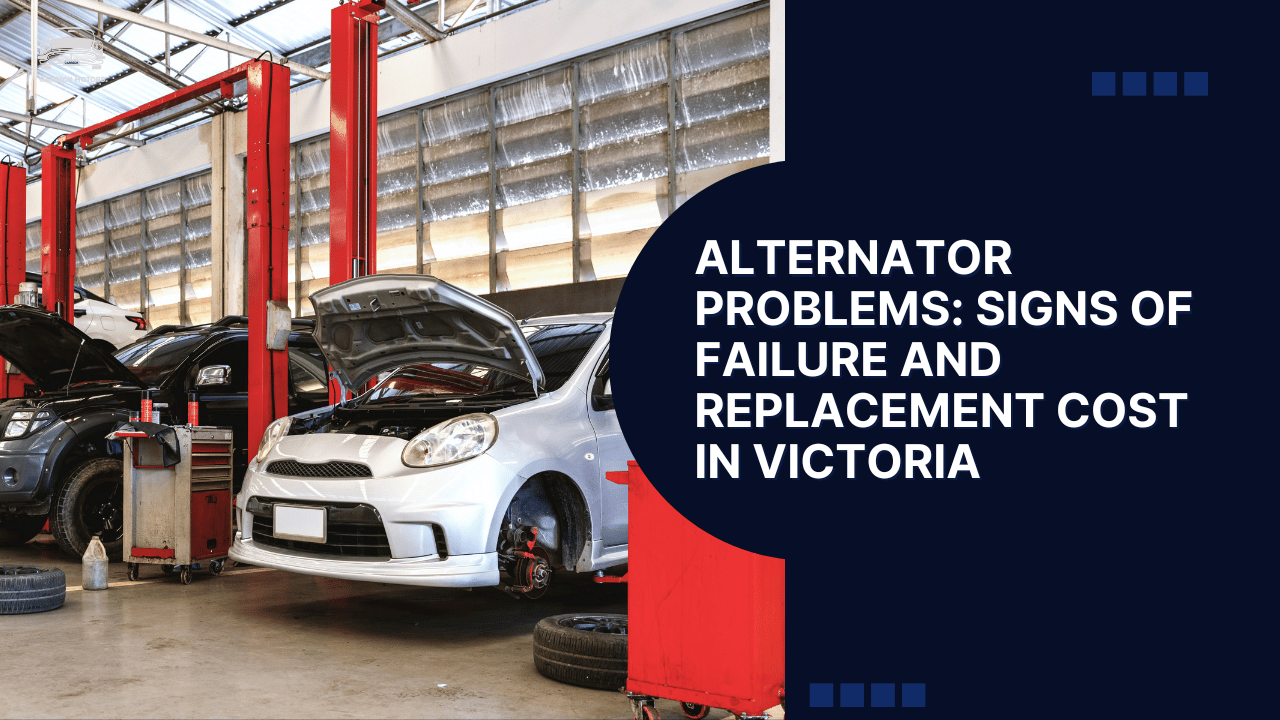
Alternator replacement in Tullamarine costs $400 to $900 for most vehicles, rising to $700 to $1,400 for European and luxury models. Alternators last 150,000 to 250,000 kilometres, or 7 to 12 years, though a worn belt, electrical fault, or manufacturing defect can end one early. The alternator charges the battery and runs every electrical system while the engine turns. Lose it and the car falls back on the battery alone, usually good for only 20 to 30 minutes before everything shuts down and the engine stalls. Carrick Motors on Carrick Drive diagnoses and replaces alternators for drivers across Tullamarine, Airport West, and Gladstone Park. This guide covers how the alternator works, the warning signs, what causes failure, and what replacement costs.
How Your Alternator Works
The alternator turns engine motion into the electricity your car runs on. A belt off the crankshaft spins the alternator’s rotor, generating alternating current that’s rectified to the direct current the vehicle uses. It does three jobs at once, and all three matter.
It generates power for everything electrical while you drive, the ignition, fuel injection, lights, climate control, and every accessory, so the battery isn’t drained during normal running. It recharges the battery, replenishing the big hit the battery takes each time you start the engine, which is why long drives restore charge that short trips can’t. And it regulates voltage, holding a steady 13.5 to 14.5 volts regardless of engine speed, so the battery charges safely and sensitive electronics aren’t damaged by spikes.
That regulated, continuous supply is the point. The battery’s real job is starting the engine and covering brief demand peaks. Once the engine runs, the alternator carries the load and tops the battery back up. When the alternator quits, the battery is left doing a job it was never meant to sustain, and it doesn’t last long.
Signs Your Alternator Is Failing
Alternator faults show through the lights, the electrics, and the battery, and they usually build over days rather than striking all at once. Watch for these:
- Battery warning light. A battery-shaped icon, or “ALT” or “GEN”, on the dash means a charging fault, often the first sign. It may flicker before staying on, and once lit the car is running on battery alone. Get it diagnosed straight away.
- Dimming or flickering lights. Headlights that dim at idle and brighten when you rev, or interior lights that pulse, point to weak or unsteady output. The battery is propping up demand the alternator can’t meet.
- Slow or glitchy electrics. Power windows crawling, the infotainment resetting, gauges behaving oddly, or warning lights flashing at random. Low voltage upsets the computers and modules that need a stable supply.
- A battery that keeps going flat. A fairly new battery repeatedly draining or needing jump-starts usually means the alternator isn’t recharging it, not that the battery itself has failed.
- Whining or grinding noise. A whine that rises with engine speed points to a worn alternator bearing, and grinding means the bearing is far gone. A squeal on startup can be a loose drive belt.
- Burning smell. An electrical burning smell means overheated wiring or an overworked alternator, and a rubbery smell means a slipping belt. Either is a fire risk worth investigating at once.
- Engine stalling. Severe failure starves the ignition and fuel injection of power and the engine cuts out, taking the power steering and brake assist with it. Pull over safely.
A charging light or a battery that won’t stay charged is your cue to get the system tested before it strands you. Alternator work sits within our all cars mechanical repairs service, where the battery and charging system are tested together before quoting.
What Causes Alternator Failure
Most alternators fail from normal wear, but belts, electrical faults, and the environment speed it up. Knowing the causes helps the next one last.
Normal wear is the main path. The bearings that support the rotor spinning at high speed wear from heat and friction, the carbon brushes that transfer current to the slip rings wear down over thousands of hours, and the diodes that convert AC to DC can fail from years of heat cycling. Any of these ends the alternator’s life, typically well past 150,000 km.
Belt problems are the big avoidable cause. A loose or worn drive belt slips, so the alternator underspins and undercharges, and a broken belt stops it dead, often taking the water pump and power steering with it since they usually share that belt. Regular servicing that checks belt condition and tension heads this off. Electrical faults do their own damage: a failing battery forces the alternator to run flat-out and wear fast, while corroded or loose connections add resistance and heat. And the environment plays a part, with engine-bay heat ageing the internals, water ingress from flooding or pressure-washing damaging them, and oil from a leak contaminating the seals.
Alternator Testing and Diagnosis
Testing confirms the alternator is the fault before it’s replaced, which matters because a battery or a belt can produce the same symptoms. The check runs in three parts.
Voltage testing comes first. With the engine running, the battery should read 13.5 to 14.5 volts. Below 13 means the alternator isn’t charging, above 15 means it’s overcharging, and the voltage should hold steady when you switch on the headlights, blower, and demister rather than sagging. Output testing goes further, measuring the alternator’s amperage against spec, and a ripple test on an oscilloscope catches failed diodes that a basic voltage check misses. Component testing finishes it: the belt is checked for wear and tension, the connections for corrosion, and the battery itself is tested, since a faulty battery both mimics and causes alternator problems.
Getting this right saves real money. Replacing an alternator when the battery was the fault, or a battery when the alternator was the fault, leaves you paying twice and still stranded. A proper diagnosis rules each part in or out before anything is bought.
Alternator Replacement Cost in Tullamarine
Cost tracks the vehicle and how easy the alternator is to reach. Small cars like a Yaris, Mazda 2, or Getz run $400 to $650. Medium cars such as a Corolla, Mazda 3, or i30 sit at $450 to $750. Large cars like a Camry or Mazda 6 land at $500 to $850, and SUVs such as a RAV4, CX-5, or Tucson at $500 to $900. European vehicles from BMW, Audi, Mercedes, or VW reach $700 to $1,400 on premium parts and tighter access, and performance cars $600 to $1,200 on higher-output units.
The alternator itself is $200 to $500 standard, $350 to $800 for OEM, and $450 to $900 for European. Labour runs $100 to $200 where access is easy and $200 to $400 where other parts must come off first. A few extras often come up: a drive belt at $30 to $80 is worth doing at the same time, and a battery at $150 to $400 if undercharging has damaged it. On part choice, a new alternator costs more but often carries a longer warranty, while a quality remanufactured unit gives good value with a solid warranty. These bands line up with the wider market once labour is counted.
Alternator vs Battery Problems
Telling the alternator from the battery is where drivers most often waste money, since the two overlap. The difference is in *when* the trouble shows.
An alternator fault shows while driving: the warning light comes on, the lights dim and vary with engine speed, several electrical systems play up at once, and the battery keeps going flat despite being sound. A battery fault shows mainly at startup: slow cranking, trouble starting after the car has sat, a battery over three or four years old, but normal running once the engine is going.
The jump-start test settles most cases. If a jump gets you going but the car dies again while driving, the alternator isn’t charging. If it starts fine for days and then won’t start one cold morning, the battery is the likely culprit. Voltage confirms it, 13.5 to 14.5 volts running points to a healthy alternator, under 12.4 volts at rest points to a tired battery. Checking both, rather than guessing, is the only way to replace the right part. Getting the charging system looked at during a regular car service catches a weak alternator or battery before it leaves you stuck.
The Replacement Process
Knowing the steps explains the cost. The job runs in four stages. Diagnosis comes first, confirming the alternator has failed and ruling out the belt, connections, and battery, then matching a replacement to the vehicle’s amperage rating. Removal follows: the battery is disconnected for safety, the drive belt released off the tensioner, the wiring removed with positions noted, and the mounting bolts undone to free the alternator, sometimes after taking off other parts for access.
Installation reverses it, bolting the new alternator in to the correct torque, reconnecting the wiring, routing the belt with proper tension, and reconnecting the battery. Verification finishes the job by checking charging voltage with the engine running, confirming it holds steady under electrical load, and making sure the warning light goes out.
Preventing Alternator Problems
A little attention gets the most life from an alternator, and it centres on the belt and the battery. Have the drive belt inspected at every service for cracks, glazing, and wear, keep its tension correct since a loose belt slips and an overtight one stresses the bearings, and replace a worn belt before it fails and strands you. A scheduled engine oil and filter service is a natural time to have all this checked.
Look after the electrical side too. Keep a healthy battery in the car, since a failing one overworks the alternator, and keep the battery and alternator connections clean and tight to avoid resistance and heat. Don’t overload the system with more aftermarket electrical accessories than it was built for. And protect the alternator from the environment: avoid aiming a pressure washer at it, steer clear of deep water, and fix any oil leak dripping onto it before the contamination does damage. If your battery keeps going flat, get the charging system diagnosed rather than just fitting battery after battery.
How to Book Your Alternator Service
Booking with Carrick Motors takes one call. Ring +61 3 9330 1082 or message the workshop on WhatsApp, and we test the battery, charging voltage, belt, and connections to confirm the real fault before quoting. We service all makes and models, fit quality new or remanufactured alternators with a warranty, and offer free pick-up and drop-off within 10 km of Tullamarine. If the charging light is on, don’t switch the engine off, drive straight to us or call and we’ll come to you.
Frequently Asked Questions
How do I know if it’s the alternator or the battery?
The timing tells you. An alternator fault shows while driving, with a warning light, dimming lights, and electrical glitches. A battery fault shows at startup, with slow cranking or a no-start, but normal running once going. Voltage confirms it: below 13 volts with the engine running points to the alternator, below 12.4 volts at rest points to the battery.
Can I drive with a bad alternator?
Briefly. The car runs on battery power alone, usually 20 to 30 minutes depending on load. Turn off the AC, radio, and any unnecessary lights to stretch that, and drive straight to a workshop. Don’t switch the engine off, since you may not be able to restart it. A long trip on a failing alternator will leave you stranded.
How long do alternators last?
Alternators last 150,000 to 250,000 kilometres, or 7 to 12 years. Driving conditions, electrical load, belt maintenance, and heat all affect it. Some fail early from a manufacturing defect, water damage, or the extra load of aftermarket accessories. Keeping the belt and battery healthy pushes an alternator toward the top of that range.
Why is my new battery going flat?
A new battery repeatedly going flat usually means the alternator isn’t recharging it while you drive. Other causes are a parasitic drain, something staying powered with the car off, or short trips that never allow a full recharge. Since a good battery shouldn’t drain in normal use, have the charging system tested to find the real cause.
Can a bad alternator damage the battery?
Yes. An undercharging alternator lets the battery sulfate, permanently cutting its capacity, while an overcharging one from a failed voltage regulator boils off electrolyte and damages the plates. If your alternator failed and the battery ran deeply flat, have the battery tested too, as it may need replacing alongside the alternator.
How much does alternator replacement cost in Tullamarine?
Alternator replacement costs $400 to $900 for most vehicles in Tullamarine, or $700 to $1,400 for European models. The alternator is $200 to $800 depending on type and labour makes up the rest. A remanufactured unit with a warranty can lower the parts cost, and a drive belt is often worth replacing at the same time.
What happens when an alternator fails completely?
Complete failure leaves the car running on battery alone. The warning light comes on, the lights dim, electrical systems drop out one by one, and once the voltage falls too low the engine stalls, taking the power steering and brake assist with it. That’s why a charging fault is addressed promptly rather than driven on.
Should I replace the drive belt with the alternator?
Usually yes, if the belt shows any wear. It’s already being removed to reach the alternator, so replacing it then adds only the part cost, $30 to $80, not another labour charge. A worn belt left in place can slip and undercharge the new alternator, so doing both together protects the repair and saves a future visit.
Alternator failure brings warning lights, dead batteries, and eventually a stalled car, while replacement costs $400 to $900 and proper testing makes sure you replace the right part. Don’t ignore a charging light or a battery that keeps dying. Call Carrick Motors on +61 3 9330 1082 to book your alternator replacement in Tullamarine today.