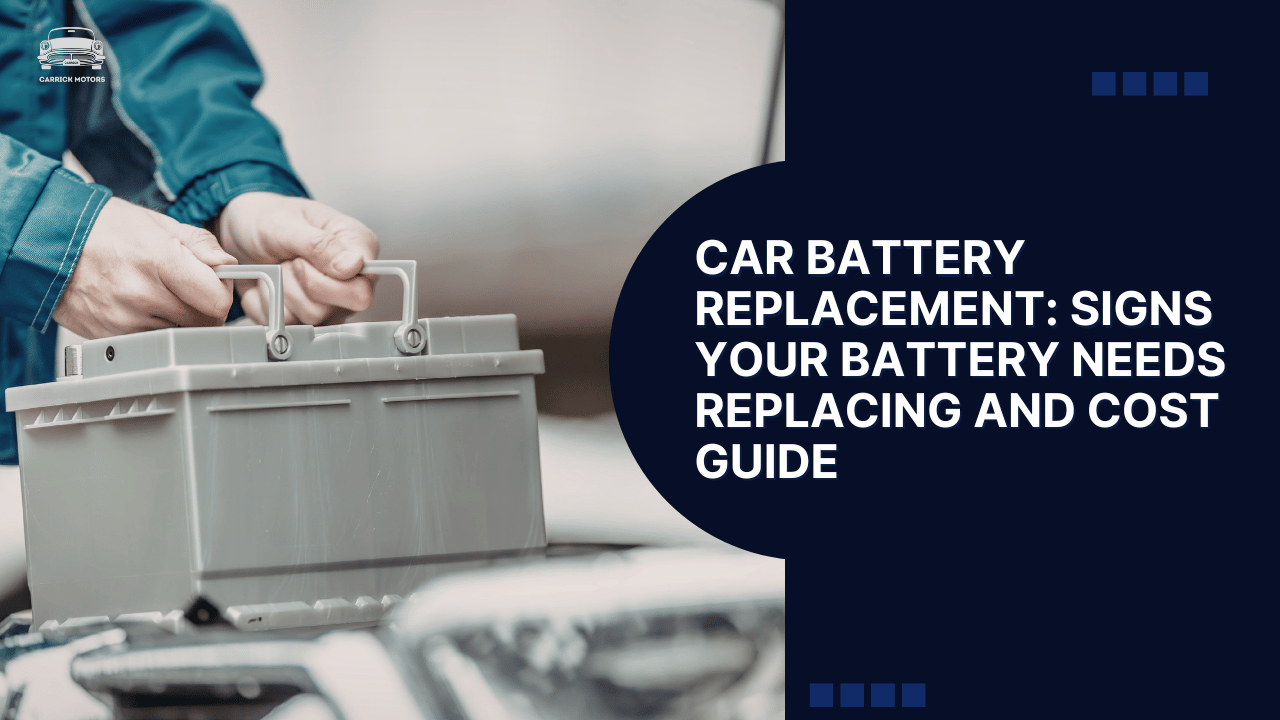
Car battery replacement in Tullamarine costs $150 to $350 for most passenger vehicles including the battery and professional installation, rising to $250 to $500 for European cars and start-stop vehicles that need AGM batteries. Most batteries last three to five years, with climate, driving pattern, and electrical load deciding where in that range yours lands. A failing battery rarely dies without warning, so recognising the early signs, slow cranking, dim lights, a dashboard warning, lets you replace it on your terms rather than being stranded. Melbourne’s summer heat is especially hard on batteries, so Tullamarine drivers often see failures in the hot months and the cold mornings that follow. Carrick Motors on Carrick Drive tests and replaces batteries for drivers across Tullamarine, Airport West, and Gladstone Park. This guide covers the warning signs, battery types, costs, and how to make a battery last.
Signs Your Battery Needs Replacing
A battery usually warns you before it fails completely, and acting on those signs prevents the roadside breakdown. Watch for these:
- Slow engine cranking. The most common sign. The engine turns over sluggishly, the starter sounds laboured, and it may take several attempts to fire, getting worse over days. A weak battery can’t deliver the 100 to 300 amps the starter needs, and cold mornings make it worse. Once cranking slows, the battery can fail entirely without much more warning, so get it tested promptly.
- Dashboard battery warning light. The battery-shaped light means a charging-system problem, which could be the battery, the alternator, or the wiring. The car may keep running on alternator power, but the battery isn’t charging properly, so it needs diagnosis rather than ignoring.
- Electrical system problems. Dim headlights at idle, weak interior lights, slow power windows, an infotainment system that resets, or sluggish central locking all point to insufficient voltage. The symptoms often worsen when several systems run at once.
- A swollen or bloated battery case. Bulging sides or a case that’s no longer flat mean internal damage from overcharging or extreme heat. A swollen battery needs immediate replacement and should never be charged or jump-started, since it risks rupture and acid leakage.
- Corroded terminals. White, blue, or greenish powder on the terminals creates resistance that cuts charging and starting current, and severe corrosion can prevent starting entirely. Cleaning helps, but corrosion that keeps coming back points to a battery leaking acid.
- Age over three years. Batteries degrade with age regardless of how they seem. Test at three years, test and consider replacing at four, and replace at five or more even without symptoms, since failure becomes likely.
- Frequent jump-starts. An occasional jump after leaving the lights on is normal, but repeated jumps mean the battery can’t hold charge, or something else, an alternator fault or a parasitic drain, is at play and needs diagnosis.
Any of these, especially slow cranking or a warning light, is your cue to have the battery and charging system tested. Battery testing sits within our all cars mechanical repairs service, where the charging system is checked at the same time.
Types of Car Batteries
Choosing the right battery type matters, since fitting the wrong one shortens its life or fails to meet the car’s demands.
Flooded lead-acid is the traditional, most affordable type using liquid electrolyte, at $120 to $200. It suits older vehicles and cars without high electrical demands or start-stop systems, and it’s the budget choice where lowest cost is the priority. Enhanced flooded batteries (EFB) improve on that with better deep-cycle capability and charge acceptance, at $180 to $280, and they suit entry-level start-stop vehicles and higher-demand applications, lasting longer than standard flooded units while staying maintenance-free.
Absorbent glass mat (AGM) is the premium technology, completely sealed and maintenance-free with superior vibration resistance, faster recharging, and better deep-discharge recovery, at $250 to $450. It’s required for most start-stop vehicles, premium and European cars, and vehicles with regenerative braking. Lithium-ion batteries are lighter with higher energy density and long life, at $400 to $800-plus, but they’re used only in specific vehicles designed for them and performance applications where weight matters. Matching the battery to the car’s specification is essential, and it’s confirmed automatically with professional installation.
Battery Replacement Cost in Tullamarine
Cost tracks the battery type and the vehicle. By type, a standard flooded battery runs $150 to $250 installed, an EFB $200 to $320, an AGM $280 to $450, and a European-spec battery $300 to $500. By vehicle, small cars like a Yaris or Mazda 2 sit at $150 to $220, medium cars like a Camry or Mazda 3 at $180 to $280, SUVs like a RAV4 or CX-5 at $200 to $320, and European vehicles from BMW, Mercedes, or Audi at $300 to $500 since they usually need AGM. 4WDs with dual-battery setups run $200 to $350 for the primary and $200 to $400 for the auxiliary.
Several things move the price within those ranges. Battery size and capacity matter, since larger batteries with higher amp-hour ratings cost more, and technology matters, with AGM dearer than EFB and EFB dearer than flooded. Brand plays a part, as premium names like Bosch, Varta, and Century cost more than budget units but last longer and warrant better. Installation is usually simple, but some cars locate the battery in the boot, under a seat, or behind trim, adding labour, and many European vehicles need the new battery registered through diagnostic equipment so the charging system recognises it. These figures line up with the wider market once installation is counted.
What Affects Battery Lifespan
Understanding what wears a battery out helps you get more years from each one, and climate is the biggest single factor in Australia. Summer heat is the real killer: under-bonnet temperatures over 50°C speed up the internal chemical reactions and evaporate electrolyte, so Tullamarine’s hot months quietly degrade the battery, and the following winter’s cold, which temporarily cuts capacity and demands more starting current, is often when that hidden damage finally shows as a failure.
Driving pattern matters nearly as much. Frequent short trips never fully recharge the battery, since starting draws it down and a brief drive doesn’t restore it, so chronic undercharging accelerates capacity loss, a common issue for local Tullamarine driving. Extended parking discharges the battery through the small parasitic drain modern cars draw for security and memory, while regular highway driving does the opposite by allowing a full recharge. Electrical load adds to it too: infotainment, heated seats, aftermarket dash cameras and audio, and above all start-stop systems that restart the engine at every set of lights all demand more from the battery. Finally, maintenance counts, since clean terminals, secure mounting, and a healthy charging system all extend battery life, which is why a regular car service that checks the charging system helps.
Battery Testing and Diagnosis
Professional testing matters because the battery isn’t always the real fault, and replacing it when the alternator or a drain is to blame leaves you stranded again. Testing runs in three parts. A load test applies a controlled load while measuring the voltage response, showing the battery’s capacity, cold-cranking ability, and internal resistance, and returning a clear good, marginal, or replace result. A charging-system test checks the alternator output, voltage regulator, belt, and wiring, since a charging fault can mimic or cause a battery problem. And a parasitic-drain test measures the current drawn with the car off, tracking down a faulty module or accessory when a battery keeps dying overnight.
Together these identify the actual problem rather than assuming the battery. That distinction saves money: fitting a new battery to a car with a failing alternator just flattens the new battery too, and chasing a parasitic drain is cheaper than repeatedly replacing batteries that were never the fault. If your battery keeps dying, the charging system is worth diagnosing as part of the alternator and electrical check before spending on a replacement.
Replacing Your Battery
Some drivers replace a battery themselves, and on an accessible, standard battery with no coding requirement it’s achievable with basic tools, disconnecting the negative terminal first and handling the heavy battery carefully. But the complications catch people out: disconnecting the battery can wipe radio codes and memory settings, many European cars need the new battery registered through diagnostic equipment or the charging system mismanages it, and an incorrect fit or specification causes problems down the track.
Professional installation avoids all of that. A technician verifies the correct specification, fits and secures the battery properly, preserves the car’s memory with a memory saver so no radio codes are lost, performs any required coding, and disposes of the old battery responsibly since it’s hazardous waste. The work is also tested afterward, confirming charging voltage of around 13.8 to 14.4 volts with the engine running, all electrical systems working, and no warning lights, and it comes with a workmanship warranty alongside the manufacturer’s battery warranty. For the sake of a modest labour cost, professional fitting removes the coding, disposal, and memory headaches entirely.
Battery Maintenance Tips
A few simple habits extend battery life and prevent early failure. Inspect it monthly for corrosion, damage, or leaks and confirm it’s mounted securely, since vibration from a loose battery causes internal damage. Have it tested annually during servicing, and ideally before summer’s heat and before winter’s cold demands, so a weakening battery is caught before it strands you.
Keep the terminals clean, removing the negative cable first, cleaning with a baking-soda solution or terminal cleaner until the metal is bright, then protecting them with a terminal spray to slow corrosion. Protect the charge too: turn off lights and accessories when the engine is off, address warning signs before the battery fully discharges, and use a battery maintainer during extended storage. And drive regularly, since a weekly run of 20-plus minutes keeps the battery charged, while a maintainer suits a car that sits unused for long periods. These small steps, bundled into a regular engine oil and filter service, keep the battery healthy for its full life.
How to Book Your Battery Service
Booking with Carrick Motors takes one call. Ring +61 3 9330 1082 or message the workshop on WhatsApp, and we load-test the battery and check the charging system to confirm whether it’s the battery, the alternator, or a drain before quoting. We service all makes and models, fit quality batteries from reputable brands with proper coding where required, dispose of the old battery responsibly, and offer free pick-up and drop-off within 10 km of Tullamarine. If your car won’t start, don’t keep jump-starting it indefinitely, since that hides the real fault, so call and we’ll test it properly.
Frequently Asked Questions
How long do car batteries last in Tullamarine?
Car batteries typically last three to five years in Tullamarine conditions. Hot summers accelerate the degradation, which often shows up as a failure during the following winter when cold cuts capacity. Batteries in cars driven mainly on short trips fail sooner from chronic undercharging. A quality battery with proper maintenance reaches the longer end of that range.
Can I replace my car battery myself?
Yes, if you’re mechanically inclined and the battery is accessible, though there are catches. Disconnecting the battery can erase radio codes and memory settings, and many modern vehicles, especially European ones, require the new battery to be coded through diagnostic equipment. Professional installation ensures the correct specification, proper coding, preserved memory, and responsible disposal, which is why many drivers prefer it.
How do I know what size battery my car needs?
Your battery specification is in the owner’s manual, on the existing battery label, or in a workshop database. The key figures are the group size (physical dimensions), cold cranking amps (CCA), and reserve capacity (RC). A replacement should meet or exceed the original specification, since an undersized battery fails early and an oversized one may not fit the tray.
Why does my car battery keep dying?
Recurring battery death has three main causes: a failing battery that won’t hold charge, a charging-system fault where the alternator isn’t recharging it, or a parasitic drain from a faulty module or aftermarket accessory. A new battery dying repeatedly usually points to the alternator, while a battery dying after sitting points to a drain. Professional diagnosis identifies which, so you fix the real cause.
Should I replace my battery before winter?
Yes, if it’s aged or showing any weakness. Batteries over four years old should be tested before winter, since cold temperatures reduce capacity while demanding more starting current, and a marginal battery that coped in summer often fails on the first cold morning. Proactive replacement avoids being stranded, and it’s far less hassle than a breakdown.
What’s the difference between CCA and Ah ratings?
Cold Cranking Amps (CCA) measures starting power, the current available to crank the engine in cold conditions, while Amp-hours (Ah) measures total capacity, how long the battery can supply current. High CCA ensures reliable starting; adequate Ah supports the electrical accessories. Both should meet or exceed the original specification for proper performance.
Is it worth buying a more expensive battery?
Often yes. A quality AGM battery may last six years against three for a budget unit, making the total cost similar while giving fewer replacements and better reliability. Premium batteries also cope better with the extreme heat common in Tullamarine. It’s worth weighing total ownership cost rather than purchase price alone, particularly for a car you rely on daily.
How much does battery replacement cost in Tullamarine?
Battery replacement costs $150 to $350 for most vehicles in Tullamarine, or $250 to $500 for European cars and start-stop vehicles needing AGM batteries. The price depends on the battery type, the vehicle, and the brand. Professional installation includes testing, any required coding, and responsible disposal of the old battery, so the quoted figure covers the whole job.
Car batteries last three to five years and rarely fail without warning, so acting on slow cranking, dim lights, or a warning light lets you replace on your terms rather than being stranded. Replacement runs $150 to $500, and proper testing makes sure you fix the battery, not the alternator or a drain, by mistake. Call Carrick Motors on +61 3 9330 1082 to book your battery test or replacement in Tullamarine today.