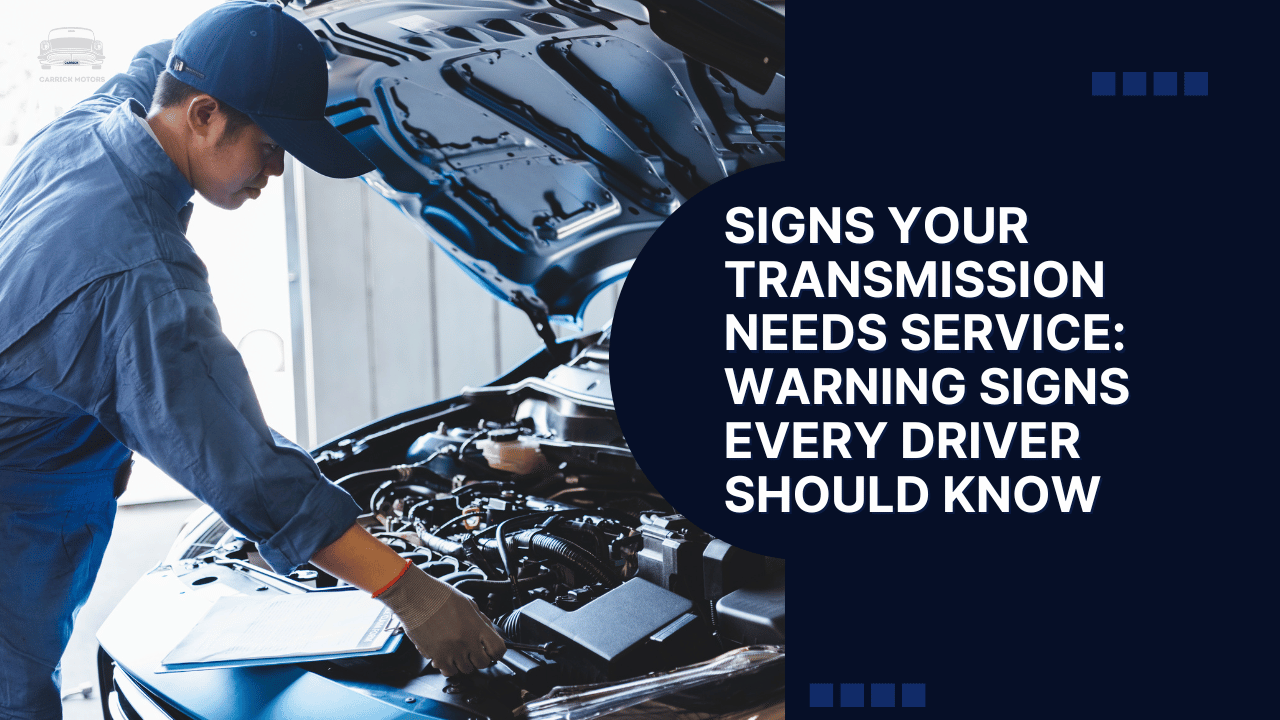
Your transmission warns you before it fails, through delayed gear engagement, harsh or jerky shifting, slipping between gears, unusual noises, fluid leaks, a burning smell, dashboard warning lights, and changes in the fluid’s condition. Catching these signs early means a repair costing hundreds rather than a replacement costing thousands, since transmission problems almost always worsen when ignored. The transmission transfers engine power to the wheels through hundreds of precision components working under extreme heat and pressure, so recognising trouble early protects one of the most expensive systems in your car. Carrick Motors on Carrick Drive diagnoses and services transmissions for drivers across Tullamarine, Airport West, and Gladstone Park. This guide walks through the warning signs, what causes them, and what service costs.
How Your Transmission Works
Transmissions vary in design but share the same job, and understanding the basics helps you recognise trouble. An automatic transmission uses hydraulic fluid pressure to engage clutches and bands, selecting the right gear ratio without any input from you, while a torque converter transfers power from the engine and lets the car stop without stalling. Because the whole system runs on fluid pressure, degraded fluid compromises every function at once, which is why fluid condition is central to an automatic’s health.
A manual transmission relies on you working the clutch and gear lever, with synchronisers matching shaft speeds so gears engage smoothly. It’s mechanically simpler than an automatic but still needs proper maintenance to last. A CVT (continuously variable transmission) uses a steel belt or chain running between variable-diameter pulleys to provide an infinite range of ratios, and it’s particularly sensitive to fluid condition, showing symptoms quickly when the fluid degrades. Whichever type you drive, the transmission service requirements differ, so using the correct fluid and interval for your specific gearbox matters.
The Warning Signs of Transmission Trouble
Transmission faults announce themselves in a handful of recognisable ways. Catching any of them early is what separates a minor repair from a major one.
Delayed gear engagement is often the first sign. A healthy transmission responds promptly when you shift from Park to Drive or Reverse, so a noticeable pause of one to three seconds, or the revs rising before the car moves, points to trouble. Low or degraded fluid, worn clutch packs, or a failing valve body are the usual causes, and the delay is often worse when the transmission is cold and eases as it warms, which points to a fluid-related issue.
Harsh or jerky shifting is the next. Smooth transitions are the mark of a healthy transmission, so abrupt, jarring gear changes, the car lurching on upshifts or downshifts, or shift quality that swings between smooth and harsh all signal a problem. Depleted friction modifiers in the fluid, the wrong fluid specification, worn clutch packs, valve body wear, or an electronic control fault can all cause it, and continued harsh shifting accelerates internal wear, so it’s worth acting on rather than living with.
Slipping is one of the more serious signs. It happens when the transmission can’t hold the selected gear, so the engine revs climb without matching acceleration, and you feel a momentary loss of drive as if the engine and wheels have briefly disconnected. Worn clutch packs, low fluid, degraded fluid, or worn bands are behind it, and slipping generates excessive heat and debris that damage the transmission fast, so continued driving makes it dramatically worse.
Noises, Leaks, and Smells
Three more signs come through your senses rather than the gear selector, and each points somewhere specific.
Unusual noises vary by cause. A constant whining or humming that changes pitch with speed suggests bearing wear or a pump problem, often worsened by low fluid causing the pump to cavitate. Grinding when shifting a manual points to worn synchronisers making metal-to-metal contact, while heavy clunking suggests worn mounts or damaged internal components and needs prompt attention. A buzzing sound can mean a torque converter issue or fluid flowing through a worn valve body. Noting when the noise happens and what makes it better or worse helps diagnosis a great deal.
Fluid leaks show as red or pink fluid, darkening to brown with age, pooling under the centre or front of the car. The common sources are a deteriorated pan gasket, worn output or input shaft seals, loose cooler-line connections, or aged case seals. Because a transmission doesn’t consume fluid in normal use, any leak means a component is failing, and low fluid quickly causes overheating and accelerated wear, so topping up is only a temporary measure while the leak is fixed. A burning smell, meanwhile, means the fluid is overheating and breaking down, from low fluid, a blocked cooler, slipping clutches, or heavy towing. Overheated fluid loses its protective properties and damages seals, clutches, and electronics, so a burning smell means don’t keep driving long distances, get it checked.
Warning Lights and Fluid Condition
The last two signs are the ones a careful driver catches early. Dashboard warning lights on modern cars flag transmission trouble directly: the check engine light can illuminate for transmission fault codes, a transmission temperature warning signals overheating, and some cars have a dedicated transmission light. Severe problems trigger limp mode, which locks the car into a single gear to protect the transmission and lets you drive gently to a workshop while restricting normal operation. When a transmission warning appears, it’s safest to stop when you can, check the fluid if accessible, and arrange diagnosis promptly, since the stored fault codes point straight at the problem area.
Fluid condition is the most direct window into transmission health. Healthy fluid is bright red or pink, clear, and mild-smelling, while dark brown or black fluid signals severe degradation, a burnt smell confirms overheating, a milky look means coolant has contaminated it, and visible particles indicate internal wear. On cars with a dipstick you can check the level, colour, and smell yourself, while sealed transmissions need a professional check. Assessing the fluid during regular servicing often catches developing problems before any symptom appears, which is the whole point of preventive maintenance.
What Causes Transmission Problems
Most transmission trouble traces back to the fluid, to mechanical wear, or to how the car is driven, and understanding the causes helps prevent a repeat. Fluid causes lead the list: a low level from a leak, degraded fluid that has lost its friction modifiers and viscosity, the wrong fluid specification for the gearbox, or contamination from water or coolant all compromise operation. Because the fluid does so much, keeping it correct and fresh prevents a large share of failures.
Mechanical wear is the second cause. All components wear with use, and while proper maintenance extends their life it can’t prevent eventual wear, though poor fluid maintenance, overheating, or overloading accelerate it well beyond normal rates, and some transmissions simply suffer design flaws. Operating conditions round it out: towing, heavy loads, stop-start traffic, and hot climates all raise operating temperature and speed up fluid degradation, exceeding the vehicle’s capacity stresses components beyond their limits, and aggressive driving or riding a manual clutch adds wear. Heat is the common thread through most of these, which is why cooling and fluid condition matter so much.
Transmission Service Costs in Tullamarine
Cost depends entirely on what the transmission needs, from a routine fluid service to a full replacement. Fluid service sits lowest: a drain and fill runs $150 to $300, replacing the accessible 30 to 50 percent of the fluid with a filter where reachable, while a complete flush at $200 to $400 exchanges the full volume including the torque converter. Regular fluid service is the cheapest way to prevent problems and often resolves fluid-related symptoms outright.
Component repairs climb from there: seal replacement for leaks is $200 to $600, a valve body service to fix shift-quality issues is $500 to $1,500, and a torque converter replacement is $600 to $1,200. Major work is the top tier, with a transmission rebuild at $2,000 to $4,500 and a replacement at $3,000 to $7,000, the latter sometimes more economical for a severely damaged unit. The consistent theme is that early intervention costs far less: a $200 fluid service stands against a $4,500 rebuild, so catching a fluid problem before it wears the clutches is the cheapest path by a wide margin. European and luxury vehicles cost more across all tiers. These figures line up with the wider market once labour is counted, and our 2026 car service price guide covers routine servicing costs alongside them. Transmission work is a natural part of a broader mechanical repair capability.
Service or Replace?
Deciding between service and replacement comes down to how much is wrong, and professional diagnosis is what settles it. A fluid service or minor repair is often enough when the symptoms are fluid-related on a transmission with a good maintenance history, when a leak comes from an accessible seal, when shift quality improves with fresh fluid, or when problems have appeared gradually rather than suddenly. These are the cases where catching it early pays off most.
A rebuild or replacement is more likely when there’s metal debris in the fluid indicating severe internal wear, when specific gears are lost entirely, when symptoms persist after a fluid service, or when a catastrophic failure has stopped the car. The difficulty is that many symptoms share several possible causes, so guessing means risking money on the wrong fix. Professional diagnosis using scan tools, fluid analysis, and systematic testing identifies the actual fault rather than assuming, which is why a proper assessment always comes before any major spend, much as it does for a related engine repair or replacement decision.
Preventing Transmission Problems
Most transmission trouble is preventable, and the habits are straightforward. Follow the service schedule by changing the fluid at the manufacturer’s interval, shortening it for severe conditions like towing or heavy traffic, and never assuming a sealed transmission needs no service at all. Always use the correct fluid, since different transmissions need specific formulations and the wrong one causes damage regardless of quality. Monitor the fluid’s level and condition on cars that allow it, and act on any change in colour, smell, or level promptly.
The rest is about heat and habits. Address symptoms early, since minor problems become major failures when ignored, and the difference in cost is enormous. Avoid overloading the car beyond its rated capacity, since that stress often builds gradually before failing suddenly. And allow the transmission to warm up with gentle driving at first, since cold fluid protects less than warm fluid. Bundling a fluid check into every regular car service keeps the transmission on the workshop’s radar so problems are caught before they escalate.
How to Book Your Transmission Service
Booking with Carrick Motors takes one call. Ring +61 3 9330 1082 or message the workshop on WhatsApp, and we diagnose the transmission systematically, checking the fluid, running fault-code scans, and testing operation to identify the real problem before quoting. We service automatic, manual, CVT, and dual-clutch transmissions across all makes and models, recommend only the work your gearbox actually needs, and offer free pick-up and drop-off within 10 km of Tullamarine. If your transmission is slipping, overheating, or showing a warning light, don’t keep driving, since that turns a repair into a replacement, so call and we’ll assess it.
Frequently Asked Questions
Can I drive with transmission problems?
It depends on the severity. Minor symptoms may let you drive carefully to a workshop, but slipping, grinding, a burning smell, or a warning light warrant immediate attention. Continued driving with known problems accelerates the damage and can turn a repairable fault into a replacement, so the safest approach is to get it diagnosed promptly rather than pushing on and hoping it settles.
How long do transmissions last?
Transmissions typically last 150,000 to 300,000 kilometres with proper maintenance, and automatics with regular fluid service often exceed 200,000 km. Neglected transmissions can fail before 100,000 km. Driving conditions, maintenance history, and the vehicle’s design all influence longevity, so regular fluid service is the single biggest factor in reaching the higher end of that range.
What does transmission repair cost compared to replacement?
Repairs range from $200 for a fluid service to $4,500 for a full rebuild, while a replacement runs $3,000 to $7,000. Repair suits a transmission with a specific fault and otherwise good condition, while replacement suits a severely damaged unit where the rebuild cost approaches the replacement value. A diagnosis identifies which applies before you commit to any spend.
Can changing the transmission fluid cause problems?
Properly performed fluid service does not cause problems. The concern is that flushing a severely neglected transmission can dislodge accumulated debris and reveal existing wear, and using the wrong fluid specification causes damage. Professional service using the correct procedure and fluid minimises any risk, which is why fluid changes should follow the schedule rather than being left for years.
Why is my transmission slipping after a fluid change?
Slipping after a fluid change usually means underlying wear that the service revealed rather than caused. Fresh fluid can have less friction than the old degraded fluid that was compensating for worn clutches, so the new fluid exposes the existing problem. It points to internal wear that was already present, and a professional diagnosis identifies the true condition.
Should I buy a car with transmission problems?
Buying a car with known transmission problems carries real risk, since repair costs can exceed the vehicle’s value and the full extent of hidden damage isn’t known until disassembly. A price reduction for the fault rarely matches the actual repair cost. A professional pre-purchase inspection assesses the transmission’s condition before you commit, which is strongly advisable in these cases.
How do I check my transmission fluid?
On a car with a dipstick, check with the engine warm and running in Park: remove the dipstick, wipe it clean, reinsert it fully, then withdraw it to read the level against the markings and assess the colour and smell. Healthy fluid is red to light brown and not burnt. Sealed transmissions without a dipstick require a professional check.
How often should transmission fluid be changed?
It varies by transmission and manufacturer, commonly every 40,000 to 100,000 kilometres, with CVTs and severe-service conditions calling for shorter intervals. Your owner’s manual holds the exact figure. Sealed transmissions still benefit from periodic service despite “lifetime fluid” claims, so it’s worth having the fluid condition assessed at regular services rather than trusting it to last forever.
Your transmission warns you before it fails, and reading those signs, delayed engagement, harsh shifting, slipping, noises, leaks, a burning smell, warning lights, or degraded fluid, lets you fix a problem for hundreds instead of thousands. Don’t ignore the early symptoms. Call Carrick Motors on +61 3 9330 1082 to book your transmission diagnosis in Tullamarine today.