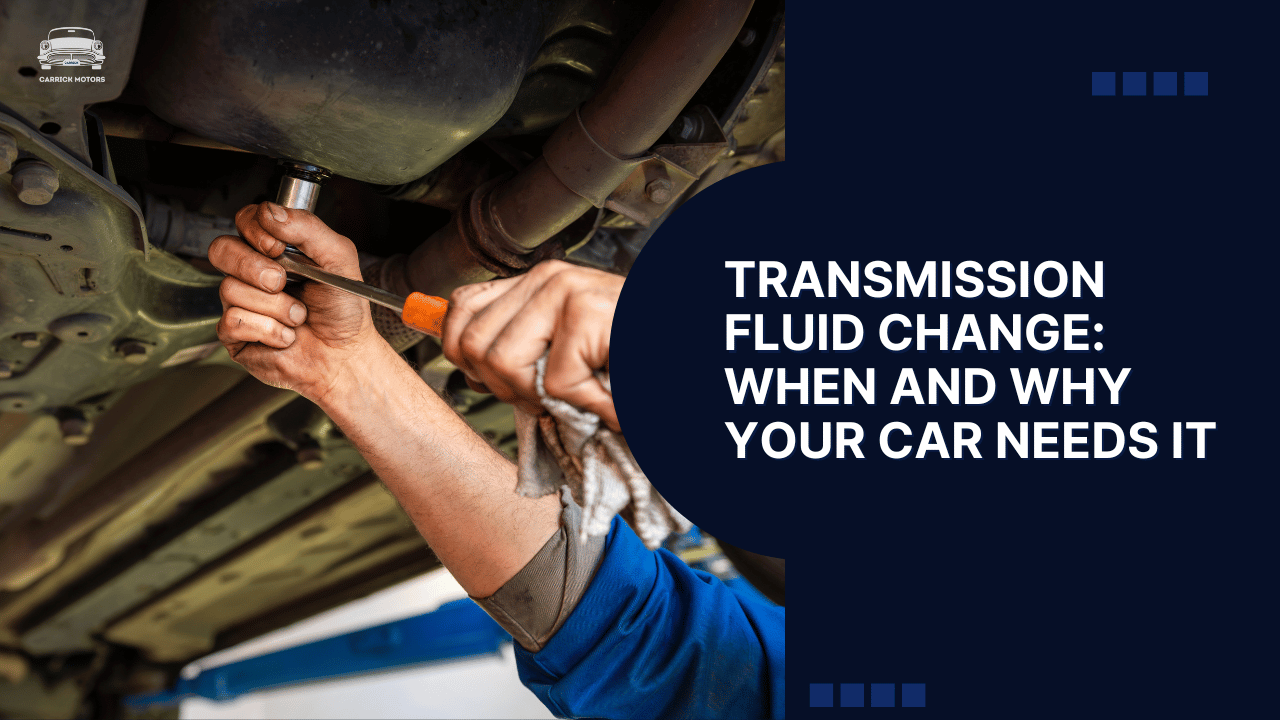
Transmission fluid needs changing every 60,000 to 100,000 kilometres for most automatics and 50,000 to 80,000 kilometres for manuals, with severe conditions cutting those figures roughly in half. Even “sealed” or “lifetime” transmissions benefit from a change at 80,000 to 120,000 km, since fluid degrades through use regardless of the marketing. A change costs $150 to $400, a modest sum against the $3,500 to $7,000 a neglected transmission costs to replace. Fresh fluid keeps gear changes smooth, protects the internals from wear, and extends the transmission’s life dramatically, while degraded fluid turns into a destructive contaminant. Carrick Motors on Carrick Drive services transmission fluid for drivers across Tullamarine, Airport West, and Gladstone Park. This guide explains what the fluid does, the change intervals, the warning signs, the methods, and the costs.
What Transmission Fluid Does
Transmission fluid does far more than lubricate, which is why letting it degrade causes such wide-ranging problems. It performs five jobs at once, and each one fails as the fluid ages.
Its first role is lubrication, creating a protective film between the gears, bearings, shafts, and synchronisers so metal never contacts metal. An automatic’s planetary gear sets and clutch packs, and a manual’s gear meshes and synchronisers, all depend on that film, and thinned, degraded fluid can no longer maintain it. Second is heat dissipation: the friction of clutch engagement and gear contact generates substantial heat, and the fluid absorbs it and carries it to the case and cooler, keeping temperatures within safe limits. Overheated fluid breaks down chemically and forms varnish deposits that restrict flow.
The remaining three roles are just as vital. Hydraulic function is unique to automatics, where pressurised fluid actuates the clutches and bands that select gears, so contaminated fluid causes erratic shifting and delayed engagement. Cleaning sees the fluid suspend wear particles and carry them to the filter, keeping abrasive debris away from sensitive parts, a capability that fades as the fluid exhausts. And friction modification in automatic fluid controls how smoothly the clutches grab, so when those additives deplete you get the harsh shifts and shudder that signal a change is overdue. Because the fluid does all of this, keeping it fresh protects the whole transmission at once.
Types of Transmission Fluid
Using the correct fluid is essential, since the wrong formulation causes damage regardless of quality, and the type depends entirely on your transmission’s design. Automatic transmission fluid (ATF) comes in many specifications: Dexron and Mercon suit many domestic and Asian vehicles, ATF+4 is specific to Chrysler group cars, Toyota uses its own Type T-IV and WS fluids, Honda its ATF-DW1, and European brands like BMW, Mercedes, and Volkswagen specify proprietary fluids where generic ATF is unsuitable. These are not freely interchangeable, and mixing specifications causes problems.
The other transmission types have their own needs. Manual transmissions use gear oil in grades like 75W-90, though some manufacturers such as Honda specify ATF instead, and others need proprietary fluids for proper synchroniser feel. CVT transmissions require CVT-specific fluid, never conventional ATF, since the friction characteristics for a belt-and-pulley system are entirely different and the wrong fluid damages the CVT quickly. And dual-clutch transmissions (DCT) need fluids matched to whether the clutches run wet in oil or dry. Matching the exact specification for your vehicle is the single most important part of the service, which is why log-book servicing selects it automatically. Getting it right is part of every proper car service.
When to Change Transmission Fluid
Change intervals depend on the transmission type, how the car is used, and the manufacturer’s schedule, which your owner’s manual sets out definitively. As a general guide under normal conditions, automatics go every 60,000 to 100,000 km, manuals every 50,000 to 80,000 km, and CVTs every 60,000 to 100,000 km. Under severe conditions all of these roughly halve, to 40,000 to 60,000 km for automatics and CVTs and 30,000 to 50,000 km for manuals.
Two situations deserve extra thought. Sealed or “lifetime” transmissions with no dipstick warrant scrutiny, since manufacturers often define “lifetime” as the warranty period rather than the car’s life, so fluid rated to last 150,000 km qualifies as lifetime if the warranty ends at 100,000. Many transmission specialists recommend a change at 80,000 to 120,000 km regardless, since a $200 to $400 service is cheap insurance against a $3,000 to $6,000 rebuild. Severe service conditions are the other, and they’re more common than drivers realise: frequent towing, heavy loads, stop-start traffic, hot weather over 35°C, and sustained hill climbs all accelerate degradation. Congested driving through Tullamarine, Airport West, and the surrounding suburbs often counts as severe service even without towing, which is worth factoring into your interval.
Signs Your Transmission Fluid Needs Changing
Recognising the symptoms of degraded fluid lets you act before wear sets in. The most direct indicator is fluid colour: fresh fluid is bright red or pink and translucent, darkening through dark red (normal aging, monitor) to brown (service needed soon) to dark brown or black (severe degradation needing immediate attention). On cars with a dipstick you can read this yourself, while sealed transmissions need a professional check. A burnt smell accompanying dark fluid confirms thermal breakdown and calls for immediate replacement, since continued operation risks irreversible damage.
The other signs come through how the car behaves. Shift-quality changes are the clearest, delayed engagement when selecting a gear, harsh or abrupt shifts, slipping where the revs climb without matching acceleration, hunting between gears, or a shudder during engagement, all pointing to depleted additives or contamination. Unusual noises follow, with whining suggesting bearing or pump wear, grinding in a manual indicating synchroniser wear from poor lubrication, and clunking pointing to worn mounts or internal damage. And fluid leaks, red fluid appearing under the car from the pan gasket, shaft seals, or cooler lines, drop the level and cause overheating, so they need addressing before internal damage occurs. Catching these early, ideally at a routine inspection, is the whole point of preventive service.
Drain and Fill vs Flush
Two service methods exist, and the right one depends on the transmission’s condition and history. A drain and fill removes the fluid from the pan, replaces the filter where accessible, and refills, exchanging only the 30 to 50 percent of the total that the drain plug can reach. It’s the cheaper option at $150 to $300, allows the filter to be replaced and the pan inspected, removes the debris that settles in the pan, and takes a conservative approach that suits regular maintenance and neglected transmissions where a gentler method is safer.
A complete flush uses a machine connected to the cooler lines to exchange fluid throughout the whole system, including the torque converter and cooler passages, achieving 90 to 95 percent replacement in one service at $200 to $400. It reaches fluid a drain and fill can’t, and it thoroughly removes contamination when the fluid is in moderate condition, though it often doesn’t include a filter change and carries a caution: flushing a high-mileage transmission with an unknown history can dislodge accumulated debris and cause immediate problems. For that reason, a conservative drain and fill is usually the safer choice for a neglected or high-kilometre transmission, while a flush suits a well-maintained one due for a thorough exchange. Discussing your car’s history with the workshop settles which method fits, and both fall within a full transmission service.
Transmission Fluid Change Cost in Tullamarine
Cost tracks the method, the fluid, and the vehicle. A drain and fill runs $150 to $250 for a standard automatic, $180 to $300 for a CVT, $200 to $350 for a European vehicle, and $100 to $180 for a manual. A flush runs $200 to $350 for a standard automatic, $250 to $400 for a CVT, and $300 to $500 for a European vehicle.
Several factors move these figures. The fluid specification matters most, since generic ATF costs $15 to $25 per litre, manufacturer-specific fluids $25 to $50, and some European fluids over $60. System capacity varies from 4 litres to over 12, scaling the fluid cost, and a filter replacement adds $30 to $100 where the transmission has a serviceable filter. The service provider is the last, with independent workshops typically charging $150 to $300 against a dealership’s $250 to $500 for equivalent work. Whichever applies, the value case is overwhelming: fluid service at $150 to $400 stands against a rebuild at $2,500 to $5,000 or a replacement at $3,500 to $7,000, so regular maintenance costing a few hundred dollars prevents failures costing several thousand. Our 2026 car service price guide sets this alongside other running costs.
Should You Change It Yourself?
Some owners consider a DIY fluid change, and it’s feasible on the right vehicle, one with an accessible drain plug and dipstick, an external filter, and an owner with basic tools and skills. But professional service is the safer call for sealed transmissions without a dipstick, for CVTs and DCTs with precise requirements, and for any car needing diagnostic equipment to check the level in a service mode.
The common DIY mistakes are costly. Using the wrong fluid specification damages the transmission, and getting the level wrong, overfilled or underfilled, causes operational problems, made harder by the fact that many transmissions must be checked at a specific fluid temperature. Some need a particular fill sequence or to be run through the gears during filling, and skipping the filter on a transmission that has one limits the whole exercise. Given that the fluid must be exactly right and the level precise, and that a mistake risks an expensive component, most drivers are better served having it done professionally, where the correct fluid, level, and procedure are guaranteed.
What Happens If You Neglect It
Understanding the consequences of skipping the service makes the case for keeping up with it. In the short term, degraded fluid causes harsh, delayed, or erratic shifting, its reduced heat transfer raises operating temperatures which accelerates further degradation, and contamination begins settling through the system as the fluid loses its suspension capability. None of this is catastrophic yet, but it’s the start of a downward spiral.
Left longer, the effects compound into real damage. Inadequate lubrication allows metal-to-metal contact that wears the gears, bearings, and clutches, contamination accumulates in the valve body and disrupts its function, and depleted friction modifiers cause clutch slippage and band wear. Severe neglect ends in complete failure needing a rebuild or replacement costing thousands. The financial contrast is stark: fluid service across 300,000 km of ownership totals roughly $600 to $1,600, while a single neglect-induced failure costs $3,500 to $7,000, exceeding a lifetime of proper servicing several times over. When a fluid problem is severe enough to threaten the whole unit, it becomes a major mechanical or replacement decision that dwarfs the cost of prevention.
How to Book Your Transmission Service
Booking with Carrick Motors takes one call. Ring +61 3 9330 1082 or message the workshop on WhatsApp, and we’ll inspect the fluid’s condition, recommend a drain and fill or a flush based on your car’s history, and use the exact manufacturer-specified fluid for your transmission. We service automatic, manual, CVT, and dual-clutch transmissions across all makes and models in Tullamarine, Airport West, and Gladstone Park, and offer free pick-up and drop-off within 10 km of the workshop. If your transmission is shifting harshly, slipping, or overdue for a fluid change, don’t wait, since fresh fluid is cheap insurance, so call and we’ll look after it.
Frequently Asked Questions
How do I check my transmission fluid level?
On a car with a dipstick, check with the engine warm and running in Park: remove the dipstick, wipe it clean, reinsert it fully, then withdraw it to read the level against the markings, assessing the colour and smell at the same time. The fluid should sit between the minimum and maximum marks. Sealed transmissions without a dipstick need a professional check using diagnostic equipment or a specific procedure.
Can I mix different transmission fluid brands?
Mixing different brands of the same specification is generally fine, since any fluid meeting a spec like Dexron VI is compatible regardless of brand. But mixing different specifications, such as Dexron with Honda ATF, causes problems and must be avoided. When you’re unsure, a complete fluid exchange using a single correct product eliminates any mixing concern.
What colour should transmission fluid be?
Healthy transmission fluid is bright red or pink and translucent. As it ages it darkens through dark red (acceptable) to brown (service needed soon) to dark brown or black (severe degradation needing immediate attention). A burnt smell alongside dark colour confirms the fluid has broken down. Any significant change from the original bright red means the fluid condition should be assessed.
Is a transmission flush bad for high-mileage vehicles?
It can be, on a high-mileage transmission with an unknown service history. Flushing may dislodge accumulated debris and cause immediate problems in a neglected unit. For that reason a conservative drain and fill is usually recommended for high-mileage vehicles without documented fluid service, since it’s gentler. Discussing your car’s specific situation with a qualified technician settles the safest approach.
How long does a transmission fluid change take?
A drain and fill usually takes 30 minutes to an hour depending on filter access, while a flush takes 45 minutes to 1.5 hours depending on the system capacity and equipment. Allowing up to two hours when scheduling covers any additional inspection or delay. Sealed and European transmissions with specific fill procedures can take longer.
Can changing the transmission fluid cause problems?
A properly performed change does not cause problems. The risks come from using the wrong fluid specification, setting an incorrect fill level, or flushing a severely neglected transmission and dislodging debris. These relate to improper execution rather than the fluid change itself, which is why professional service using the correct fluid and procedure minimises any risk.
What happens if I never change my transmission fluid?
Never changing the fluid leads to progressive degradation and eventual failure. The fluid loses its lubricating properties allowing wear, the friction modifiers deplete causing poor shift quality, contamination builds up and disrupts the valve body, and reduced heat transfer raises operating temperatures. These combined effects eventually cause transmission failure needing a costly rebuild or replacement, far exceeding the cost of routine servicing.
How often should CVT fluid be changed?
CVT fluid should be changed every 60,000 to 100,000 km under normal conditions, or 40,000 to 60,000 km under severe service, using the manufacturer’s CVT-specific fluid. CVTs are particularly sensitive to fluid condition, showing symptoms faster than conventional automatics when the fluid degrades, so keeping to the interval and never substituting regular ATF is especially important.
Transmission fluid keeps your gearbox lubricated, cool, and shifting smoothly, and changing it on schedule, every 60,000 to 100,000 km for most cars, prevents the wear that ends in a multi-thousand-dollar rebuild. A change costs $150 to $400; a failure costs many times that. Call Carrick Motors on +61 3 9330 1082 to book your transmission fluid service in Tullamarine today.