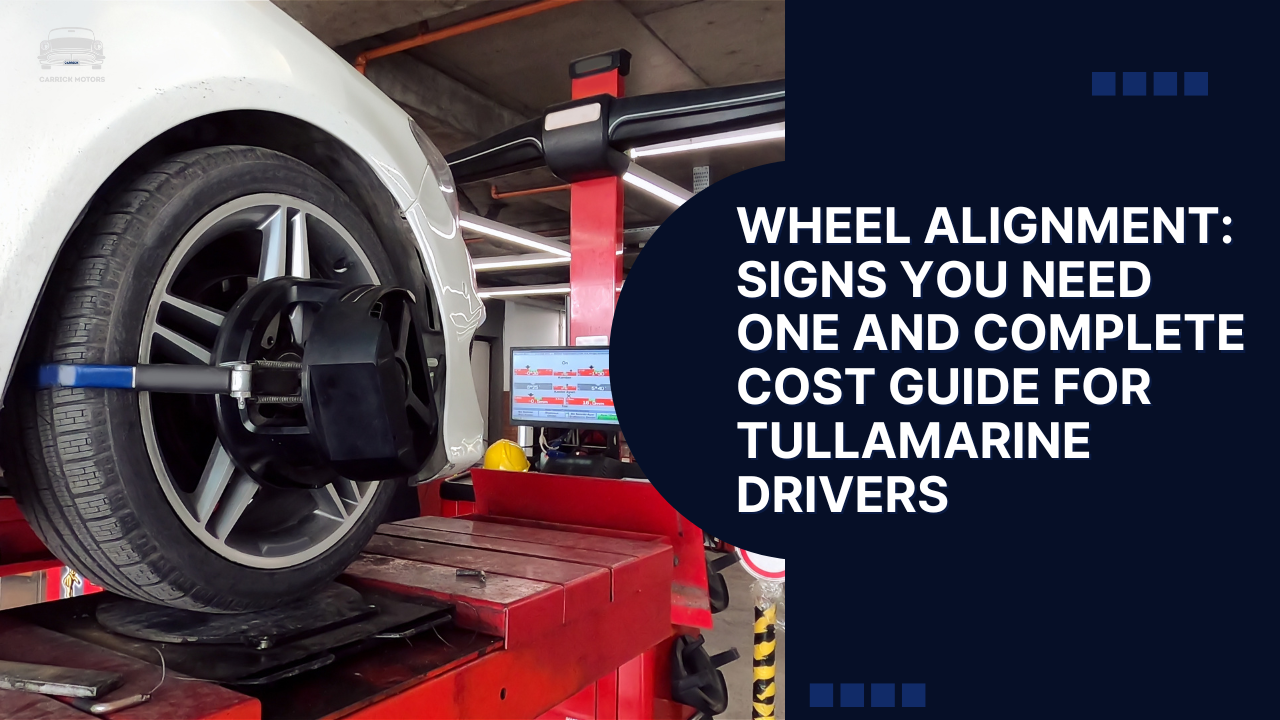
Wheel alignment in Tullamarine costs $79 to $150 for a two-wheel alignment and $99 to $200 for a four-wheel alignment, and most cars need a check every 10,000 to 15,000 kilometres or once a year. The warning signs are hard to miss once you know them: uneven tyre wear, the car pulling to one side, a steering wheel that sits crooked when you’re driving straight, and vibration through the wheel. Proper alignment extends tyre life by up to 25 percent, improves fuel economy, and keeps the car handling safely, while misalignment quietly wears your tyres and suspension and compromises control. Carrick Motors on Carrick Drive provides wheel alignment for drivers across Tullamarine, Airport West, and Gladstone Park. This guide explains the signs, the costs, and everything worth knowing before you book.
What Wheel Alignment Actually Is
Wheel alignment is the adjustment of the angles at which your tyres meet the road, and three angles do the work: camber, caster, and toe. Each affects wear, steering, and stability in its own way, and modern cars specify them in fractions of a degree, so even a small deviation shows up in how the car drives and how the tyres wear.
Camber is the inward or outward tilt of the tyre viewed from the front. Too much positive camber (top tilting out) or negative camber (top tilting in) wears one edge of the tyre and affects cornering grip. Caster is the tilt of the steering axis viewed from the side, and it governs steering feel, straight-line stability, and how well the wheel self-centres after a turn; incorrect caster causes wander and uneven steering effort side to side. Toe is whether the front edges of the tyres point toward each other (toe-in) or away (toe-out) viewed from above, and it’s the angle that wears tyres fastest when it’s wrong, since the tyre effectively scrubs sideways as it rolls.
Getting all three within tolerance does more than protect the tyres. Correct alignment lowers rolling resistance, improving fuel economy by roughly 3 to 5 percent, gives predictable handling in an emergency swerve, and reduces the uneven loading that wears out suspension and steering parts early. It’s a small adjustment with a large effect, which is why it’s central to any tyres, balancing and alignment service.
The Warning Signs You Need an Alignment
Catching alignment problems early saves your tyres and keeps the car safe, and a handful of signs point clearly to a problem.
The most obvious is the car pulling to one side. On a straight, level road with light traffic, a well-aligned car tracks straight with barely any correction, so a consistent drift to the left or right suggests misalignment creating unequal rolling resistance. Before blaming alignment, rule out an underinflated tyre on one side, a dragging brake calliper, or the normal road crown that slopes toward the kerb for drainage; true alignment pull happens consistently regardless of the road.
Uneven tyre wear is the other clear teller, and the pattern reveals the cause. Wear on the inner or outer edge only points to a camber problem, a sawtooth “feathering” you can feel by running your hand across the tread points to a toe problem, and diagonal or patchy wear suggests combined alignment or suspension issues. Comparing the left and right tyres helps, since a big difference between sides flags misalignment affecting one side more than the other. The remaining signs round out the picture: a steering wheel that sits off-centre when you’re going straight, vibration through the wheel that worsens at certain speeds and comes with pulling or wandering, vague or wandering steering that needs constant correction, tyres squealing during ordinary moderate cornering, and any recent pothole or kerb impact, which frequently knocks the alignment out even when no symptom appears yet. Because several of these overlap with worn suspension or steering parts, a proper suspension and steering inspection confirms whether it’s purely alignment or something that needs repair first.
Two-Wheel vs Four-Wheel Alignment
Two alignment types exist, and the right one depends on your car. A two-wheel (front-end) alignment adjusts only the front wheels, measuring the rears for reference but not adjusting them, and it takes around 30 to 45 minutes. It suits older cars with a solid rear axle and cases where the symptoms are clearly isolated to the front tyres, at $79 to $150 in Tullamarine.
A four-wheel (full) alignment measures and adjusts all four wheels so they work together, taking 45 minutes to 1.5 hours, at $99 to $200. Most modern cars have independent rear suspension where the rear angles can drift and affect both handling and tyre wear, so a four-wheel alignment gives a better result, which is why it’s the standard recommendation for most current vehicles. The extra $20 to $50 over a two-wheel service buys comprehensive correction across the whole car rather than just the front.
What Affects the Cost
Several factors move the price within those ranges. Vehicle type is the biggest, since a standard passenger car aligns quickly on common specifications, while European luxury and high-performance cars often need extra time, specialised equipment, and tighter tolerances. Suspension condition matters too, because worn ball joints, tie rod ends, or bushings have to be replaced before an accurate alignment is even possible, and seized adjustment points need freeing or replacing, both of which add to the base price.
The service provider creates variation as well: tyre chains often discount alignment when you buy tyres, independent workshops price it comparably, and dealerships typically charge a premium of $150 to $300 for the same work, which is a large part of why a local Tullamarine workshop is more economical. Finally, additional services commonly bundle in, tyre rotation at $20 to $40, wheel balancing at $15 to $25 per wheel, or a suspension inspection at $50 to $100, and combining them usually lowers the individual costs. For how alignment sits alongside other running costs, our 2026 car service price guide breaks down local pricing.
Alignment vs Balancing: The Difference
These two are constantly confused, but they fix entirely different problems, and knowing which you need saves a wasted visit. Wheel alignment adjusts the angles at which the wheels point relative to the car and the road, so it addresses directional behaviour, how the car tracks, how the tyres wear, and how the steering feels. Wheel balancing corrects the weight distribution around each wheel-and-tyre assembly, attaching small weights to counter the heavy spots that cause vibration at speed.
The symptoms point you to the right one. Choose alignment when the car pulls or wanders, the steering wheel sits crooked, or the tyres wear unevenly. Choose balancing when you feel a speed-specific vibration, typically between 80 and 110 km/h, that peaks and fades as the speed changes, or after fitting new tyres, which always need balancing. Often a car needs both, especially with a new set of tyres or when several symptoms appear together, and a professional inspection distinguishes the causes so you pay only for what the car actually needs.
How Often You Need It
Alignment frequency depends on your driving and the roads you use. Manufacturers typically suggest a check every 20,000 to 25,000 km, or at particular service intervals, with your owner’s manual giving the model-specific figure. In practice, Tullamarine drivers benefit from more frequent attention than that, since urban driving with kerbs, potholes, and stop-start traffic stresses alignment far more than open-highway running, so an annual check suits most local drivers covering average distances.
Certain events warrant an immediate check regardless of the interval: a significant pothole impact, a kerb strike while parking, any collision even a minor one, replacement of a suspension component, fitting new tyres, or the first appearance of uneven wear or a handling change. New tyres in particular are the ideal moment to align, since correct alignment from day one maximises the life of that new set, and the alignment cost is tiny against the tyres it protects. A post-winter check is also worth it locally, since seasonal road damage adds pothole hazards that quietly shift the alignment over the colder months. Bundling an alignment check into a regular car service keeps it on schedule without a separate trip.
What Happens During an Alignment
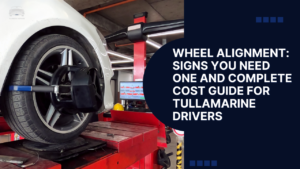
Knowing the process helps you judge whether an alignment was done properly. It begins with a pre-alignment inspection, because an accurate alignment is impossible on worn parts: the technician checks the tyres for wear, damage, and correct inflation, inspects the ball joints, tie rod ends, and bushings for wear, and examines the steering components, since any of these being worn prevents an accurate result and would just drift back out.
From there, computerised measurement takes over. The car goes on an alignment rack, sensors clamp to each wheel, and the alignment computer reads the current camber, caster, and toe against the manufacturer’s specification, documenting the starting figures. Adjustment then follows, working systematically through the angles the car allows, toe usually offers the most adjustment via the tie rods, while camber and caster adjustment vary by design and sometimes need a component change to correct. Finally, verification confirms the achieved figures with a printout of before-and-after readings, and a short test drive checks that the car tracks straight, the wheel sits centred, and the handling feels right. A good workshop shows you that printout, since it’s proof the work was done to spec.
The Real Cost of Ignoring It
Putting off an alignment creates costs that build steadily, and the biggest is accelerated tyre wear. Misalignment can cut tyre life by 25 to 50 percent, so a set worth $600 to $1,200 can need replacing at half its normal life, wasting $300 to $600, against an annual alignment costing around $150. The alignment pays for itself several times over in tyre savings alone.
The other costs stack on top. Increased fuel consumption of 3 to 10 percent from the extra rolling resistance adds $150 to $500 a year in fuel with significant misalignment. Suspension wear accelerates as the uneven forces load the bushings, joints, and bearings unevenly, and those components cost far more to replace than an alignment. Safety is the most serious, since a misaligned car handles unpredictably in an emergency, stops over a longer distance from reduced tyre contact, and loses grip in the wet. And resale value suffers, since visible uneven tyre wear signals neglected maintenance to any buyer. Set against all of that, a $79 to $200 alignment is one of the best-value services on the car, and it pairs naturally with tyre and brake work when they’re due at the same time.
How to Book Your Alignment
Booking with Carrick Motors takes one call. Ring +61 3 9330 1082 or message the workshop on WhatsApp, and we’ll inspect the tyres, suspension, and steering, run a computerised alignment measuring all the angles, and set them to your car’s specification, showing you the before-and-after readings. We service all makes and models across Tullamarine, Airport West, and Gladstone Park, flag any worn component that needs attention first, and offer free pick-up and drop-off within 10 km of the workshop. If your car is pulling, the steering wheel sits crooked, or you’ve just hit a bad pothole, an alignment check protects your tyres and your safety, so call and we’ll sort it.
Frequently Asked Questions
Does wheel alignment affect fuel economy?
Yes. Misaligned wheels increase rolling resistance because the tyres effectively drag slightly sideways as they roll forward, so the engine uses more fuel to maintain speed. Correcting the alignment reduces that resistance and can improve fuel economy by 3 to 5 percent compared to a significantly misaligned car. Over a year of average driving, that saving adds up meaningfully against the modest cost of an alignment.
Can I align my wheels myself at home?
No. Accurate alignment needs professional equipment that isn’t available for home use, since modern specifications are measured in fractions of a degree, far beyond what a visual check can manage. Alignment racks, computerised sensors, and calibrated adjustment tools are essential for an accurate result, and a DIY attempt usually leaves the car worse than before. A professional alignment at $100 to $200 is well worth it.
How long does a wheel alignment take?
A standard alignment takes 30 minutes to 1.5 hours depending on the vehicle and how much adjustment is needed. A two-wheel alignment is quicker than a four-wheel one, and cars with seized adjusters or unusual specifications take longer. If worn components turn up during the inspection and you have them repaired, the total time extends. Most passenger cars are finished within an hour.
Should I get an alignment after hitting a pothole?
Yes. A significant pothole impact that jolts the car or makes an unusual noise can shift the alignment angles or damage suspension components, and the change often doesn’t show an obvious symptom until the tyres have already started wearing unevenly. An inspection costs far less than premature tyre replacement, so it’s worth checking after any solid impact rather than waiting for a problem to appear.
What’s the difference between two-wheel and four-wheel alignment?
Two-wheel alignment adjusts only the front wheels, suitable for cars with a non-adjustable rear suspension, while four-wheel alignment measures and adjusts all four for the comprehensive correction that modern independent-rear-suspension cars need. Four-wheel alignment costs $20 to $50 more but ensures all four wheels work together, which is why it’s the standard recommendation for most current vehicles.
How do I know if I need alignment or balancing?
Alignment problems show as pulling, wandering, a crooked steering wheel, and uneven tyre wear, while balancing problems show as a vibration that peaks at a specific speed, usually 80 to 110 km/h. Alignment governs direction; balancing governs smoothness. A car can need both at once, especially with new tyres, and a professional inspection identifies which service (or both) your car actually requires.
Does my new car warranty cover wheel alignment?
Generally no. Standard new-car warranties treat alignment as a maintenance item, like an oil change or tyre rotation, rather than a defect, so it’s the owner’s responsibility. The exception is misalignment caused by a manufacturing defect in a suspension component, which may be covered. Alignment knocked out by potholes, kerbs, or normal wear remains the owner’s cost regardless of the warranty.
How much does wheel alignment cost in Tullamarine?
Wheel alignment costs $79 to $150 for a two-wheel alignment and $99 to $200 for a four-wheel alignment in Tullamarine, with the exact figure depending on your vehicle and its suspension condition. European and performance cars sit at the higher end, and dealerships charge a premium of $150 to $300 for the same work, so an independent local workshop is the more economical choice.
Wheel alignment protects your tyres, improves your fuel economy, and keeps the car handling safely, and the warning signs, pulling, uneven wear, a crooked wheel, or vibration, tell you when it’s due. At $79 to $200, it’s one of the cheapest ways to prevent hundreds in premature tyre and suspension wear. Call Carrick Motors on +61 3 9330 1082 to book your wheel alignment in Tullamarine today.